




Gaming
Games
Tunic's devs reveal the secrets of the cutesy but mysterious Zelda-like
In development for four years, the hotly-anticipated but enigmatic Zelda-like Tunic remains under wraps. We speak with designer Andrew Shouldice, who unravels its secrets.
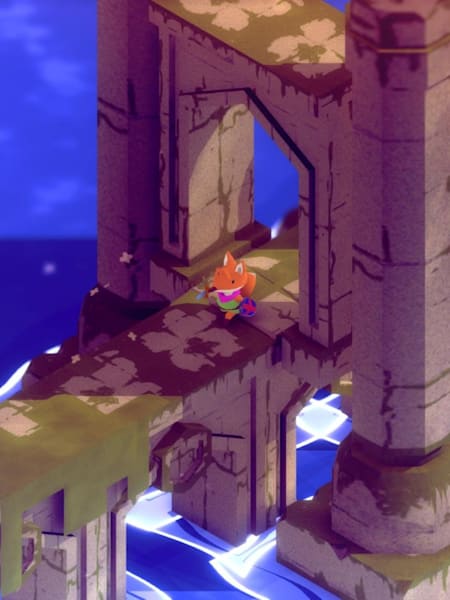
On its watercolour surface, Tunic looks like a playful tribute to the classic top-down era of The Legend of Zelda, which includes beloved titles like Link's Awakening and Link to the Past. Beneath that facade however lies an experience that harnesses the exploratory elements so central to the early games in Nintendo's acclaimed series, rather than the more linear dungeon-driven affairs that marked its later years.
Andrew Shouldice, the one-man studio behind the game, readily admits that the Zelda comparison is intended at a first glance, but that Tunic itself was more inspired by a peculiar feeling rooted in nostalgia than any particular game.
"The core of the game is exploring a place that you don't fully understand," Shouldice says. "I have memories of being a kid and leafing through the instruction manuals of video games that my neighbours owned. I was too young to understand them, and definitely too young to play them, but those images stuck with me. Just wondering at the secret possibilities that a game could get at. That's the fancy-pants auteur reason for it."
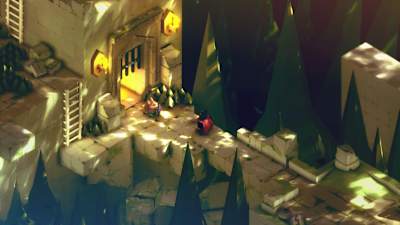
A typical foe you'll face in Tunic
© Andrew Shouldice
Earlier in its development, Tunic was known by the working title Secret Legend and that's apt, because it's exactly what Shouldice says the game is about: the lure of hidden things, both real and imagined. To him, most 'secrets' in big-budget games aren't really secrets at all, they’re collectibles. For example, the ethereal ravens in last year's God of War are designed to be found from the very start, since the game announces their presence and actively tracks your progress as you tomahawk them from afar.
Shouldice is more interested in what he deems "risky secrets", such as the eight stars in indie puzzler Braid that weren't found until weeks after its release, or the glitchy pseudo-character WD Gaster in pop phenomenon Undertale.
To Shouldice, these secrets are most powerful when they get a player to consider a new approach that'd never crossed their mind, or reveal a submerged mechanic that they'd never interfaced with. In Tunic, this often comes in the form of pages of an in-game instruction manual, which is written in what Shouldice terms a "trippy glyph language" that your cute fox cannot speak or read.
Early on, most players will find a page that has a diagram which points at left trigger on the controller, and references 'page 6'. Once the player finds that page and experiments with the button around enemies, they'll likely realise that the left trigger locks onto enemies, an essential part of the game's combat. "It's kind of a gimme, but it's exactly the sort of thing that we want players to be looking for," Shouldice says. "I want people to pore over those pages the same way I did when I was a kid."
While Shouldice clearly has a lot of love for the Zelda series, he admits that at a certain point, entries in the series began to be a sort of "comfort food", where the progression and style was rote and expected. With Tunic, he aims to strike at a vein similar to that of the latest entry in the series, Breath of the Wild, which ejects the player into a hostile world that they don't belong in.
He cites a puzzle in the early Zelda-like StarTropics as a particular salient example of this kind of design. In that game’s first dungeon, you can step onto a certain block on the map just before the boss to unlock a hidden chamber that contains a very valuable healing item. If you explore more in that space however, you can find another passage that leads to an identical hidden chamber nested within the first. If you scavenge around for a third hidden room, though, the game drops you into a lethal pit full of bones.
"It's one of those secrets that actually feels secret," Shouldice says. "You don't expect it to punish you for pushing your luck like that, for being curious. I can't promise something like that is in Tunic, but that's the exact kind of feeling we’re looking to achieve."
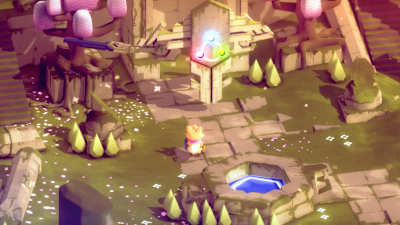
Zelda fans might recognise this imagery
© Andrew Shouldice
More than anything, Shouldice describes Tunic as a journey of personal discovery, where the secrets aren't just a tucked-away nook with a shinier sword, but revelations that lead to a deeper appreciation of the game. They come in the form of new gadgets that unlock combat options, mechanics that you didn't necessarily know about from the start, and shortcuts that allow you to take the game in a completely different order.
In particular, Shouldice points to the indie platformer Fez, which he regards as a masterpiece, as an instructive example of this kind of design in action. But while that game depended on a number of 'big twists' that upended your understanding of what kind of puzzler it was, including a fictional language that players were expected to decode for themselves, Shouldice says Tunic focuses more on a procession of tiny turns that slowly add up into a complete experience.
"The first time you play Dark Souls, you probably don't know what poise is," he says. "It's not explained in the game at all, but it's a major part of a character build in that game. You don't know all the different routes or good weapons, either. That's the kind of game knowledge that we want to build. I was recently play-testing the game with a friend of mine and they accidentally took a turn and wandered into a really high-level area. They got knocked around by the monsters and eventually gave up. During the debrief I told them, 'that could've been the first monsters in the game you fought, if you know what you're doing.' That's the kind of game Tunic is."
While Shouldice is cagey on the subject of Tunic's official release date, he says that the game has recently hit a number of internal milestones, which indicates that it's closer than a lot of people might think. Shouldice says that he's personally thought of the game as taking "just one more year" for the past three years of development, but he's starting to wonder if it might actually be right this time. No matter the exact date, despite the game's enigmatic nature, it's clear that there's a fanbase champing at the bit to play the game.
According to the game's community manager, Harris Foster, keeping the mystery alive without revealing the secret sauce has become one of the hardest parts of marketing the game.
"When we show the showfloor demo, I can see people's minds working as they walk away," Foster says. "They say stuff like, 'Oh, wait, because I could use X with Y, does that mean I could use Y with Z?' I can already see that the fanbase of the game is just starting on that process, which is what the game is all about. I think they're going to be very pleased with the final result."
