








Gaming
Games
7 tips to excel at Wargroove
Turn-based tactical gameplay will never go out of style and Wargroove’s a brilliant entry in the genre. Here are our tips to help you master the game.
One of the best things about covering video games is that every month, you get one or two pleasant surprises. The AAA releases are expected and anticipated; their advertisements are plastered on billboards and run on television during primetime hours. The huge amounts of money spent to both create and advertise these games imply a baseline of quality; it's passed through too many hands to be objectively bad, and it is often objectively good.
But independent games are a lottery. It's in the name; independence allows the developer more creative freedom and leeway, but it also allows for increased risk and for decisions that are not polled and tested beforehand. There are scores of indie games released every month and it's hard to know which ones will be the breakout hits.
Wargroove, the new turn-based tactical game by indie developers Chucklefish, is that breakout game of February 2019. Available on PC, Nintendo Switch and Xbox One, the game has a 16-bit RPG presentation, right down to its pre-rendered fight cutscenes and on-screen interfaces. But unlike those games, which were strictly single-player experiences, Wargroove allows for multiplayer combat (up to four players) and submitted level design. There are already well-detailed maps paying homage to Fire Emblem, Zelda and Advance Wars.
The first missions of the single-player campaign are fairly straightforward; you can brute force through a lot of the encounters, no matter your strategy. But once you hit Act II, the difficulty creeps up. And the multiplayer, where you can challenge other human players, comes with meta strategies that you'll need to defend against.
How do you get over the hump? Here are some fundamental tips.
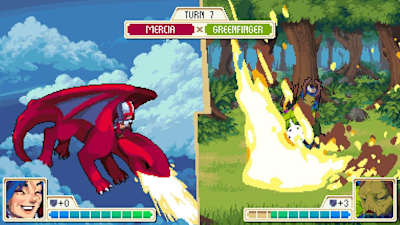
Consolidate and build your army before advancing it
© Chucklefish Games
1. Pay attention to your units' and enemies' move range
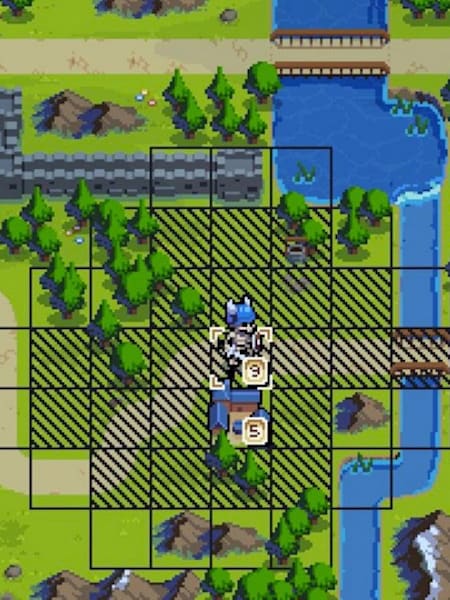
Turn-based games are largely a matter of who strikes first, so spacing is very important. If you click on any enemy unit (or any of your own units), you can see all the spaces they can move to. Use this knowledge to your advantage. Place yourself one space outside an opponent's attack range, so that you can strike first on the next turn. It's easy to forget about these details, especially as your army gets bigger. But keep checking the move range out of habit, and eventually you'll be able to eyeball the approximate distance.
2. Macro is king
Knowing match-ups is important: "Which of my units counter which of my opponent's units?" But a strong economy is even more important. Err on the side of capturing villages (particularly neutral villages nearby) rather than looking to strike first.
When you first capture a village, it'll have weak defence; keep a couple of units nearby to defend it while it strengthens (10 percent health per turn), so that you don't lose it three turns later. When you capture a barracks, take some time to recruit your army and reinforce your camp. Arrange them so that the support units, such as archers, are in the back and the infantry's in the front.
It's easy to win one encounter. It's a lot harder to make a sustained push into enemy territory. If you don't have the gold or the means to rebuild your army, your opponent will overwhelm you with a counterattack, and you won't have the money to defend against it.
So take things slow and, in single player, don't worry so much about the star ratings, which are based on how quickly you beat your opponent. Learn your fundamentals, going for speed records encourages poor strategy.
3. Advance slowly and group around choke points
Outside of the star rating, speed is not a positive; the offence in this game is strongest when you take things slow and stay in formation. Pikemen must be adjacent to one another to score critical hits. Archers need to not move at all to score critical hits. The only time you might want to move quickly is in the beginning, when you're claiming resources. After that, it's best to hunker down.
Use choke points, such as bridges and natural topography, to your advantage; place strong units at the pass to soak up damage while you build yourself up. Place archers on high ground to pre-empt any attack. Place dogs on mountains to increase your vision. No attack should be a surprise.
4. Protect your commander like you would a queen in chess
It's very easy to lean on your commander's abilities, especially in the early parts of the campaign. They're just so powerful; they can take down entire units by themselves while taking comparatively little damage themselves.
But never leave them undefended or apart from the larger army. It's easy for a lone unit to get surrounded, and even a commander can die in a single turn if you're not careful. Think of it as a queen in chess. You would never bring the queen out from the back line without creating support for it first. You'd advance your pawns first and control the center of the board.
Use the commander to land killing blows (which charges his or her groove) rather than having them lead the offensive. Remember: if you lose your commander, the game is over.
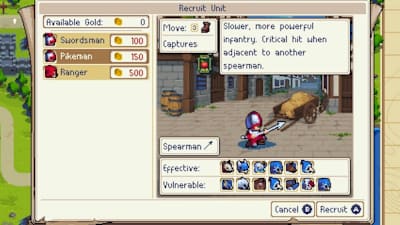
When in doubt, build pikemen
© Chucklefish Games
5. Build more pikemen
Pikemen are offensive beasts, and they cost 150 gold, which makes them cost efficient. Archers, which are their natural counter, cost 500 gold. Keeping with the chess metaphor, think of the pikemen as pawns; they're weak by themselves and very strong when lined up, which allows them to make critical hits.
In fact, Pikemen are so effective in the current metagame, that there's talk about rebalancing them (perhaps by making archers less expensive?). But until that happens, they're a phenomenal unit. When in doubt, build more pikemen. You could always use another pikeman.
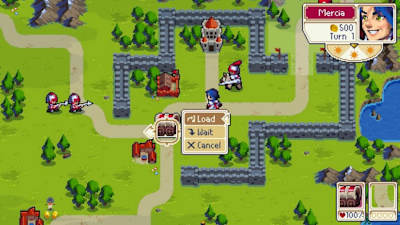
Wagons can transport slow-moving units to the front of the line
© Chucklefish Games
6. Wagons are underrated
The one drawback of building pikemen is that they're fairly immobile. Across rough terrain, they can only move one or two spaces at a time. Your army will be hampered when you finally decide to push instead of defend.
This is why wagons come in so useful. They cost 300 gold, they're durable and they have unbelievable mobility. Use wagons to transport your infantry to the front lines, where they can be most effective, or use wagons to move supporting units through rough terrain, where their defence will be higher. Build several wagons and have them continuously working at all times.
7. On the Nintendo Switch, use the L and R buttons to toggle between units
The smartest way to move your cursor is to toggle. On the Switch, for example, pressing the L or R shoulder button will auto-select units that haven't received orders. It's very easy to miss one of your units if you're manually clicking on each of them. This way, you can scroll through them and make sure you cover everyone.
The game never explicitly tells the player about this command function in the tutorial. Now you know.
