The really short version is: it’s climbing up three different artificial walls, indoors. Most professional climbers usually specialise in just one of the sport's three sub-categories of lead, speed, or boulder. As the sport's popularity has soared in recent years however, a new format, Sport Climbing, has forced some climbers – in only a couple of years – to become world masters in disciplines they've never even attempted, let alone competed in.
26 min
ABC of... Climbing
Join Sasha DiGiulian as she takes you on an expedition around the globe with some of the world's top climbers.
The origin story – the history of climbing combined
Rock climbing as a sport – and distinct from mountaineering – has been steadily building momentum since its roots in late 19th century Europe. The first purpose-built climbing wall is reckoned to be Schurman Rock at Camp Long in Seattle, which dates from 1939, but the first modern artificial indoor wall as we would recognise it was built in a corridor of the University of Leeds, UK, in 1964. The sport really started to mushroom in popularity in the 1980s with the proliferation of climbing gyms and high-level competitions around the world. The first-ever world championships were held in Frankfurt, Germany in 1991 and the sport’s first global governing body, the International Council for Competition Climbing, was formed in 1997, to be replaced by the IFSC in 2007.
Sport climbing is now part of the Olympics. It appeared for the first time as a medalling competition in Tokyo as one combined event with athletes having to compete in lead, speed and bouldering. In Paris in 2024, speed climbing gets its own event and medal, while lead and bouldering will be part of a combined event.
What are we watching, exactly? How does climbing combined work?
The three disciplines involved in the Sport Climbing event are actually quite separate and distinct from one another, requiring very different sets of skills to master:
Bouldering
Goal: To climb as many problems as possible in the fewest possible moves
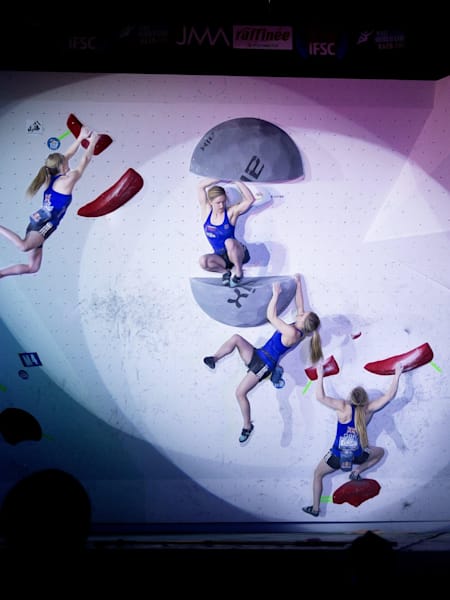
Bouldering is held on a wall of about 4m high. You climb without ropes, but there are mats beneath for climbers to jump down onto should the need arise. There are set problems (routes) and climbers have four minutes to complete each problem. The goal is to try and climb as many of these problems in the fewest number of attempts. Normally, there are two or three crux moves (the most challenging moves on the wall) to get through.
Speed
Goal: Two competitors and the fastest to the top wins
Wall height: 15m with 5° overhang
Time restriction: N/A. The current world record is 5.48s
Skills needed: Athleticism, explosive power
In speed climbing, the main goal is to climb a standardised 15m wall in the quickest possible time. Two competitors go head-to-head in a race to the top. As the route is always the same, this element of the competition can be practised well ahead of time.
Lead
Goal: Climb as high as possible in the time limit
Wall height: 15m with at least 7m overhang
Time restriction: Six minutes
Skills needed: Power, endurance
For lead climbing, an athlete's aim is to climb as high on the 15m wall as possible within the six minute time restriction. If more than one competitor reaches the top, the person who got there in the quickest time is deemed the winner. There are bolts on the wall that the climber clips their rope into as they make their way up. This acts as a safety system if they fall. With at least seven metres of overhang included on each route, athletes need power, endurance and technical skills to succeed in lead.
Shauna Coxsey in action at the IFSC Bouldering World Championship
Equipment requirements vary by discipline, but the main bit of kit you’ll need is a pair of climbing shoes. These differ from your average pair of gym shoes in two key ways. Firstly, the soles are extremely soft and grippy to help give you better purchase on the wall. Secondly, they’re worn extremely tight, to the extent that they force your toes to curl downwards and help you grip onto footholds. Most other equipment can be hired from your climbing wall or gym, at least until you’re sure what sort of climbing is the one for you.
2 min
Shauna Coxsey teaches Daniel Ricciardo how to wall climb
Some might say Ricciardo has a mountain to climb in the F1 World Championship but the Aston Martin Red Bull Racing driver has taken that all too literally in the build-up to the British Grand Prix.
The tricktionary – what are climbing's key tricks and techniques?
Since speed climbing competitors repeat the same route again and again, it’s the best place for us to find a universal trick or technique. For example, many pro climbers avoid hold four, which requires launching through the air with precision so that when hold five is reached, momentum is carried through. The move is named after its inventor Reza Alipour and is known simply as 'The Reza'.
1 min
See these incredible climbing moves
Watch some incredible moves from the climbing wall.
06
Names to watch out for
Domen Škofic takes a break during the epic Trbovlje Chimney climb
Domen Škofic – A Slovenian lead specialist who already has an overall World Cup under his belt, as well as several 9A+ ascents.
Jain Kim – The South Korean lead climber and boulderer is one of the most decorated athletes in the climbing world with multiple overall World Cup and world championship wins in both lead and combined.
Natalie Grossman – The American dominated the 2022 bouldering World Cup, winning five of the six events and bagging third in the lead climbing series. In 2023, she won two further bouldering World Cup events.
Janja Garnbret – The second Slovenian climber on this list, she’s won overall World Cups in lead, bouldering and combined, and world championships in lead and bouldering. She's the first (and so far only) climber to have won every bouldering World Cup event in a season.
Oriane Bertone – At just 18, France's Oriane Bertone is part of a young group of athletes making a name in Sport Climbing. Most recently, in 2023 she finished second in the bouldering competition at the world championships.
Jessica Pilz – 2018 World Champion (lead) Jessy Pilz hails from Austria and can consistently be found on the podium at World Cup events in both lead and bouldering.
Alberto Ginés López - The Spaniard is the reigning men's Olympic gold medalist in Sport Climbing.
Petra Klingler – A Swiss boulderer with a world championship title to her name, Petra Klingler also has a background in speed climbing (she was Swiss champion), which could stand her in good stead in the combined event. On top of that, she’s also a hugely accomplished ice climber.
Shauna Coxsey – Britain’s most successful ever climber, Coxsey is the nation's first-ever overall Bouldering World Cup winner and holder of the UK speed climbing record. She was on the combined podium at the 2019 World Championships.
07
Where can I see more?
If you want to see more action from the wider climbing world, including both sport and traditional forms, you've come to the right place. Check out these climbing movies and videos on Red Bull TV and Redbull.com
If you want to watch regular competition, the IFSC World Cup has events across China, South Korea, the USA and Europe. For more info, head to the IFSC website.
Outside the IFSC mandated events, Red Bull launched an innovative outdoor climbing competition in 2022 called Red Bull Dual Ascent. Whereas most indoor climbing comps top out at about the height of a standard pitch of 60-70m, Red Bull Dual Ascent see athletes having to climb much higher at 180 metres. The event location is at Switzerland’s 220m Verzasca Dam.
1 min
Red Bull Dual Ascent 2023
It's back! The head-to-head multi-pitch climbing competition featuring 12 mixed teams made up of 24 climbers.
The format sees teams of two battle head-to-head in multi-pitch competition on identical, artificial routes next to each other. In 2023, Red Bull Dual Ascent takes place on November 4 and will be broadcast live on Red Bull TV.