






Bike
MTB
Inside urban downhill: How riders and bikes adapt to the city
From racing down staircases to adding extra weight to the bike, Johannes Fischbach reveals the skills, setup and mindset needed to master urban downhill.
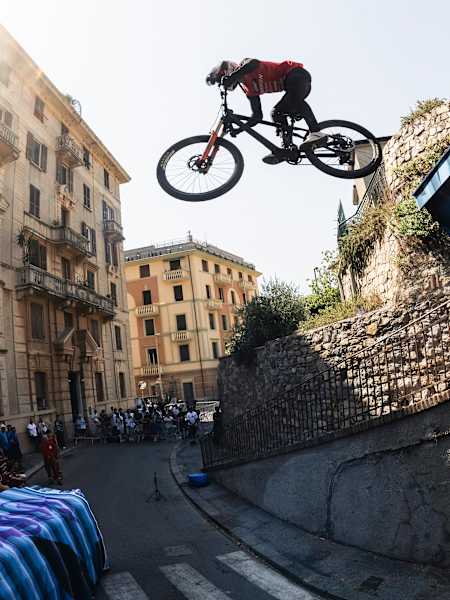
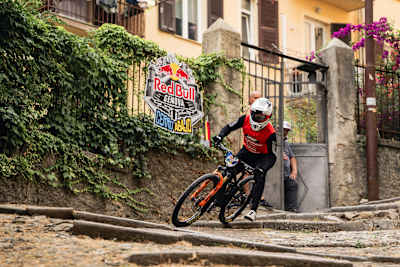
Urban downhill takes everything that makes downhill mountain biking fast and technical, then drops it into the middle of a city. Dirt gives way to tarmac, cobblestones and staircases, while purpose-built jumps and obstacles turn city streets into a high-speed racetrack.
Few know the discipline better than Johannes ‘Fischi’ Fischbach. Ahead of the Red Bull Stuttgart Cerro Abajo event on September 5-6, 2026, the three-time German downhill champion and recent Red Bull Genova Cerro Abajo runner-up reveals five things that make urban downhill different.
01
The terrain changes everything
The biggest difference is immediately obvious: the ground beneath the tyres.
“The main difference is the surface,” says Fischbach. “Normal downhill takes place on earth and dirt, whereas in the city you ride over stairs, tarmac and cobblestones.”
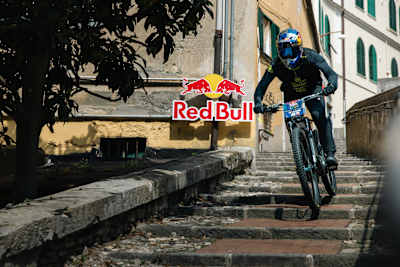
No dirt, but plenty of tarmac, stairs and cobblestones
© Andrea Zaffaroni/Red Bull Content Pool
That completely changes how riders approach jumps and obstacles. Dirt offers at least some margin for error, while concrete, stairs and kerbs are much less forgiving.
“You time a normal dirt jump differently to a jump over a set of stairs,” he explains. “With stairs, tarmac edges or steps, the landings are hardly forgiving of mistakes. If you’re too short or too long, it usually ends badly.”
It's part of what makes urban downhill so spectacular. Familiar city streets are transformed into high-speed racetracks where precision is every bit as important as outright speed.
02
You have to train differently
Fischbach's core preparation remains broadly similar to conventional downhill. Sprinting, strength work and strength endurance all still play a major role, while plenty of time is spent riding downhill.
But preparing for a city course requires a little extra homework.
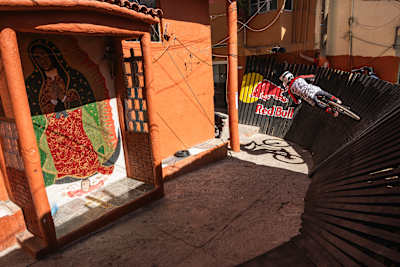
Obstacles like this don't exist on a conventional downhill track
© Bartek Wolinski/Red Bull Content Pool
“I incorporate more dirt jumps and pump track sessions, and practise specific urban elements like wall rides, wall taps or jumps from a shark fin at the skate park,” he says.
Those sessions help replicate the unusual features riders encounter during urban races – obstacles that simply don't exist on a conventional downhill track.
03
Even the bike setup gets unconventional
Fischbach races urban downhill on his carbon Raymon Ravor enduro bike, with 170mm of suspension travel at both the front and rear. The combination of relatively low weight and plenty of suspension makes it well suited to the demands of city racing. Sometimes, though, making a bike faster actually means making it heavier.
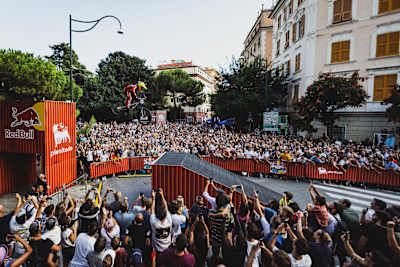
Johannes Fischbach soars home in Genoa
© Mauro Puccini/Red Bull Content Pool
On particularly fast and rough courses, Fischbach attaches an additional 1–1.3kg around the bottom bracket. Positioned low and centrally on the bike, the extra weight helps keep it planted as he blasts across steps, bumps and uneven surfaces at high speed.
“When setting off and accelerating, you do notice that the bike is a bit heavier,” he explains, “but on the high-speed sections, the extra control more than makes up for it.”
It might sound counterintuitive in a sport where reducing weight is often an obsession, but in urban downhill, stability can be worth the trade-off.
04
Tyre choices can get extreme
Choosing the right tyres is another balancing act. Riders need enough grip to tackle the various jumps, corners and obstacles, but also want to minimise rolling resistance on fast stretches of tarmac.
I cut a slick tyre – that is, I removed the entire tread
Fischbach generally uses Maxxis DHR II tyres at both ends of his bike, but at Red Bull Genova Cerro Abajo, he experimented with something much more unusual.
“I cut a slick tyre – that is, I removed the entire tread,” he says. "That brought certain advantages, but also some disadvantages – I still need to see whether the tyre can be used again or whether it makes sense for Stuttgart."
05
The perfect run starts before the clock
With little room for error, knowing exactly what you're going to do before leaving the start gate is crucial. For Fischbach, that means running through the entire course in his head moments before racing.
“I close my eyes and imagine myself riding the course perfectly – that’s exactly what I then try to do in reality,” he says. “This visualisation just before the start is the most important part of my preparation.”
Johannes Fischbach will have the home support behind him in Stuttgart
© Bartek Woliński/Red Bull Content Pool
Once the clock starts, there isn't much time to think. Urban downhill courses throw obstacles at riders from start to finish – something Fischbach particularly loves about the legendary Red Bull Valparaíso Cerro Abajo course in Chile.
“There are obstacles all the way from top to bottom,” he says. “You never have a moment to relax or think for a second.”
That combination of speed and precision is what keeps bringing Fischbach back. And with Red Bull Stuttgart Cerro Abajo bringing the series to Germany, he'll have an extra incentive this time around: the chance to fight for victory in front of a home crowd.

1 min
Red Bull Stuttgart Cerro Abajo is coming
For the first time ever, the world’s biggest urban downhill mountain bike series is coming to Germany.


