
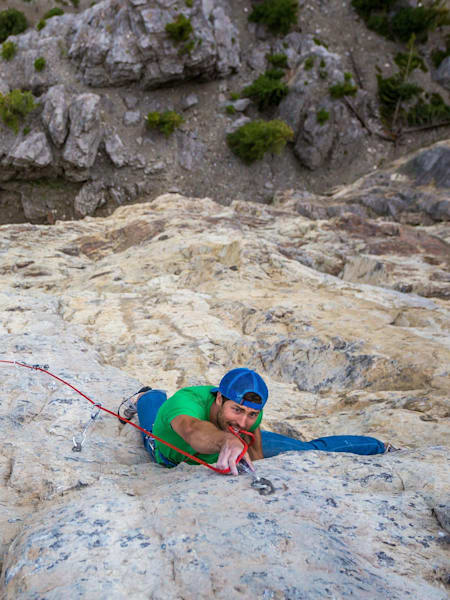
Climbing
Get a glimpse into the world of one of the planet's best rock climbers
For 20 years Sonnie Trotter has pushed the limits of trad, sport and bouldering. This past autumn he completed his hardest goal to date. Get the full story here.
Mid-November, 6am, the summit of El Capitan, Yosemite, California. A lone figure appears on the golden slabs and, although he’s a few hundred metres away and hard to see, it’s clear he’s smiling. The climber is Canadian Sonnie Trotter from Canmore, Alberta and he’s hiking up to the top of the Big Stone on this cold morning to put the finishing touches on his biggest project to date: a first ascent – a three-pitch, all-free variation to the Huber brother’s El Niño -- he’s calling Pineapple Express. It’s a 26-pitch route on the wall’s steep south-east face rated 5.13b/c.
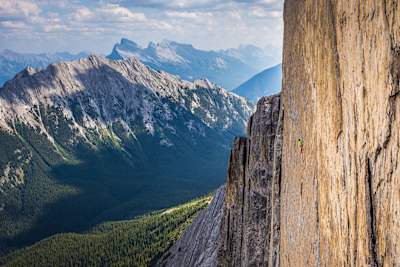
Lone figure on the golden slabs
© John Price Photography
He spent two seasons working on the line, at times partnering with Alex Honnold who helped him work out the moves, remove loose flakes and bolt his variation. His goal was to make not only the first ascent, but to also do it in a day – a first for this route.
A few days after Trotter and I met, on November 19, he completed the route in 13 hours, with support from Tommy Caldwell who followed behind, carrying food and water. Sonnie led every pitch. “It was awesome,” he told me of the day. “It was the coolest experience in my life for sure.”
He continues, “I never had anything that made me as happy as climbing. [That day] fulfilled a dream for me, the dream of going to this crazy landscape and having an adventure with a friend. It’s just so uplifting, man. So uplifting.”
For 20 years, Sonnie's made a living as a professional climber, climbing coach and guide. Though he’s authored harder trad first ascents than Pineapple Express, including the single pitch Cobra Crack rated 5.14b, in Squamish, B.C., he says that day on Pineapple Express was his most demanding to date.
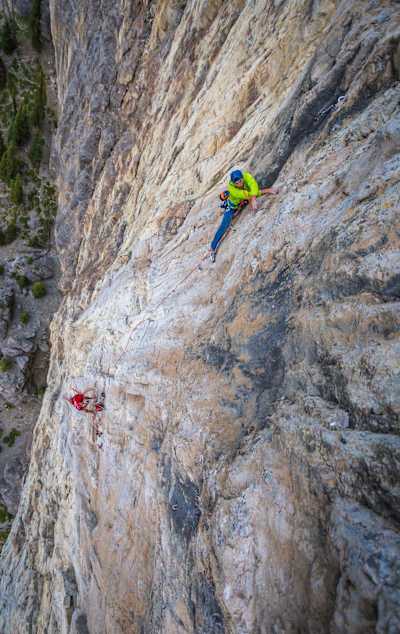
"I never had anything that made me as happy as climbing"
© John Price Photography
Over the decades, Sonnie has climbed dozens of first ascents throughout Canada and in Europe, many of which remain unrepeated – and he’s sport climbed up to 5.14d. “When he decides it’s go time, it’s done,” says his longtime climbing partner, Will Stanhope.
With Pineapple Express as his career high-water mark, Sonnie, 39, said with his characteristic smile, “I’ve fulfilled almost all of my dreams in the sport that I’ve wanted to do since I was a young kid.”
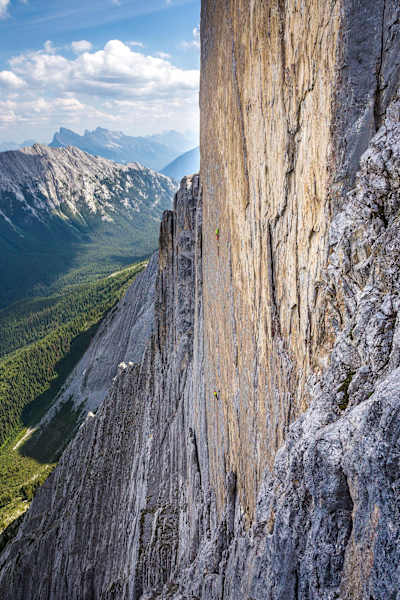
Dwarfed by the rock
© John Price Photography
The youngest of three siblings, Trotter was raised on a 100-acre farm and grew up playing hockey around the Great Lakes in Ontario before switching to independent sports such as mountain biking and snowboarding. His peers in those groups turned him onto climbing when he was 15. Sonnie’s dad instilled in him the importance of health and fitness, and these principles helped him quickly progress through the climbing grades. “I was in the climbing gym seven days a week, two to three weeks in a row,” he says. He later won the Speed Climbing National Championship and also podiumed in the Lead Climbing Championship. He completed his first 5.14 a year and three-quarters after he took up the sport.


Within one year of learning trad, he went from 5.12 to 5.13d. “I was seeking out the hardest lines,” he says, “I liked the puzzle.”
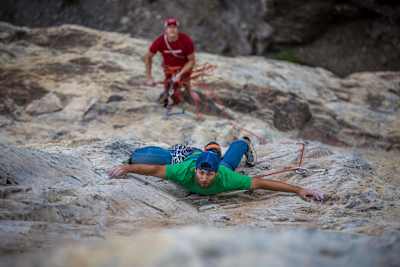
Sonnie was introduced to climbing at 15
© John Price Photography
This past year Sonnie was on an extended road trip with his family of four, Yosemite being just one destination. During the trip he visited many of his favourite climbing spots in Alberta, British Columbia, Washington, Oregon, California, Nevada and Utah. He and his family (which includes two small children) travelled in a trailer about the size of a small bedroom. It was the first climbing trip for his 20-month-old daughter Mesa and five-year-old son Tatum. “Being together, being outside everyday and sharing our love for travel, rocks and starry nights really can’t be beat,” he said.
“Raising my kids. I have to listen to them to find out what they like or don’t like. As long as we’re having fun and everyone is feeling the joy we’ll keep [climbing].”
Though his personal highlight of the trip was completing Pineapple Express, the family highlight came during a cold January night in Red Rock Conservation Area, near the sprawling city of Las Vegas. That night the family trudged out deep in the desert to watch the Blood Moon rise. Despite the chill and roaring wind, “it was a special night,” he says. “We were under all these rock formations and it was so clear that we could see a billion stars.”

