




Fitness
Fitness Training
How Thomas van Tonder built incredible grip strength in six months
How do you prepare to cross 280m of monkey bars suspended 216m above a river? Thomas van Tonder reveals the training, nutrition and determination behind his extraordinary feat.
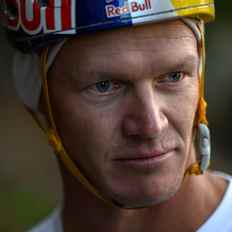
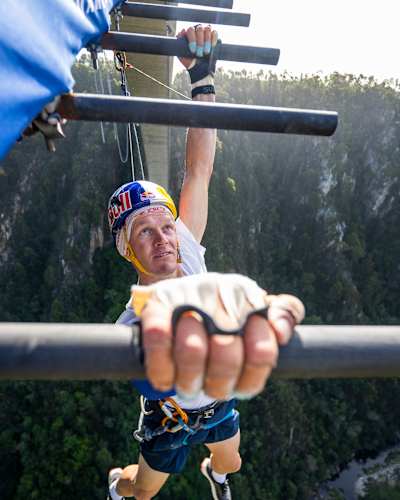
On October 26, South Africa's Obstacle Course Racing world champion Thomas van Tonder completed an extraordinary physical challenge: crossing 600 monkey bars suspended below South Africa's Bloukrans Bridge, 216m above the river. Covering 280m in 47 minutes and 37 seconds, the feat required months of preparation, exceptional grip endurance and considerable upper-body strength.
It was a feat never before attempted, and particularly gruelling because of the specific nature of the crossing: van Tonder didn’t merely complete a hand-over-hand straight shot from one side of the bridge to the other. Instead, his route mimicked the arch of the bridge, involving a 45 degree incline, straight out of the gate.
Prior to the crossing, he pointed out the distinction: “It’s hard to compare just hanging, or swinging on horizontal bars with what we’re doing here. It’s hard to describe the amount that it’s more difficult. If the bars are level, I’ve done more than 300m in a single go, it took me six to seven minutes, without specific grip training.”
But this, he acknowledged, was a whole different thing.
01
No grip, no glory: how to build an iron grip
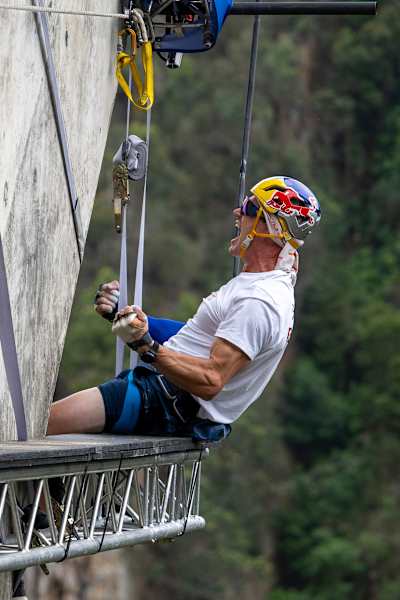
Thomas van Tonder's training focused on pull-ups and hang time
© Joerg Mitter/Red Bull Content Pool
In the months leading up to the challenge, van Tonder took part in diverse and intense training sessions, focusing on two things: “The two crucial elements are pull ups and hang time. I need to be able to move myself, and I need to be able to stay on the bars. Training wise I’ve been the most focused on grip endurance and pull strength.”
One workout fit that bill perfectly: “One test that I can think of - I would give myself a certain amount of time, like 10 minutes, and I would hang on the bar for that entire time. And within that 10 minutes, I have to do as many pull-ups as I can - without getting off the bar, without breaking, without resting. (“Resting” means hanging on one hand to shake out the other.)
Van Tonder attempted this challenge on a regular basis, hitting a personal best each time: “I could do 90 pull-ups in 10 minutes, hanging on the bar, as my best effort.”
It’s hard to compare just hanging, or swinging on horizontal bars with what we’re doing here
As van Tonder’s training progressed, the incline of the crossing, essentially “doing monkey-bars uphill,” as he phrased it, loomed large. “It’s hard to compare just hanging, or swinging on horizontal bars with what we’re doing here. It’s hard to describe the amount that it’s more difficult. If the bars are level, I’ve done more than 300m in a single go, it took me six to seven minutes, without specific grip training. But I know that I would not be able to swing all the way to the other side without having to shake out my hands.”
He continued to say that “Adding the pull factor into the hang factor pumps out everything so much faster. I want to say four to five times faster.”
02
No shortcuts, just serious work
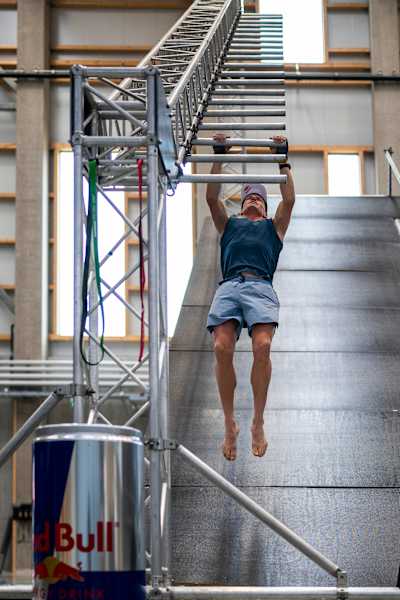
Thomas van Tonder racked up around 17,000 pull-ups during training
© Joerg Mitter/Red Bull Content Pool
As the day of the crossing approached, van Tonder’s training remained intense, but structured and involved the following cycle:
- Day one would involve a simulation. He would complete a mock crossing on his large rig at home, crossing bars until he reached 300m: “On simulation day, it typically took me 30-40 minutes to finish. My fastest time was just under 30 minutes. Keep in mind the simulation rig was not as steep as the bridge - a bit more flat, a bit more forgiving.”
- On day two, he would head to the gym, spending less time hanging on his hands, but still training pull-ups: “I’d train the muscle groups that need training. That would be the pull-up sessions, the weighted sessions, I have cables, and trying to train … in ways that simulate monkey bars.”
- Day three would involve active rest, and he would repeat the cycle twice, then fully rest on Sundays.
Over the six months of training, van Tonder logged some serious reps: “We tried to figure out, over the last six months, what the stats were: how many pull ups, how much hang time, and the pull-ups added up to 17,000.
Thanks to this training plan, van Tonder noticed major improvements in his capacity, but saw a number of physical changes as well. He laughed as he shared that his clothes no longer fit him.
We tried to figure out, over the last six months, what the stats were … and the pull-ups added up to 17,000
“My upper body has definitely grown. I’ve tried to keep it lean, and not be “bulk man,” but naturally doing all the work we've been doing, my upper body has definitely gotten bigger. My hands have gotten thicker. I haven’t noticed that my legs have gotten skinnier, but again, I haven’t been measuring or tracking that.”
“Initially my weight went up. I’ve been trying to manage my weight down to what it normally is, and typically I’m between 83-85kg. And I was up to 89kg at one stage. So I brought that down to 86 currently… and I’m pretty happy with that.”
03
Thomas van Tonder's top 10 exercises for hanging tough
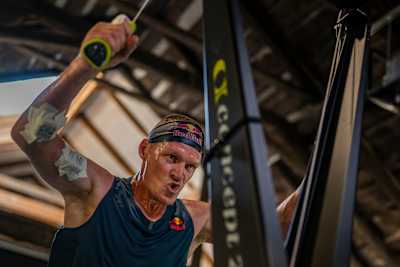
Cable pulls were a big part of Thomas van Tonder's training regime
© Joerg Mitter/Red Bull Content Pool
When asked to share his most frequented and favourite exercises in preparation for his crossing, 10 easily came to mind:
- Dead hang
- Pull-ups
- Eccentric pull-ups
- Single-arm pull movements, like lat pull-downs and cable pulls
- Opening and closing hands in rice bucket
- Shoulder mobility and strength development, specifically at the end range of motion
- Grip squeezes
- Swinging battle ropes to improve cardiovascular health
- Rowing to strengthen upper body
- Running to lose weight
04
Building your strength, one pull-up at a time
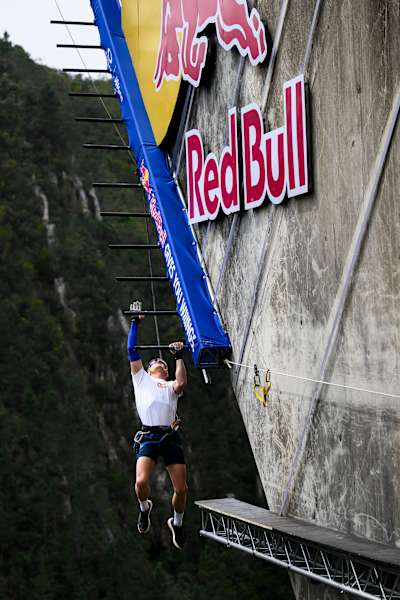
The incline on the bridge made the 600 bars infinitely more challenging
© Mihai Stetcu/Red Bull Content Pool
For those inspired by van Tonder’s feat, he offered advice on developing similar strength and skills, most specifically when it comes to pull-ups: “I would say, get bands, something that helps with managing the weight, and try to aim for three to five first. Find a band that helps you do more than one, and then do that repetition as much as you can, and aim for a smaller goal - Aim for three pull-ups. Aim for five pull-ups. And if you can get to five pull ups with a band, try two without a band. And just continue that progression and you’ll eventually get to 10.”
Van Tonder emphasises that the key to any training program is consistency, and with that, progression and improvement are inevitable: “When I first started this training, when I knew this project was coming and I started doing pull-ups, it took me 14, 15 minutes to do 50 pull-ups. And I can do it now in two minutes. I can do it in one go.”
05
The fine art of fuelling for the ultimate endurance test
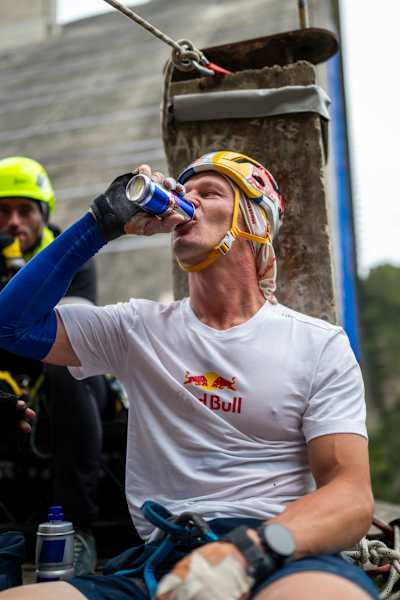
Thomas van Tonder's challenge was a test of both strength and endurance
© Joerg Mitter/Red Bull Content Pool
No stranger to large-scale, high-stakes events and physical challenges, van Tonder had already established a firm grasp on his nutritional needs: “For the last few days, I’ve been trying to keep it lean, no unnecessary fats. It’s a tricky balance, trying to lose extra weight before something like this means you’re lowering your carb stores and hydration stores and I can’t do too much of that.”
It’s a test of strength, yes, but also endurance, where carbohydrates and proper hydration are vital. But he pointed out that none of these tweaks were uncharted territory for him, and that while he slightly pulled back on certain macros, he didn’t drastically change anything.
When it came to “race day,” van Tonder reverted back to a familiar routine: his morning involved a “three-hour build up,” where his last full meal was three hours prior to start time. He ate once again 90 minutes later, something small, which served as his last solid food. After that, as the start time approached, he ensured he was fully hydrated.
About the author
