
Social Innovation
This start-up is changing the perception of mental health in the workplace
Sanctus are dealing with burnout in London's fast-paced tech and creative sector with personal trainers who focus on the mind instead of the body – get to know their work right here.
James Routledge knows only too well the stresses and pressures of running a start-up. While he was building a company several years ago, he succumbed to anxiety attacks which eventually rendered him unable to continue. But as one dream of success died, another emerged, and today Routledge leads Sanctus, a service which aims to change perceptions of mental health by creating safe spaces for people to talk about it on the internet, in the community and in the workplace.
Sanctus run group therapy session at their London headquarters and conduct coaching with the employees of many businesses, including Aviva, BCG, Transferwise, Onfido, Carwow and Red Bull.

Sanctus advocates for workplaces that support mental health
© Red Bull Content Pool
Routledge is candid about his own mental health problems when talking on social media as well as in person, and in a reversal of the usual business logic, his candour is a vital asset to the Sanctus mission.
“Sanctus was born out of my own frustration and experiences with my mental health and being on a mission to change the perception of mental health, to get people to treat their mental health like their physical health,” he says.
With business partner George Bettany he's building an accessible and attractive brand around therapy, with a vision of building no less than “the Nike of mental fitness”.
It’s worth aiming high, particularly in a sector populated largely by under-30s: 75 per cent of young people with a mental health problem are not receiving treatment, suicide is the biggest killer of young people in the UK, where it's also the leading single killer of men under the age of 45.
Those figures make sense when considered against the stigma around talking about mental illness, and the mystery surrounding traditional treatments such as therapy. Sanctus, by contrast, offer easy – and importantly, sociable – routes towards addressing issues.

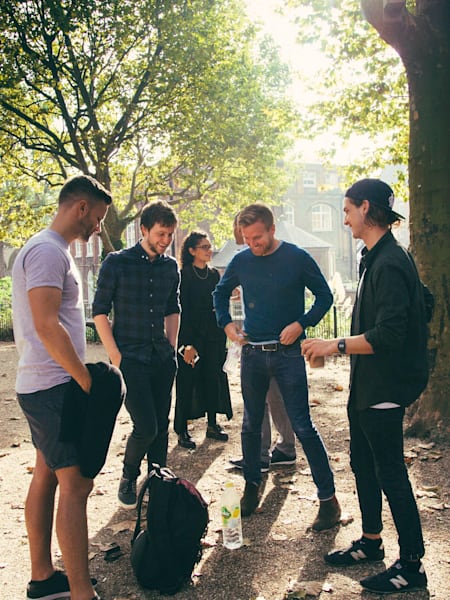
The Sanctus team encourage people to discuss their mental health
© Red Bull Content Pool
“We’re not asking you to do something strong and bold and difficult,” say Rose Scanlon-Jones, Sanctus’s community manager. “We’re slowly changing the perception so you feel more comfortable to talk about your mental health and acknowledge other people’s mental health.”
Central to that is talking on a person-to-person level instead of in a forum or over social media. “It’s incredibly important to have real-life human beings to talk to, because science says that’s what’s going to help you the most,” adds Scanlon-Jones.
Sanctus is going from strength to strength and now employs 13 staff and coaches, with over 400 people attending coaching sessions per month. And just as the founders of Nike encoded fitness and performance into every aspect of their lives, James Routledge knows that living the brand’s values are key to the success of the endeavour as well as to his own wellbeing.
“The number one thing I do to stay well is coaching and therapy,” he says. “Having spaces and individuals I can share with and talk about what’s going on in my head.”