
Freestyle Soccer
The Definitive History of Red Bull Street Style
Red Bull Street Style’s origin story and everything else you never thought to ask in one place.
This unique trait has helped it maintain its own high creativity, as the influx of eager individuals push it constantly. So much of the rigidity of team athletics gives way to personalization and crazy invention, leading to consistent shifts in the meta.
With over 1.5 billion fans worldwide, this is a sport that is here to stay.
Competitive freestyle is a worldwide phenomenon
The player brings all their talents to raise the game to a place beyond mere juggling. Watching a pro weave endless loops of movement with ease will leave you awe-struck. Aerials, backflips, spins, handstands and foot hops and ball crawls crescendo as both player and ball orbit each other splendidly, and surprise us with a move we hadn’t considered.
Let’s take a trip through the years of the sport, from the very beginning until the present moment.
How it started
Starts are so not simple to peg, but we will recount the story as it is generally agreed on, with the big pop off with Diego Maradona and his mad tricks on the field. At least for the modern era, we set the timer here. This was when the match was sparked.
In the 1990s the sport took off for several reasons, with the first being the freestyle moves of Mr. Woo and Kang Sung Min, both hailing from South Korea.
Complimenting them were the videos of Soufiane Touzani on his YouTube channel, whose popularity brought in a whole new audience of enthusiasts into the fray, and inspired millions.
The early 2000s
We also can’t forget about the ads featuring Mr. Woo and Brazilian superstar Ronaldhino in the early 2000s.
This brings us into the turn of the new millennium. The biggest consistent leaps for the sports happen here, with the rise of freestyle athletes, and like all sports, it needed a big stage for us to see the best of the best compete for the crown.
How Red Bull Street Style was born
With the advent of the inaugural Red Bull Street Style, in 2008, the world and the fans and the athletes finally had their championship coliseum. The first winner was French freestyler Sean Garnier, who has since become a household name and who has traveled the world in his pursuit to push the game forward.
The now ubiquitous Red Bull format of 2 players going head to head in a 3-minute battle to win over the judges and advance to the next round was a key element in bringing urgency to the game in front of a live audience.
And it just got bigger and bigger from there.
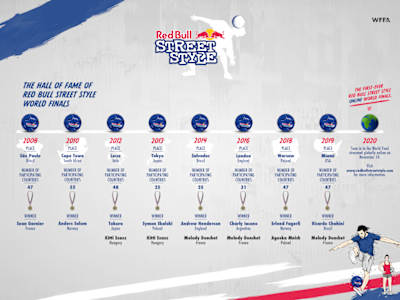
Red Bull Street Style Hall of Fame
© Red Bull Kuwait
2010 sees the second world final, which was brought to Cape Town, South Africa.
Where the 2008 final used the Adidas F50 balls, they were now using the Monta Street balls, specifically designed for freestyling masters. Norweigian Azun was the crown champion that year. Kamalio, the crowd favorite, took 2nd place and Rocky squeezed into 3rd place despite battling with injuries throughout the finals.
Another two years would pass before the third installment of the Red Bull Street Style World Finals would happen at the Lecce amphitheatre in Italy, and this one was famous for a few things that happened.
Now what set the 2012 world finals apart was the historic and stunning venue, like way stunning, and the breathtaking and unforgettable backflip catch that saw Japanese freestyler Tokura edge past Daniel Dennehy for the championship. In 3rd place, we had Gunther Celi.
Another major first was the inclusion of a female world final, for whom the crown title went to Kittu Szasz of Hungary.
2013 took the finals to Tokyo, Japan. It was held in the beautiful Zojo-ji Temple. This year we saw Szymon Skalski take 1st place, and history was made when Kitti Szasz defended her title, winning the championship in a repeat of the previous year.
2014 was a return to Brazil for the finals, where it went down at the Pelourinho Square in Salvador. The change that year was the opportunity for competitors to bring their own balls (size 5). The championship for men went to Andrew Henderson, 2nd went to Charly Lacano, and 3rd to Erlend Fagerli. And Kitti’s 3-peat was foiled when Melody Donchet defeated her for top place.
In 2016, after another 2-year break the finals landed in the city of London, England. Members from 48 countries participated, and we finally finally saw Charly win his first ever final. Kosuke and MC Pro took 2nd and 3rd. Again, we celebrated when Melody Donchet won her title.
2018 was Warsaw, Poland for the Red Bull Street Style World Finals. With the excitement reaching a fever pitch, so did the mad creative skills of the athletes elevate as well.
Another first that year when the Fagerli brothers (hailing from Norway), Erlend and Brynjar, took 1st and 3rd place. Melody beat out Aguska for 1st place.
2019 was the latest iteration, happening with flair in Miami, USA. And Miami had its thrills. For starters, Melody Donchet shattered all records by becoming the first athlete in either category to win 3 Red Bull Street Style 1st place titles.
On the other side, Brazilian Ricardinho won 1st place, with 2nd and 3rd going to Boyka and Erlend respectively.
Every year more new combinations were invented, with balance tricks, breakdancing techniques and flips turning it into a performance built to wow both the crowd and judges. And with a sport this young, the possibilities get more awesome with every new generation of athletes.
Among all freestyle football tournaments across the world, Red Bull Street Style is the pinnacle, and it keeps growing. It is held with the cooperation of the World Freestyle Football Association (WFFA).
You’ve just wrapped on your History of Street Style. What we really get a kick out of is knowing that big name stars feel like there is something to learn and apply to their team game from Street Style. Everyone watches. Everyone learns. The street moves show up on the primetime pitch.
Keep playing and see you at the next finals. The story of freestyle continues. This is your story, too.