
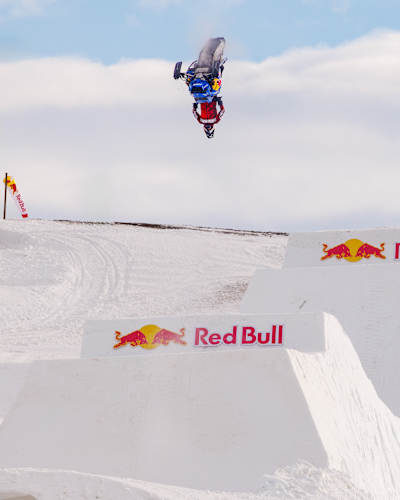
Snowmobile
Seven snowmobile backflips in a row: Andreas Bergmark sets a world record
How do you land seven backflips in a row on a snowmobile? Swedish rider Andreas Bergmark gave it a go – but unpredictable mountain weather nearly got in the way of his world-record attempt.


Andreas Bergmark made snowmobile history again. The Swedish rider landed seven consecutive backflips in a single run, setting a new world record for the most backflips performed on a snowmobile in succession.
Bergmark is no stranger to pushing the limits on a snowmobile. The Swedish rider has built a reputation for taking on extraordinary challenges, from landing the world's first backcountry front flip and jumping a huge gap in Canada to riding a snowmobile across water in central Stockholm. He has also landed the world's longest backflip.
His latest project, attempting seven snowmobile backflips in a row, called for a specially built course in Tänndalen, Sweden, featuring seven carefully engineered jumps. With unpredictable mountain weather threatening to disrupt proceedings, the project also demanded plenty of patience. Ultimately, it proved both more challenging and more exciting than Bergmark had initially imagined.


"It's always super fun to do something that has never been filmed before and to push the boundaries," he reveals.
01
How Andreas Bergmark prepared for his world record attempt
Bergmark began planning the project two years before filming, long before he approached the first jump. What started as an idea to link several huge backflips soon grew into an ambitious film project, complete with a purpose-built course.
“We decided it had to look really cool aesthetically. A bit more like a work of art. It had to be an epic course,” explains Bergmark.

The course was first sketched out digitally
© Red Bull

The initial sketches showed what Bergmark would face in Tänndalen
© Red Bull
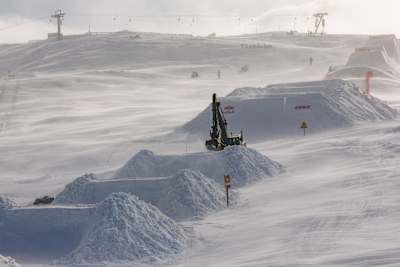
The sketch became a reality thanks to an enthusiastic construction team
© Richard Ström
Turning an idea in Bergmark's head into a course that works in practice presented a unique set of challenges. It took the right location, suitable machinery, the ability to produce huge quantities of snow and, crucially, a mountainside with the perfect gradient.
Unlike a backflip on skis or a snowboard, performing one on a snowmobile is best done while travelling uphill. That's why the course in Tänndalen was built on an ascending slope. The incline allowed Bergmark to get plenty of height without having to drop as far on landing, while also helping him find the right rhythm and flow between all seven jumps.
The course also had to look as impressive on camera as it did to ride. Everything needed to be carefully considered, from the spacing between jumps and the size of the kickers to how the entire run would look from different camera angles. There was plenty to get right before Bergmark could even attempt the first jump.
02
Why it proved to be a far tougher challenge than expected
Once the course was finally ready, it was time to start testing. Bergmark felt confident about the task. After all, performing backflips is something he’d done countless times before. What’s more, he’d had a specially built, extra-light snowmobile made to make the rotations easier.
But reality turned out to be quite different when the test and filming days got underway.
The hard, groomed landings were a world away from the softer snow Bergmark is used to riding on. The suspension also struggled to cope with the demands of the course, putting the snowmobile under enormous strain. To make matters worse, the mountain weather was at its most unforgiving, with crosswinds of up to 30 metres per second capable of lifting the snowmobile several metres into the air.
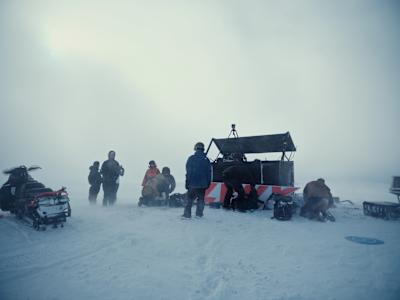
The mountain winds made for some tough conditions
© Anton Enerlöv
It soon became clear that the challenge would be considerably tougher than Bergmark had anticipated: “Before the project, I was probably much, much more cocky about how easy it would be for me to pull it off.”
Even though Bergmark has performed countless backflips over the years, no two jumps are ever the same. To land seven in a row requires a level of precision where the slightest mistake can have major consequences.
"Every time you attempt a backflip, there's no guarantee it will be perfect. The margins are incredibly narrow. You might push off too hard, too softly or pull slightly off-centre," explains Bergmark. "You're supposed to pull straight backwards, but even the slightest deviation can throw the whole backflip off."
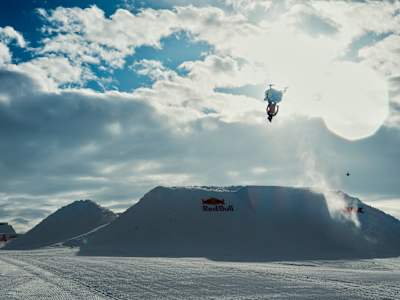
Every jump required complete concentration
© Anton Enerlöv
03
The smallest jumps proved the most difficult
One of the biggest surprises was just how technical the jumps turned out to be, especially the smaller ones. The course began with three small, fast kickers before gradually increasing in size.
Despite the larger jumps looking considerably more imposing, it was the small ones that caused the most problems. With minimal time in the air, there was hardly any room for adjustments: “On the small jumps, it’s all or nothing," says Bergmark. "It goes so fast that you don’t have time to adjust. Whereas with the bigger jumps, you’ve got more time.”
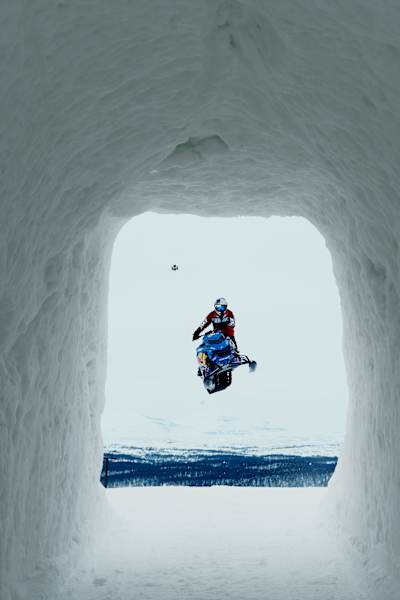
Even the straight jump into the tunnel was a major challenge
© Anton Enerlöv
Even the straight jump into the tunnel, which was designed to give Bergmark a brief respite between backflips, proved anything but straightforward. It became another precision manoeuvre, with almost no room for error.
"The margin for error on that jump was tiny," adds Bergmark. "If I'd landed half a metre to the right or left, I would have hit the wall rather than made it into the tunnel. The idea was to give me a moment of calm and let me catch my breath. Instead, it turned out to be quite the opposite."


A fine line between success and failure
With such narrow margins, everything had to be right: the weather, the snowmobile, the course and Bergmark's timing. Above all, every jump had to be perfectly shaped.
The importance of getting everything right became clear when Bergmark attempted a backflip off the first of the two big jumps. The snowmobile began rotating sideways, and he realised while still in the air that he wouldn't be able to land it. He bailed out and crashed to the side.
But rather than call it a day, he climbed back onto the snowmobile and tried again. "After a crash like that, I can almost get angry. I get frustrated and think, f*ck, why does this have to be so difficult?"
His second attempt also ended in a crash. Only then did the team stop to investigate what was going wrong. They eventually found the culprit: a small ridge of ice on the take-off ramp caught the ski, sending the snowmobile into an unwanted sideways rotation.

Not even two crashes could stop Bergmark from setting a new record
© Richard Ström
After a crash, I can almost get angry. I get frustrated and think why does this have to be so difficult

04
A successful attempt and a new world record
Pulling off something spectacular is never easy, especially when it's never been filmed before. Despite unexpected setbacks, crashes and constantly changing weather conditions, Bergmark and the team remained focused on their goal: setting a new world record with seven backflips in a single continuous run, captured in one take.
After practising each jump individually, Bergmark gradually began to string them together. Three here, two there. In the end, only one challenge remained: to land all seven in a row.
Suddenly, it all clicked. “After the sixth one, I started to feel that I’d got it,” says Bergmark.
Then there was just one final jump left. “Halfway through it, I just thought: this is absolutely spot on. Now all I have to do is land, head out and celebrate,” he adds.
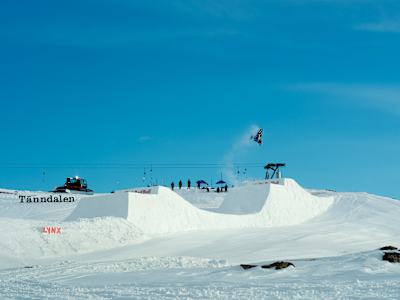
Bergmark performs all seven backflips in a row during a single run
© Anton Enerlöv
After seven successful backflips, two years of planning, countless tests and more than a few setbacks, the project was finally complete. But it wasn't necessarily the record itself that left the biggest impression on Bergmark. He had initially expected the challenge to be relatively straightforward, but weeks of testing, crashes, technical adjustments and difficult weather soon changed his perspective.
“I suppose I’m a bit more humble after this project, though. Before, I was more confident and thought: it’ll be easy. It wasn’t easy," he admits.
However, it seems highly unlikely that this will put a stop to future projects. "I’ve got quite a few projects in mind, so we’ll see which one comes next."