Everything you need to know about the Tour de France Femmes avec Zwift 2026
The fifth edition of the Tour de France Femmes avec Zwift begins in August, and this year’s race sees a Swiss start, iconic summit finishes and a fitting climb-packed finale on the French Riviera.
While the dust is still settling on a record-breaking Tour de France, the racing isn’t over yet - with Saturday, August 1, marking the start of the Tour de France Femmes avec Zwift.
The nine-day stage race is the fifth edition of the women’s race in its current format, and if last year’s race was anything to go by, it’s one you won’t want to miss.
From the route, key days and riders to watch, here’s all the important information you need ahead of the Tour de France Femmes avec Zwift 2026 edition.
01
How many stages are there?
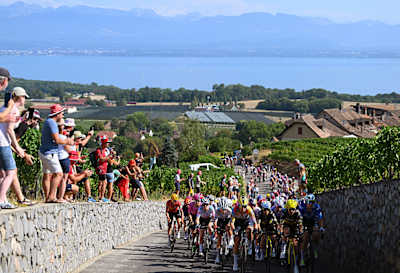
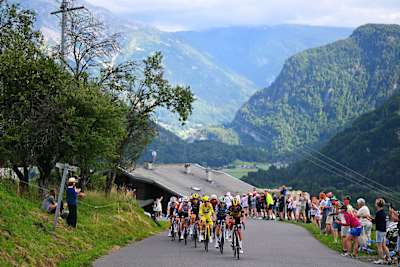
The peloton heads towards Geneva on stage 2 of 2026
Starting in Lausanne the Tour de France Femmes avec Zwift race route will spend three days in Switzerland before crossing the border into France midway through Stage 3 from Geneva to Plogny. The Swiss Grand Depart is the second overseas start for the women’s edition, following Rotterdam in the Netherlands in 2024.
After crossing into France, the route winds its way the country’s north-eastern corner before crossing the Auvergne-Rhône-Alpes – home to numerous iconic climbs – before finishing in the Côte d’Azur.
Riders will cover 1,175km over the nine stages, which break down into three flat stages, three hilly stages, two mountain stages and one individual time trial, finishing in Nice on August 9.
Stage 1: Saturday, August 1, Lausanne to Lausanne – 138km – flat
Stage 2: Sunday, August 2, Aigle to Geneva – 147.9km – flat
Stage 3: Monday, August 3, Geneva to Poligny – 156.5km – hilly
Stage 4: Tuesday, August 4, Gevrey-Chambertin to Dijon – 21km – individual time trial
Stage 5: Wednesday, August 5, Mâcon to Belleville-en-Beaujolais – 140km – hilly
Stage 6: Thursday, August 6, Montbrison to Tournon-sur-Rhône – 153.4km – hilly
Stage 7: Friday, August 7, La Voulte-sur-Rhône to Mont Ventoux – 146.8km – mountain
Stage 8: Saturday, August 8, Sisteron to Nice – 171.9km – flat
Stage 9: Sunday, August 9, Nice to Nice – 99.2km – mountain
While all nine days are guaranteed to feature explosive riding from the world’s best female riders, there are three make or break stages you won’t want to miss.
Stage 3 - August 7
Geneva - Poligny 156.5km, hilly
What’s at stake? After two days featuring two sprint-focused stages to kick off the Tour de France Femmes, the general classification is likely to be led by a sprinter as the race gets ready to depart Switzerland for France on Stage 3.
The first hilly day includes four categorised climbs, starting with an ascent of the cat 1 Col de la Faucille (11.4km at 6.3%), so fans can expect a big shuffle in the standings with the yellow jersey contenders rising to the top.
With an individual time trial to follow on Stage 4, the 156.5km parcours offers a chance for a favourite to try and build an advantage on the lumpy terrain before the race turns towards the Alps.
La Voultre-Sur-Rhône - Mont Ventoux 146.8km, mountain
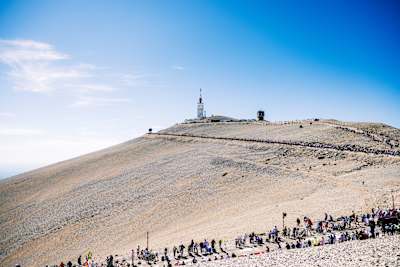
What’s at stake? The first-ever appearance of Mont Ventoux in the Tour de France Femmes is worth tuning into in its own right, but the ascent of one of the sport’s most iconic climbs is where a general classification bid is likely to be secured or scuppered.
The 146.8km stage features three categorised climbs before it even reaches the foothills of the 15.7km at 8.8% monster; get the pacing wrong, and the time gaps could be monumental.
Stage 9 - August 9
Nice - Nice 99.2km, mountain
What’s at stake? Unlike the men’s edition, there will be nothing ceremonial about the final stage of the Tour de France Femmes, which features a circuit that starts in downtown Nice before ascending the Col d’Eze.
Repeated four times before finishing on the Promenade des Anglais, if the general classification is still close, fans can expect fireworks on the Cote d’Azur as riders battle it out for the yellow jersey.
03
Which teams are taking part?
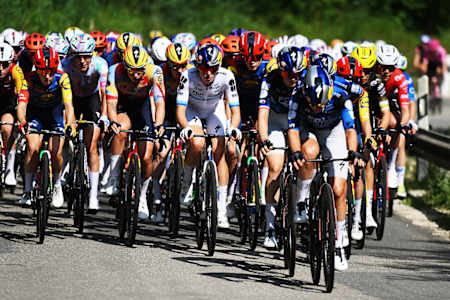
FDJ UNITED-SUEZ prepare to contest cycling's biggest race
There are 21 teams made up of seven riders each competing at the 2026 Tour de France Femmes. This is fewer than previous editions, although this year sees 14 Women’s WorldTour teams entered alongside seven ProTour Women’s teams.
The first four editions of the Tour de France Femmes have produced four different winners in the general classification, with Pauline Ferrand-Prevot the reigning champion. Previous winners Kasia Niewiadoma and Demi Vollering are both on the startlist, so the 2026 race could produce the first two-time winner.
Others looking to write their name in the history books include two-time Giro d’Italia Women winner Elisa Longo Borghini, two-time world champion Anna van der Breggen, 2026 Vuelta España Femenina winner Paula Blasi and the 21-year-old time trial specialist Zoe Bäckstedt.
The hectic nature of a sprint finish can make it hard to predict a winner in the Tour de France Femmes, as seen with only eight riders having more than one stage win in its four editions, but the points jersey rewards the most consistent of the fast women, of which three immediately stick out.
Marianne Vos is a two-time winner of the green jersey and will back herself to add a third, particularly after the disappointment of having to withdraw from the Vuelta España Femenina with a broken collarbone. The 2023 points classification winner Lotte Kopecky won the green jersey at the Spanish Grand Tour in May and will hope to add to her one Tour de France Femmes stage victory, while the most successful stage hunter at the race, Lorena Wiebes, returns to add to her five stage wins and defend the points classification contest that she dominated in 2025.
The general classification is the main competition of the Tour de France Femmes, and its leader is awarded the famous yellow jersey.
How to secure the yellow jersey: Presented to the rider with the lowest cumulative time, the GC is contested by the strongest all-round riders who can generally excel in the mountainous stages while minimising time losses in individual time trials. Pauline Ferrand-Prevot is the most recent winner and is targeting her second title this year.
The white jersey:
The youth competition follows the same format as the GC, but is limited to riders who will be aged 25 and under at the end of 2026
How to secure the white jersey: The white jersey is a sign of a rider with promise and potential. Nienke Vinke is the most recent winner, but the Dutchwoman won’t be lining up to defend her title in France.
The green jersey:
The points jersey is green in colour and is worn by the rider who has accumulated the most points.
How to secure the green jersey: Points are awarded for the first 15 places on each stage, while the amount of points on offer vary depends on the type of stage – with 50 awarded for winning a flat stage, while only 20 are awarded for coming first in a mountain stage. Each day’s racing also includes an intermediate sprint where points are also awarded for the first 15 riders. Generally contested by the out-and-out sprinters, the competition can sometimes be won by riders who get in each day’s breakaway and are able to contest hilly finishes.
The red and white polka dot jersey:
The leader of the mountains classification gets to wear the red and white polka dot jersey, and the race’s out-and-out climbers contest it. While it does work on a similar format to the points competition, specific KOM points are awarded to riders who lead that day’s stage as they cross the peaks of categorised climbs.
How to secure the polka dot jersey: The most points on offer (15) is for leading over a hors categorie (HC) climb, while leading over a fourth categorie climb will only score you two points.
06
How is it different from the men’s Tour?
Three former champions climb towards the Col de Joux Plane in 2025
There are a number of things that differentiate the Tour de France Femmes from the men’s version.
The most obvious thing is the number of stages and therefore the race’s overall length. The Tour de France Femmes runs for nine stages, while the Tour de France involves 21.
In addition to fewer stages, the parcours themselves are often shorter, contributing to a total length of 1,175km with 18,795m elevation gain, compared to 3,321.2km with 54,450m elevation gain for the men's 2026 Tour de France.
Although the stages are shorter, this can often contribute to more aggressive racing with riders having fewer kilometres to make their move. There are also no rest days, so fatigue can start to play its part as the race reaches its conclusion.
Finally, there are 37 fewer riders competing at the Tour de France Femmes than the men's with a total of 21 teams made up of seven riders compared to 23 teams of eight. The prize pool they are competing for is smaller too, with a total of €250,000 on offer – €50,000 of which goes to the winner of the yellow jersey. The men meanwhile compete for approximately €2,300,000, with €500,000 of that going to first place in the general classification.
While the 2026 Tour de France Femmes is the fifth edition of the race, there has been a women’s Tour de France on and off for more than 70 years.
The first edition was held in 1955 and was five stages long, although it was a one-off event with riders and fans left waiting 29 years before another race of its kind.
From 1984, a women’s Tour de France was held alongside the men’s event, and riders tackled shortened versions of the same stages as the men’s race. Held for six years, it was won three times by Frenchwoman Jeanie Longo between 1987-89.
The '90s and early 2000s were a barren period for the women’s edition until Tour de France organiser ASO launched La Course in 2014. A one-day event, it was held in conjunction with the men’s race, and ran until the Tour de France Femmes was announced in 2021.
The first edition of the Tour de France Femmes was staged in 2022 and consisted of eight stages. An instant success, it returned the following year with Dutch rider Demi Vollering winning (she's racing for FDJ Suez this year), while 2024 saw the first overseas Grand Départ in Rotterdam, the Netherlands. An iconic edition, the general classification was won by just four seconds by Kasia Niewiadoma on the slopes of Alpe d’Huez – halving the smallest victory margin in Tour de France history when Greg Lemond beat Laurent Fignon in 1989.
Last year, the race was increased from eight to nine stages, and was won by a dominant Pauline Ferrand-Prevot – the Frenchwoman returning to road cycling from mountain biking and becoming the first home winner of either Tour de France since Jeanie Longo in 1989, or Bernard Hinault in 1985 on the men's side.
08
FAQs: All you need to know about the Tour de France Femmes avec Zwift 2026
Within France, the Tour de France Femmes is broadcast live on France 2 (and France 3 for certain stages). Outside France, the race is broadcast by member channels of the European Broadcasting Union (EBU) and on Eurosport in many countries.
The 2026 edition concludes on August 9 in Nice, with a finish on the Col d’Eze - an iconic climb that will also prove decisive for the general classification. The queen stage of this year’s race is the climb up Mont Ventoux, marking the Provençal giant’s first appearance in the Women’s Tour de France.
The Tour de France Femmes has a total prize fund of €250,000, making it the highest-prized women’s race on the global calendar.
Since the race was relaunched in 2022, here is the full list of winners:
2022 - Annemiek van Vleuten (NL)
2023 - Demi Vollering (NL)
2024 - Katarzyna Niewiadoma (PL)
2025 - Pauline Ferrand-Prévot (FR)
The first edition of the current race took place in 2022, starting on the Champs-Élysées, but the history of women’s cycling on the Tour’s routes goes back much further. An initial attempt took place in 1955 (five stages, organised by Jean Leulliot), followed by an official Tour de France Féminin from 1984 to 1989 (six editions). Several alternative races subsequently took place under various names - the Grande Boucle Féminine Internationale (1992–2009), the Route de France Féminine (2006–2016) - before the definitive relaunch under the ASO banner in 2022.
About the author
Charlie is a freelance contributor based in London, UK. He covers a variety of two-wheel disciplines, including road cycling, mountain biking and BMX, and also writes about cycling for publications such as Rouleur, Bike Radar and the Guardian. When not writing about it, he's a keen cyclist and runner himself, and has completed iconic events such as the Paris Roubaix Challenge sportive and London Marathon.