
Bike
MTB
9 tips that'll make your e-bike's battery last longer
We've got everything you need to know to get the best range and lifespan from your bike battery.
If you’re new to e-biking – and indeed even if you’re already experienced – you might benefit from some quick tips on prolonging the range and lifespan of your battery.
As the power source for those flowy uphills and flat-out singletrack blasts, it's not difficult to recognise the battery as fundamental in any electric bike's functioning. However, perhaps less obvious are the factors that influence its output when tyre hits dirt, and longevity in terms of both ride length (range) and its overall lifespan.
1. Use the right mode in the right moment
Let’s get the most obvious one out the way first: if you charge (no e-bike pun intended) around in turbo mode all day, well, your ride isn’t going to last all day. If you want to be out for a couple of hours or more, switch through the bike’s modes for maximum efficiency and fun combined. On roads, connections and faster sections of trail, ride in the lower and mid settings (modes and naming differ per system), for technical and climbs hit the turbo, and when you’ve ridden for too long limp home. (Some systems offer on-screen power output readings, but these are sometimes hard to keep track of while tackling challenging terrain.)
2. Reduce weight
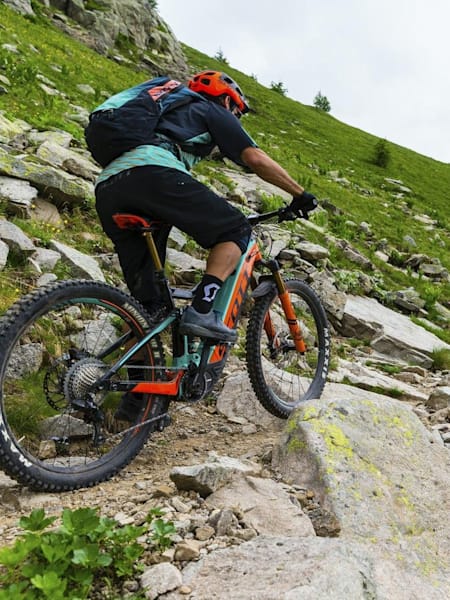
Rider and machine weight is perhaps the single greatest factor affecting range. While there are no instant fixes for the main weight – the rider – removing any unnecessary weight from your backpack and bike will help. The difference here is most notable on climbs, where the motor and battery are working hard to drive the rider (as opposed to flatter rides where they are only working to maintain rider speed). Either way, lighter riders will always get more out of a charge.

Reducing weight helps the battery
© Oscar Embid
3. Use the right tyres
Rolling resistance is another key factor in the range you get from a battery charge. This is affected by tyre compound, width, tread pattern and pressure. While you should always choose the tyres that best suit your riding, it’s worth experimenting with pressures to find a comfortable balance. Higher pressures will induce less rolling resistance but affect control of the bike. As a side-note, some solid and semi-solid tyre inserts are starting to creep into E-Biking (aimed at combatting punctures), and these can increase rolling resistance, reducing range.
4. Ride a variety of terrain
Lots of steep climbs and techy singletrack will deplete your battery in fewer kilometres than gentle gradients and flowing turns. However, you’ll probably be riding slower anyway, so sometimes it’s best to measure the ride in terms of time on the bike (and fun factor!) anyway.
5. Pedal smoothly
A good, smooth pedalling technique will really help prolong range. Spin your feet as opposed to stamping hard on the pedals and choose appropriate gears – low gears for steep climbs put far less load on the motor and therefore battery.
6. Ride smoothly too
Now your pedalling technique is dialled, you should tune in your riding too. Flow through turns instead of hammering in, stopping and hitting the gas hard again. Accelerating from zero puts a huge workload on the battery.
7. Don't let the battery get too cold
There’s not much you can do about this one, but lower temperatures will decrease range from one battery charge, as ‘electrical resistance increases,’ according to battery experts Bosch’s literature.
8. Store the battery in cooler temperatures
According to Bosch, batteries should not be stored at temperatures above 30ºC, nor should they be left in blazing sunshine – much the same as any battery. Ideally, store your battery in a cool, dry place at 0-20ºC, and if you’re storing for long periods then leave it 30-60 percent charged. Fully charged or empty isn’t ideal for storage.
9. Don't jet wash the battery or motor
As with any bike part, and despite what some e-bikers might tell you, it’s best not to point a jet wash at an e-bike battery or motor. You’ll probably ignore this bit though. A quick spray with an electrical contact cleaner at the battery terminals will reduce potential for corrosion and maintain good energy transfer.
