









Fitness
Fitness Training
HYROX Singles vs HYROX Doubles: which is harder?
HYROX Singles and Doubles may share the same course, but which is actually harder? Experts break it down.
Part of this story
This year, more than 50 percent of those competing in a HYROX race across the world will choose to race as a team in the Doubles category. Across the global HYROX community, it’s what’s brought about a fundamental question: Is it harder to race alone or as a pair?
On paper, the comparison looks straightforward: a HYROX Singles race requires an individual to endure the full weight of every functional station and 8km of running entirely solo. While the running mileage remains the same in a doubles pairing, the station workload is split, meaning the physical volume per person is effectively halved at each station.
However, elite competitors who have tackled both formats will tell you that the reality can be far more nuanced. Both formats cover the same running distance: 8km broken into 1km intervals alongside eight functional fitness stations. Here, doubles isn't a shortcut or an ‘easier’ alternative to singles; rather, it introduces a completely different physiological and tactical scenario.
Here’s everything you need to know about singles and doubles at HYROX and the vital information that will help you decide which race is for you. Underestimate it at your peril…
01
What is a HYROX Doubles race?
A HYROX Doubles race follows the same basic structure as a Singles race: eight workout stations, each separated by a 1km run, covering 8km of running in total. The difference is that you do it with a partner (whether same-sex or mixed doubles is up to you – more on that below) and each station can be split between the two according to individual preference or overall race strategy.
That freedom, however, is a little deceptive. While it may sound easier, it’s a different story in reality – most competitive pairs divide stations to play to their strengths. One athlete takes the SkiErg while the other recovers, then they swap roles at the next stop, for example, or they opt to split each station down the middle, which means that when they're working, they're going flat-out.
There's no pacing themself through a sled push at 70 percent, as their partner is standing there as the clock ticks relentlessly. The running, unlike the stations, can't be split – both athletes complete every kilometre together, which adds a layer of tactical complexity around matching pace and managing effort between efforts.

Alexander Rončević and Fabian Eisenlauer competed together in Amsterdam
© Joerg Mitter / Red Bull Content Pool
02
How do the HYROX Doubles categories work? Key pointers
To ensure fair competition, HYROX divides the division into distinct structural categories: Men's Doubles, Women's Doubles and Mixed Doubles. While the overarching 8x1km structure remains identical to Singles, the rules governing how to navigate the floor are completely rigid.
The most crucial rule of the doubles division is that as the running can’t be split, teams must stay locked in step, as drifting too far apart can result in severe time penalties or disqualification. Consequently, a team's running split is bound to the pacing capabilities of the slower runner.
You never feel alone in the doubles race
After each run, both team members must enter the workout station together. Only then can the workout begin – once all reps or the distance has been completed, the station can be exited and both partners must leave together. If a doubles team accrues more than three penalties for not staying together, they’ll be out of the competition.
As for the eight functional stations, they can be divided however the team sees fit. Partners can execute a clean 50/50 split, assign specific stations to play directly to individual strengths, or swap roles when fatigue hits. The only catch is that the resting partner must remain completely clear of the equipment while the working partner is active.
Additionally, the division of the age groups is based on the average age of the two doubles participants at the time of the event. For example, if partner A is 28 years old and partner B is 36 years old, their combined age is 64, giving them an average team age of 32 and placing them within the 30–39 age bracket. On time frames, doubles teams finish approximately 22 percent faster than those racing in Open Singles on average.
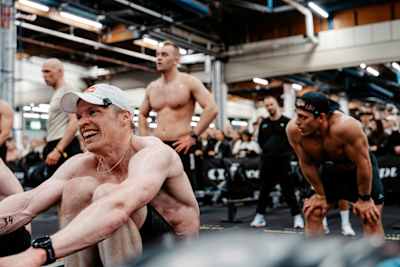
Iivo Niskanen rows while Jonne Koski catches his breath in Helsinki
© Lauri Vuorinen / Red Bull Content Pool
03
Why is HYROX Doubles so popular?
HYROX’s Doubles format has rapidly evolved into one of the most popular entry points in the world of HYROX. This surge in popularity is driven in part by a mix of psychological comfort and accessibility.
For example, racing with a partner provides an immediate psychological buffer – having someone to share the mental load, pick up the slack during a tough patch and push past perceived personal limits completely changes the dynamic of the race. In doubles, 100 wall balls and 100m of lunges can feel more approachable when a ‘You Go, I Go’ format is adopted.
Similarly, with more athletes sweating it out on the competition floor, the high-energy environment of doubles means competitors are constantly surrounded by the energy of other teams pushing toward the finish line. Experiences are better shared, after all.
04
HYROX Doubles: Open vs Pro weights
Across HYROX Doubles, the weights and wall ball target heights vary between men’s and women’s Open and Pro divisions. Below, we break down what each team competing can expect:
Women's Open Doubles
Women’s Pro Doubles
Men’s and Mixed Doubles
Men’s Pro Doubles
SkiErg
1000m
1000m
1000m
1000m
Sled push
102kg
152kg
152kg
202kg
Sled pull
78kg
103kg
103kg
153kg
Burpee broad jumps
80m
80m
80m
80m
Row
1000m
1000m
1000m
1000m
Farmer’s carry
2x16kg
2x24kg
2x24kg
2x324kg
Lunges
10kg
20kg
20kg
30kg
Wall balls
4kg (9ft target)
6kg (9ft target)
6kg (M: 10ft / W: 9ft)
9kg (10ft target)
05
The emergence of Elite Doubles at the HYROX World Championship
At the sharper end of the sport, a major update was introduced in 2026: the inclusion of the Pro Doubles Elite 15 race at the HYROX World Championships. This addition to the Elite calendar means the sport’s best doubles athletes compete for top spot, showcasing this fast-paced format to the wider HYROX community. It's almost means that certain Elite 15 athletes, including Alexander Rončević with Tim Wenisch and Joanna Wietrzyk with Jess Pettrow, now compete across both the singles and doubles Elite 15 categories.
06
HYROX Singles or Doubles: what the pros say
HYROX’s standardised format means that athletes across the world – whether it’s their first race or their 15th – are experiencing the same race conditions as the athletes at the very top of the sport; and the same applies for the doubles division.
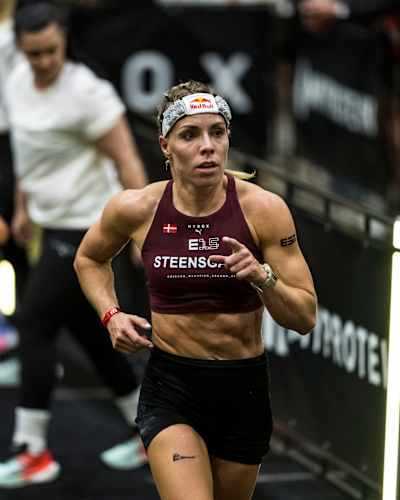
One such athlete competing among the world’s best is Denmark’s Ida Mathilde Steensgaard. Well-versed in the nuances of HYROX’s single division, thanks to her decision to also compete in the doubles, she is well aware of the quirks that competing with a partner can bring.
“In an individual competition, you have to sit in the pain for a long time and you’re only by yourself,” she says. “It’s long suffering, whereas doubles is harder when you’re at the stations.”
As each partner can rest while the other works, Steensgaard explains that the intensity naturally ramps up for those putting in a shift. “In doubles, you’re working at an extremely high pace, so it’s more high intensity and more all‑out power,” she says. “It can be really, really uncomfortable, but it’s a different kind of uncomfortable.”

Alexander Rončević and Jake Dearden compare notes at HYROX Major Amsterdam
© Joerg Mitter / Red Bull Content Pool
The start-stop nature of a HYROX Doubles race, she explains, will have partners feeling the burn considerably faster. Speaking to BOXROX, HYROX Elite 15 racer Jake Dearden raised a similar point. “Preparing for doubles is a little bit different to the solos,” he said. “It’s more of an anaerobic event. You’re redlining then recovering, redlining then recovering, over and over again.”
Additionally, “you never feel alone in the doubles race,” Steensgaard says. In singles, “you can end up being somewhere in the pack where you maybe run a lot by yourself,” but in Doubles, “you’re constantly around other people, because the field is closer and more condensed.”
The best doubles teams are the teams that are able to adjust and change strategy within the race
Another key difference, Steensgaard says, is the way the race plays out. “In solos, you often see people leading from the start and then they keep the same positions, whereas in doubles it’s quite different,” she explains. “You can see people starting out at the back and then catching up.”
As the leaderboard chops and changes throughout the race, race lanes can become condensed – bringing an element of dynamism to each section. “It’s total chaos, but also quite interesting,” she laughs. “It’s more interesting to watch a doubles race, because things can change so much and it’s much closer – there are a lot of elbows out during the run.”
This element of improved strategic oversight was also felt by Dearden. “The best doubles teams are not the teams that have the best plan before the race,” he told BOXROX. “They’re the teams that are able to adjust and change strategy within the race.”
07
HYROX Doubles for beginners
If you’re completely new to the world of HYROX, Steensgaard recommends “doing doubles first – it’s much more fun, you can have a partner, you can share the load and you’re running with somebody else,” she says. “It’s just a nicer experience.”
She continues: “If you’re in quite good shape and you feel like you want to give yourself a challenge, you could do individual, but start with the Open weights and not with the Pro unless you’re already quite a high‑level athlete.”
When training for HYROX Doubles, Steensgaard believes that you still need to respect that the event is won on the run, but raced at brutal, repeated spikes of intensity on the stations. For the average racer, that means “more running, and a little less station work.”
Steensgaard also reminds athletes that it’s not enough just to be strong in the gym, as doubles is “mainly lower‑body strength endurance.” She says: “Your legs will get really beat up, so you need your legs to be able to handle the full competition.”

Ida Mathilde Steensgaard in action at the Hyrox World Championship 2025
© Christian Pondella/Red Bull Content Pool
Mentally and physically, it’s harder to do an individual race
08
The final word
So, which is harder – HYROX’s Singles division, or Doubles? “Mentally and physically, it’s harder to do an individual race,” Steensgaard says. “Individual is 100 percent harder.” She describes that “you have to be so in-tune with your body, making sure not to over‑pace and not to under‑pace either.” However, a Doubles race isn’t to be sniffed at – especially Mixed Doubles, in which male and female HYROX athletes can race together. “One of the most uncomfortable things I’ve ever done was racing Mixed Doubles,” she says. “It’s painful in such a different way.”
Steensgaard advises mixed partners to split stations according to individual strengths and weaknesses and reminds those doing so not to “overextend yourself.” When comparing the two directly, Steensgaard reflects that “I always feel OK after racing the Doubles, but when I’ve done an individual competition, I’m fatigued on a whole other level.”
About the author
Part of this story
