

Gaming
Games
Meet the man behind FINAL FANTASY BRAVE EXVIUS
Producer Hiroki Fujimoto discusses FINAL FANTASY BRAVE EXVIUS, its first major version update and reflects on his career of 25 years.
With FINAL FANTASY BRAVE EXVIUS surpassing 20 million downloads worldwide, Hiroki Fujimoto – the producer of the global version – is in high spirits.
A joint collaboration between SQUARE ENIX® and gumi Inc. (developer of Brave Frontier), FINAL FANTASY BRAVE EXVIUS’s combination of nostalgia, traditional role-playing elements and addictive gacha system has proven to be a hit with the global mobile gaming community.
We met Hiroki Fujimoto to discuss the latest version of the game as well as his 25 years in the video games industry.
Congratulations on crossing 20 million downloads for FINAL FANTASY BRAVE EXVIUS and the successful launch of version 2.0 of the game!
Thank you! Of course, we were very pleased when we hit 20 million downloads worldwide. We had a big boost in players thanks to the Ariana Grande collaboration. But it wasn’t a situation where we were constantly monitoring the numbers going “we’re almost there, we’re almost there… we’re here!”. It was more of a “oh, we’ve hit it!” moment. [Laughs]
Version 2.0 has a number of new features, the most significant of which is the highly-anticipated change to the summoning gacha system. Players of the global version have been clamoring for it since it was implemented in the Japanese version. Many were pleasantly surprised to see it implemented so soon.
What made you decide to accelerate its implementation to Global?
I would like to touch on why we revised the gacha system in the first place. Since launch, we’ve been consistently adding characters into the game. So now, there’re lots of characters that players can pull from the gacha pool, and this has made it difficult for players to get characters that they really want. This was something that we thought we could improve on, and hence the revision to the gacha system.
When we introduced this new gacha system to the Japanese version of the game, it was very, very well received. We decided that, something that is this good, we wanted to bring it to the global version as quickly as we could. We needed time for translation and development, but we did our best to shorten the time required and implement it on Global as soon as we could.
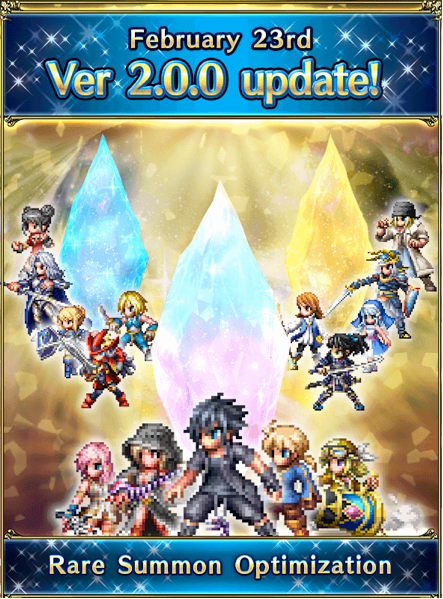
FINAL FANTASY BRAVE EXVIUS v 2.0
© gumi
The Japanese version has a number of other well-received features such as energy rewards if a friend uses a player’s lead as a companion, unit enhancements and most recently, EX currency to reward players who spend money. Should players expect these features to come sooner as well?
For features that are well-received in Japan, we do hope to implement them to Global as much as possible. However, the global version is actually quite distinct from the Japanese version. It’s not a port. These are two concurrently running games and they have different operating principles. So, we’ll need to move forward carefully in deciding which features we’ll implement to the global version.
This isn’t the first time you’ve mentioned Global being distinct from the Japanese version. Why the decision to make Global different, rather than a direct language port?
It’s really due to the cultural differences between Japan and the rest of the world. There are quite a number of other games which have tried the approach of a direct language port and failed.
Another approach is to release the license for the game to be operated in another country.
But with FINAL FANTASY BRAVE EXVIUS, we didn’t want to just let the license go just like that. We wanted to maintain some control to make sure that it’s as best as it can be.
How different do you envision Global to be from the Japanese version? And in what way?
While these are distinct games, with different operating principles, the Japanese version forms the base for the global version. What we have on the Japanese version, we will try, as much as we can, to bring to the global version. We then add features to the global version that we feel are good for the global community; features that are not present in the Japanese version. For example, we have Facebook login, which allows players to access and play the game from their various devices. We also have a daily login bonus which is not present in the Japanese version, and exclusive Lapis (in-game currency) and item bundles.
Earlier this year, Ariana Grande was added as a playable character, becoming Global’s first original crossover collaboration unit. How did you arrive at Ariana Grande over more intuitive game related collaborations like the Monster Hunter and Dragon Quest collaborations in the Japanese version?
[Laughs] Well, in all the numbered FINAL FANTASY games, we have a main theme song. The latest, FINAL FANTASY XV has Florence Welch singing “Stand By Me”. We decided that we wanted to have a theme song for FINAL FANTASY BRAVE EXVIUS and deliberated on who we would like to have sing our song.
We wanted to partner with the number one singer at the time, and it was Ariana Grande.
There’s a thread on Reddit which contains a wish list of crossover collaborations – popular ones include Valkyrie Profile, Xenogears and Chrono Trigger. Have you seen this thread and were any of the suggestions taken up?
[Chuckles] Yes, we are aware of this thread on Reddit. We are also taking feedback from a lot of different sources for potential collaborations for the future. We don’t only look at past titles, which is what most of the player suggestions are, we also look at future titles when deciding on collaborations for the future.
Let’s shift the focus from FINAL FANTASY BRAVE EXVIUS to you for a bit. Fujimoto-san, you’ve been in the video games industry since 1992. What made you decide to pursue a career in the video games industry?
It was the impact I felt when the Famicom came out. It was big deal, because at that time, when you wanted to play games, you needed to go to the arcade and pay money to play games. When the Famicom came out, you could get it, and you could play at home for free. It was really something. You could do such wonderful things at home. From then on, every time a new piece of hardware came out, I’d buy it, I’d play games at home, and by the time I reached university and graduated, and had to decide what to do with my future, I thought that I’d like to work on games as it was cutting edge and associated with the impact that was made on me.
Related
You’ve been in the industry for 25 years. How do you continue to stay motivated and inspired?
[Nods] 25 years! [Laughs] Well, Square Enix was formed by the merger of Square and Enix. I was originally from Enix. It’s a company where there was an ever-present feeling of “let’s create something interesting”. It’s a company where you could do anything, create anything, as long as it was interesting and fun… and made money. [Laughs]
Currently, my focus is more on games, but when I was in Enix, I could work on not just games, but really, anything, as long as it was interesting. That was definitely one of the reasons why I was able to maintain my motivation at a high level for so long. Enix, for example, was actually thinking of doing conveyor belt sushi, selling soya sauce in China… [laughs], it was a really fun company because we could do anything and take on lots of different challenges.
You started your career producing console games before switching fully to mobile games in 2002. What prompted you to make that switch from console to mobile in 2002?
The console games market was getting mature. I wanted to do something new and that was the point in time when handphones started to appear. The thing about Japanese handphones at that point in time was that they were high specs and could actually run games.
Eventually smartphones came and they were able to run apps, and that was when I decided to go into mobile gaming.
Do you miss producing console games?
I do feel like creating a console game in the future. But the thing about mobile games is that the mobile gaming world keeps moving forward at a great speed, and as such, you need to keep thinking of new things, so that has held my interest in mobile. Moreover, when it comes to the console, you’re only making games for people who have that particular console, but when you’re making a mobile game, you’re potentially making a game for millions of players.
What is the biggest difference between producing for mobile and for console?
Different people have different perspectives on this. For me, when you’re developing a console game, you are developing it from the perspective that the user will pay money for that game. The overall structure of the game is typically one where you you gradually face increasing sets of challenges until you reach the final boss. For consoles, you can take your time to gradually build interest to a climax, but with smartphone games, it needs to be from the start, from the moment the user picks it up.
You’ve worked on a number of mobile titles aside from FINAL FANTASY BRAVE EXVIUS, including the mobile version of FINAL FANTASY III, IV, V and VI. What is the most challenging title you’ve worked on?
They were all challenging in their own right... but it would have to be FINAL FANTASY III. We were working off the DS version, so the art wasn’t in a bad state. If you ported it over as is, you could play it. But as a producer, I decided that to make the best game we could make, we needed to redo the art. Corporate’s perspective however, was that since it’s playable, what’s the need of spending all this money to redo the art. In the end, we managed to redo all the art and make it a better game.
FINAL FANTASY BRAVE EXVIUS has weekly content updates. How do you ensure that your development cycle is able to deliver content updates every week?
A lot of this is also thanks to the hard work by the people at gumi. We think about what we want to deliver to the players, how we can keep them interested and how we can give them a good experience, and we use that to keep us motivated and focused on delivering.
In the community engagement videos that you partake in for FINAL FANTASY BRAVE EXVIUS, you make it a point to personally engage the community in English, rather than through an interpreter. Why the decision to do so?
[Laughs] When it comes to video interviews, I like to communicate directly to my audience without an interpreter for a more direct connection. But when it comes to face-to-face interviews like now, English isn’t my first language, so to ensure that we communicate effectively, an interpreter is used.
Any parting words for the GL FINAL FANTASY BRAVE EXVIUS community?
I’d like to thank everybody for continuing to play and support the game. We, including the people at gumi, are doing our best to deliver as great a game as we can, and we look forward to your continued support!
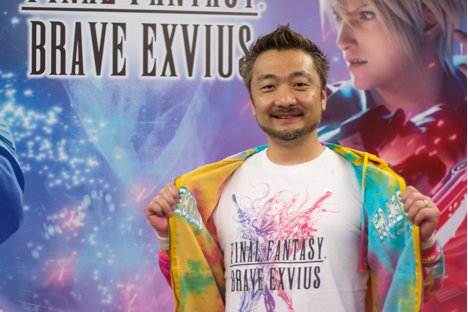
Hiroki Fujimoto
© Red Bull
Bonus questions:
Favourite title you’ve worked on:
It’s a lot to choose from. But it has to be the first title I worked on. Wonder Project J.
Latest game you’ve played that isn’t FINAL FANTASY BRAVE EXVIUS:
The latest game I cleared is FINAL FANTASY XV. I’ve cleared the main storyline, but there’s still a lot of post-game to clear.
Favourite Ariana Grande song:
“Touch it”. For the game, the original version would’ve been fine, but we decided to do a special orchestral version to be used as the game’s theme song.
Favourite unit in FINAL FANTASY BRAVE EXVIUS:
[Pauses] Ariana Grande. [Laughs] As a unit she’s a decent unit that can go up to 6 stars and has her own unique equipment. When we did the collaboration, we went to meet her, to shake her hand and show her the game. She was very pleased with the game and before leaving, we shared a hug.
Favourite “waifu” and “husbando” unit in FINAL FANTASY BRAVE EXVIUS:
Roselia. She’s very useful as a healer and she’s pretty cute. For “husbando”, it’s Medius. I know that not many players use him in their parties, [laughs] but if you do, you’ll find that he’s actually pretty cool.
More games content, like us on Facebook!
