The 4 types of defense in basketball: The ultimate tactical guide
Win more games by mastering the 4 basketball defenses: man-to-man, zone, combination, and press. Learn how they work, their pros and cons, and key tactical variations.
Defense may not generate as many highlight clips as a game-winning shot, but elite players know championships are often decided on the other end of the floor. Red Bull athlete Arike Ogunbowale has built her reputation on clutch scoring, yet like every top guard, she understands that creating steals, forcing turnovers, and disrupting offensive rhythm can completely change a game.
Whether you're trying to lock down an opposing scorer or generate momentum-changing stops, understanding the different types of basketball defense is essential. From man-to-man and zone schemes to aggressive presses and hybrid systems, here's how the game's most effective defensive strategies work.
Can be physically demanding and vulnerable against quicker or more athletic opponents.
Zone Defense
Players guard designated areas of the court instead of individual players.
Protects the paint, conserves energy, and forces offenses to work for quality shots.
Skilled outside shooting and crisp ball movement can expose gaps in coverage.
Combination (Junk) Defense
Blends man-to-man and zone principles to disrupt an offense's rhythm.
Takes star players out of the game while keeping help defenders in position.
Requires excellent communication and can leave openings if rotations break down.
Press Defense
Applies aggressive pressure before the offense can establish its half-court set.
Forces turnovers, speeds up the tempo, and creates easy transition scoring opportunities.
Demands exceptional conditioning and can surrender easy baskets if the press is broken.
02
Basketball defense positions and responsibilities
While defensive schemes determine how a team guards the court, each position still has specific responsibilities. Whether you're playing man-to-man defense, zone defense, or a full-court press, every player contributes to stopping the offense.
Position
Defensive Responsibility
Point Guard
Ball pressure
Shooting Guard
Perimeter defense
Small Forward
Wing coverage
Power Forward
Help defense
Center
Rim protection
03
Man-to-Man Defense
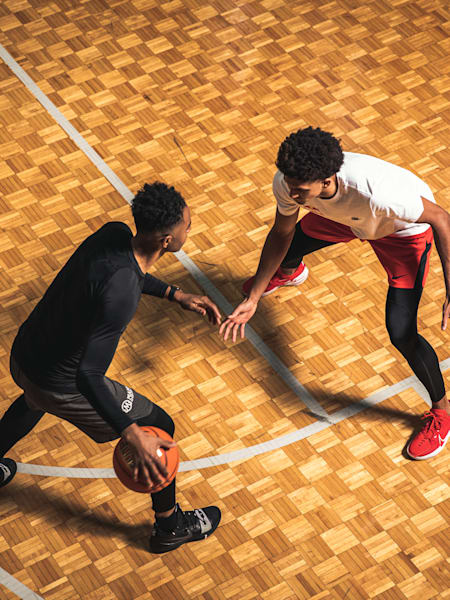
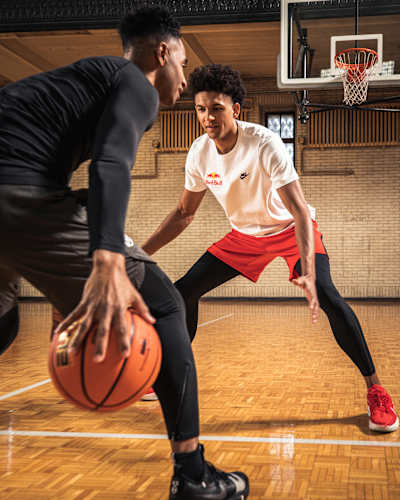
Man-to-man defense pairs every defensive player with an offensive counterpart to guard. Usually, players will mark their equal on the court, but basketball coaches sometimes shake things up depending on who they’re up against. Man-to-man defense is highly reliable because teams get consistent cover on the opposition, so it’s easy to set up traps, force turnovers, and box out key players.
That being said, man-to-man defense is also pretty basic, which also means it’s recognizable. Opposition might catch onto the defensive strategy sooner rather than later. And for teams that are all about strength but aren’t so good on speed, a man-to-man can be pretty demanding and also open teams up to isolation offensives, if they’re not careful.
Pros of Man-to-Man Defense
Creates individual accountability. Every defender knows exactly who they're responsible for, making communication straightforward and limiting confusion during possessions. Coaches can also identify breakdowns more easily when reviewing film.
Generates turnovers through pressure. Because defenders stay attached to their assignment, they can aggressively contest passes, deny passing lanes, and force ball handlers into mistakes that lead to steals and transition opportunities.
Improves rebounding position. Staying matched with an opponent makes boxing out more natural after a shot goes up. Defenders already have inside position on their assignment, increasing the likelihood of securing defensive rebounds.
Cons of Man-to-Man Defense
Physically demanding. Players must fight through screens, slide laterally, and remain engaged throughout every possession. Over the course of a game, this can quickly become exhausting, particularly against teams that move constantly without the ball.
Can expose defensive mismatches. If an offense creates favorable one-on-one situations through screens or switches, slower defenders may find themselves isolated against quicker guards or explosive wings.
Requires disciplined help defense. While each player has an individual assignment, teammates must still rotate quickly when someone is beaten off the dribble. Poor communication can leave open driving lanes or uncontested perimeter shots.
Straight Man-to-Man
Straight man-to-man is basketball's most fundamental defensive system. Each defender follows one offensive player everywhere on the court while maintaining proper positioning between their assignment and the basket. The emphasis is on ball pressure, denying easy passes, and forcing contested shots. Because responsibilities are clearly defined, straight man-to-man is often the first defensive system taught at the youth and high school levels. It develops essential defensive habits like footwork, closeouts, communication, and help-side positioning that translate into every other defensive scheme. At higher levels, teams often disguise straight man-to-man by switching screens, trapping certain actions, or adjusting matchups throughout the game, but the underlying principles remain the same.
Sagging Man-to-Man & The Pack Line Defense
Unlike traditional man-to-man, sagging man-to-man defense encourages defenders to give non-shooters extra space while remaining ready to help against dribble penetration. Instead of pressuring every offensive player equally, defenders "sag" into passing lanes and driving gaps, making it more difficult for offenses to attack the basket.
One of the best-known versions of this philosophy is the Pack Line Defense. Popularized at the college level, the Pack Line keeps help defenders inside an imaginary line several feet inside the three-point arc whenever they're guarding a player without the ball. The goal is simple: protect the paint first and force offenses to beat you with contested perimeter shooting. The trade-off is that disciplined closeouts become essential. If defenders are slow rotating back to shooters, offenses can quickly generate open three-point attempts before the defense has time to recover.
In a zone defense, players guard a specific zone of the court. Teams can really make this defense their own and arrange players in different ways. Unlike the man-to-man defense, defensive players only guard the opposition if and when they enter their zone.
Zone defenses are less physically demanding than man-to-man, but also provide less intensive coverage of the ball. Plus, because the defense is tied to these ‘zones’, the offense might take advantage to shoot from areas with less coverage.
Pros of Zone Defense
Conserves player energy. Since defenders protect areas rather than chasing individual matchups around the court, players can remain fresher throughout the game while still maintaining strong defensive positioning.
Protects the paint. Most zone alignments naturally crowd the lane, making it difficult for opponents to score around the basket or attack off the dribble.
Neutralizes aggressive drivers. Teams built around penetration often struggle when multiple defenders are already waiting in the lane, forcing them into kick-out passes or contested floaters.
Cons of Zone Defense
Can be vulnerable to outside shooting. Crisp ball movement and accurate three-point shooting force defenders to rotate quickly, creating openings around the perimeter.
Demands outstanding communication. Because offensive players constantly move between defensive zones, teammates must communicate every cutter, screen, and rotation to avoid leaving shooters uncovered.
Makes defensive rebounding more difficult. Since defenders guard space instead of individual players, locating someone to box out after a missed shot isn't always straightforward, creating second-chance opportunities for the offense.
Popular Zone Formations
2-3 Zone Defense
The most common layout is the 2-3 zone. In this kind of layout, two defensive players are positioned at the free throw line, and the other three stay close to the baseline. This formation provides effective coverage to the inside, but doesn’t protect against outside shots from the wing.
3-2 Zone Defense / 1-2-2 Zone Defense
The 3-2 zone defense shifts an extra defender toward the perimeter, making it an effective option against teams that rely on outside shooting. Three defenders line up across the top of the key while two protect the paint. This alignment allows defenders to contest wing shooters more quickly and disrupt passing lanes around the arc, but it comes at the expense of interior coverage. Coaches often switch to a 3-2 when an opponent begins finding success from three-point range.
A closely related variation is the 1-2-2 defense, which positions one defender at the top, two across the wings, and two near the baseline. The point defender pressures the ball while the wing defenders deny passing lanes, making it difficult for offenses to initiate their sets. Because the 1-2-2 naturally funnels the ball toward the sidelines, it's frequently used as the foundation for half-court traps and transition into a press defense.
Both formations require active communication and quick rotations. If one defender is late closing out or fails to recognize a cutter, the offense can quickly exploit the open space that develops. When executed well, however, the 3-2 and 1-2-2 force offenses to play faster than they want and discourage comfortable perimeter ball movement.
1-3-1 Zone Defense
The 1-3-1 zone defense is one of basketball's most aggressive zone formations. One defender pressures the ball at the top of the floor, three defenders stretch across the middle of the court, and a single player protects the baseline beneath the basket. Its unusual shape creates confusion because passing angles that are normally available suddenly disappear. The wing defenders can aggressively jump passing lanes, while the middle defender patrols the high post and helps protect against dribble penetration. Teams often use the 1-3-1 defense to force turnovers and speed opponents into making rushed decisions. The biggest challenge comes in the corners. Since the formation naturally extends toward the top of the floor, offenses that quickly reverse the ball can create open looks from the baseline corners before the defense has time to rotate. For that reason, successful 1-3-1 teams rely on disciplined communication, anticipation, and athletic rotations rather than simply reacting after the pass is made. Against inexperienced offenses, the 1-3-1 can completely disrupt offensive rhythm. Against disciplined teams with excellent ball movement, however, every defender must rotate in sync to prevent easy scoring opportunities.
Combination defenses, often called junk defenses, blend elements of both man-to-man and zone coverage. Rather than committing to one defensive philosophy for an entire possession, coaches assign certain players to guard specific opponents while the remaining defenders protect designated areas of the floor. These hybrid systems are designed to disrupt offensive rhythm. If an opposing team depends heavily on one elite scorer, a junk defense can deny that player touches while still protecting the paint and limiting easy scoring opportunities elsewhere. Because offenses see these defenses less frequently than traditional man-to-man or zone schemes, they often require valuable time to recognize exactly what's happening.
Pros & Cons of Combination Defenses
Pros
Neutralizes star players. Hybrid defenses are excellent for limiting high-volume scorers without abandoning team defensive structure. Coaches can assign their best defender to shadow a primary scorer while the remaining players provide zone support.
Creates uncertainty. Offensive players often hesitate when they can't immediately identify the defensive coverage. That split-second hesitation is enough to disrupt timing, create turnovers, or force contested shots late in the shot clock.
Flexible during games. Combination defenses allow coaches to adapt without completely changing personnel or philosophy. Small tactical adjustments can dramatically alter how an offense attacks.
Cons
Communication is critical. Since some defenders are playing man-to-man while others defend space, everyone must understand their responsibilities on every possession.
Can leave open shooters. If rotations aren't perfectly coordinated, offenses can exploit temporary gaps created as defenders switch between assignments.
Requires practice. Junk defenses aren't usually installed overnight. They demand repetition so every player understands when to help, switch, recover, or stay home on shooters.
Match-up Zone Defense
The match-up zone defense draws on man-to-man and zone-defense principles, but with a more versatile twist. In a match-up zone defense, players are not tied to their positions, but can swap places when they need to. This flexibility not only makes this a highly adaptable type of defense, but also makes it way less scoutable.
Teams can play a match-up zone in different formations like 2-1-2, 1-3-1, or 1-2-2. These formations keep key defensive players near paint, helping them secure rebounds. setting them up perfectly to get those rebounds.
Box & One Defense
Four players are positioned at each corner of the paint and the last defensive player is responsible for defending a key opposition player on the court.
Though this can work really well at tiring out a key offensive player, teams should think twice about using this kind of formation against a star player who usually scores in close-range to the basket. If they manage to break through, the four defensive players in the paint might find it harder to defend because of just how crowded it is in there.
Diamond & One Defense
In a Diamond & One defense four defensive players are positioned in a diamond shape in the paint, with one player at the free-throw line and another at the baseline. Once again, the final player is out on court guarding a key offensive player.
Just like the box and one defense, the diamond and one defense works well against a team with a star player like Arike Ogunbowale.
But again, if that key player dominates from the low post, this might not be the right formation.
Triangle & Two Defense
In a Triangle & Two Defense two defensive players play man-to-man, guarding the opposition. Meanwhile, the remaining three players are positioned in a triangle formation in the paint.
The Triangle & Two defense is great at guarding the paint while also covering the opposition’s two key players. But teams will still have to deal with overcrowding in the paint if they happen to be facing off strong low-post shooters.
Press defense is all about disrupting an offense before it has the chance to settle into its half-court set. Rather than waiting for the ball to cross midcourt, defenders apply pressure immediately after an inbound pass or made basket, forcing the offense to advance the ball under constant pressure. A successful press defense isn't simply about gambling for steals. Its primary objective is to speed up the opposing team, force poor decisions, and drain valuable seconds from the shot clock. Even if the press doesn't result in a turnover, it can prevent the offense from running its preferred plays and create rushed possessions. Press defenses can be played out of both man-to-man and zone principles. Some teams use them for an entire game to dictate the pace, while others deploy them strategically after timeouts, late-game situations, or following made free throws to change momentum.
Pros & Cons of Press Defense
Pros
Creates turnovers and easy transition buckets. Constant ball pressure forces offenses to make quicker passes, increasing the likelihood of steals, deflections, and rushed decisions that lead to fast-break opportunities.
Controls the game's tempo. Teams that thrive in transition often use the press to speed opponents up, turning the game into an up-and-down contest where athleticism becomes an advantage.
Forces offenses out of their comfort zone. Even experienced ball handlers can become uncomfortable when every inbound pass, dribble, and passing lane is contested from end to end.
Cons
Requires excellent conditioning. Applying full-court pressure for long stretches demands tremendous energy. Without proper substitutions and depth, defenders can fatigue quickly.
Can surrender easy baskets. Once an offense successfully breaks the initial pressure, it frequently creates numerical advantages that lead to uncontested layups before the defense can recover.
Leaves little margin for error. One missed rotation or poorly timed trap can allow the offense to escape the press and attack an unsettled defense.
Key Press Variations
Full Court Press
In a full-court press, the defense pressures the offense across the entire court with aggressive and persistent guarding . Since your team has got to cover the whole court while also taking the defensive pressure up a notch, of the two variations, the full-court press is definitely more intense.
Half-Court Press
As the name suggests, in a half-court press defense, the defensive team applies pressure on half of the court. You can count on a half-court press defense at any time in the game and it’s a great option in many ways because all your defensive players are on the frontcourt.
However, if the offense gets the ball round the perimeter, they’re probably in with a good chance of scoring.
Run and Jump Press
The run and jump press is one of basketball's most aggressive pressing systems. Unlike traditional man-to-man pressure, defenders constantly look for opportunities to surprise the ball handler by switching assignments and trapping unexpectedly. As the ball advances, one defender may sprint to double-team the dribbler while a teammate "jumps" into the vacated matchup behind them. These unpredictable switches create hesitation, making it difficult for offenses to identify open passing lanes before the trap arrives. The run and jump press works best with athletic, high-energy teams that communicate well and recover quickly after traps. Because defenders are frequently rotating, everyone must anticipate the next pass and understand where help is coming from. Without disciplined rotations, aggressive trapping can easily give up layups or open three-point shots. Many coaches use the run and jump press after made baskets or late in games when they need to force turnovers quickly. Even when it doesn't produce steals, it can shorten the shot clock and disrupt offensive rhythm before a team ever gets into its set.
07
Essential basketball defensive fundamentals
No defensive system is effective without strong fundamentals. Whether a team plays man-to-man, zone, or full-court pressure, success ultimately comes down to technique, communication, and consistent effort. Great defenses aren't only built on complicated schemes, they're built on players mastering the details of every possession.
The Defensive Stance
Every strong defender starts with proper positioning. A wide base, bent knees, and a low center of gravity allow players to slide laterally without crossing their feet. Keeping weight on the balls of the feet helps defenders react quickly to changes in direction, while active hands discourage passes and make ball handlers think twice before attacking.
Active Communication
The best defensive teams rarely play in silence. Players constantly communicate screens, cutters, switches, and help responsibilities before problems develop. Calling out actions early allows teammates to rotate confidently and prevents the breakdowns that offenses are designed to create.
Closing Out
Contesting shooters requires more than simply sprinting toward them. Defenders should close out under control with short, balanced steps and high hands, forcing difficult shots without allowing an easy drive to the basket. A reckless closeout often gives the offense exactly what it wants: an uncontested shot from the charity stripe.
Boxing Out
The defensive possession isn't over when the shot goes up. Securing the rebound starts by locating an opponent, establishing body position, and preventing second-chance opportunities. Consistently boxing out turns good defensive possessions into completed stops and often sparks transition offense the other way.
08
Frequently asked questions about basketball defenses
Basketball defenses FAQs
Man-to-man defense is the most common defensive system at every level of basketball, from youth leagues to the NBA. It teaches players core defensive fundamentals such as positioning, help defense, communication, closing out on shooters, and boxing out after missed shots. Because every defender is responsible for guarding one offensive player, coaches can more easily identify mistakes and develop individual defensive skills.
While teams frequently mix in zone, press, or combination defenses throughout a game, man-to-man remains the foundation upon which most defensive systems are built.
Many youth coaches choose to emphasize man-to-man defense because it encourages players to develop the individual skills they'll need as they progress. Guarding one opponent teaches proper footwork, defensive stance, ball pressure, communication, and help-side rotations, skills that sometimes receive less emphasis in a zone. That said, zone defense isn't inherently "bad" for young players. It can be an effective teaching tool when introduced at the appropriate age and used alongside fundamental skill development. The key is ensuring players learn how to defend both the basketball and the player they're responsible for, rather than simply standing in one spot on the floor.
The biggest difference is who and what a defender is responsible for guarding.
In man-to-man defense, every player guards a specific offensive opponent wherever they move on the court. In zone defense, players protect designated areas instead, picking up offensive players only when they enter their zone. Man-to-man typically creates more on-ball pressure and accountability, while zone defenses help protect the paint, conserve energy, and force offenses to rely on crisp passing and outside shooting. Many successful teams switch between both throughout a game depending on the opponent and game situation.
Drop coverage is a pick-and-roll defensive strategy commonly used in today's NBA and college basketball. Instead of aggressively trapping the ball handler, the screener's defender stays closer to the basket, or "drops" into the lane, to discourage drives and protect the rim.
The goal is to force the ball handler into a difficult mid-range shot or encourage a contested pull-up jumper while preventing easy layups and lob passes. Teams with strong rim protectors often rely on drop coverage because it keeps their best shot blocker near the basket, though skilled perimeter shooters can exploit the extra space if defenders aren't careful.
You'll often hear people refer to the "five types of defense in basketball," but there isn't universal agreement on what the fifth category is. Most coaches group defensive systems into four primary categories:
Man-to-man defense
Zone defense
Combination (junk) defense
Press defense
Some consider switching defenses, match-up zones, or drop coverage to be separate defensive styles because they involve unique tactical principles. In reality, they're better thought of as variations within the four major defensive families rather than entirely new defensive systems.
Defensive strategies can only take one so far. Learning a defense on paper is definitely not the same as playing it out on court. So coaches should make sure to drill and practice these plays until they become instinctive. After all, shot makers like Lethal Shooter can’t drain a three-pointer without someone defending them.
Great defense is about much more than memorizing diagrams or learning a handful of formations. The best defensive teams combine sound fundamentals with disciplined communication, relentless effort, and the ability to adapt as the game unfolds.
Whether you're coaching a youth team, preparing for high school competition, or simply trying to become a smarter basketball player, understanding the strengths and weaknesses of each defensive system gives you a significant advantage. A well-timed zone can cool off a hot offense. A full-court press can completely change a game's momentum. And a disciplined man-to-man defense often provides the consistency needed to win close contests.
Of course, no strategy replaces repetition. Defensive rotations, closeouts, rebounding position, and communication all improve through practice. As players gain experience recognizing offensive tendencies and reacting instinctively, every defensive scheme becomes more effective.