
Red Bull Motorsports
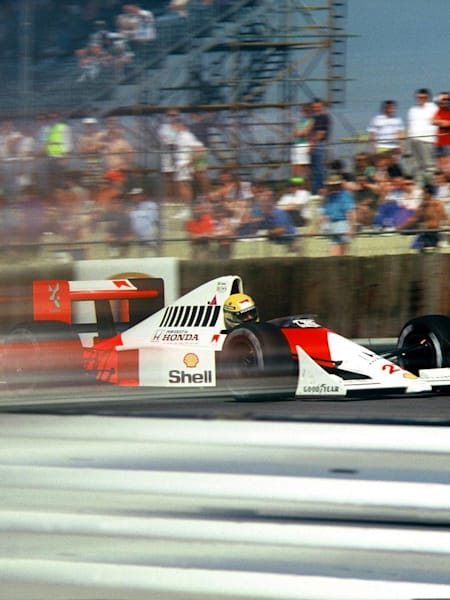
F1
Take a peek through the lens of Miguel Costa Jr.
A look at some of the best work of the Brazilian photographer, who's been working in the industry for more than 30 years. If you like motorsports you need to know Miguel Costa Jr.
Being part of motor racing for more than three decades, Miguel has photographed all the championships and the greatest idols of the sport.
"I think that a motorsports picture must show exactly what you see when you are at the race track: a lot of speed and colours. So that is what I try to do with my work. I try to record everything I see, to bring some feeling into the pictures," says Costa Jr.
And the results are simply spectacular.

David Coulthard
© Miguel Costa Jr.

The brakes are smoking!
© Miguel Costa Jr.

Felipe Massa
© Miguel Costa Jr.

Rally Dakar 2000
© Miguel Costa Jr.
But what came first? The passion for photography or for motorsports? Miguel doesn't know how to best answer that question.
Both things came together. I realised that I had my own style and started trying to work in motorsports. I'm kind of self-taught and only did something academic when I was already a professional photographer. And I keep it that way: studying, always trying to improve my skill set.
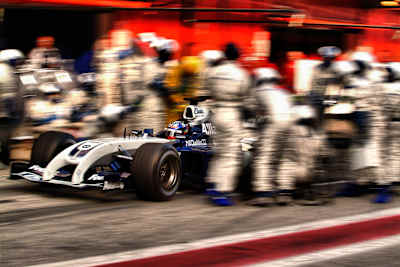
Montoya performs a pit-stop in Spain 2004
© Miguel Costa Jr.
This photo above is one of his favourites. It's of a pit stop on the Barcelona circuit in Spain.
But how to show speed in a picture when the car is actually stopped? Miguel chose to bring clarity to the car and leave the mechanics blurred around, giving enough ‘speed’ for that click.
Another of his favourites is the below image, captured during the night at the 24 Hours of Le Mans.
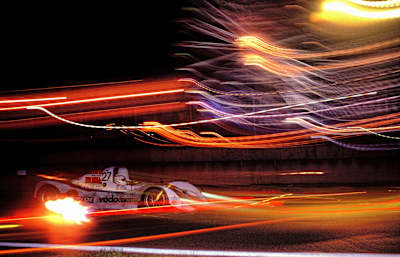
Le Mans looks really stunning at night
© Miguel Costa Jr.
"On the side of the circuit there's a playground and at night it's all lit up there," explains Miguel. "To me that's a fascination, because you have a lot of light elements to use and in photography light is the most important thing."
Of course, photographing racing cars so closely has also caused some scary moments for Miguel Costa Jr.
The biggest one also came up at a Le Mans race. During the 24 Hours of Le Mans, Mercedes cars had an aerodynamic issue that year, causing some jumps around the circuit, sometimes with all fours wheels in the air.
It was a ticking time bomb going around at speeds in excess of 300 kph.
Can you believe it, one these ‘bombs’ exploded right in front of Miguel's camera?
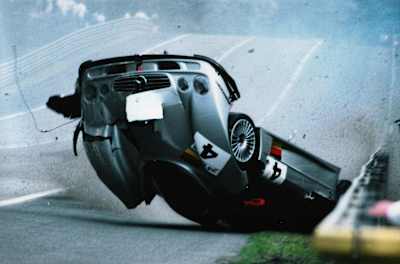
Webber crash at Le Mans' 99
© Miguel Costa Jr.
"It was Mark Webber driving," Costa Jr. explains. "As he started down the straight, the car took off at a speed of more than 300 kph. When I saw what was going on, I set everything fast and started to click as the car was flipping, flying and crashing."
"When it came down – and it was prototype, those cars are giants – the front hit the ground. It came towards me like a meteor. I got down behind the guard rail and heard the noise. I thought: 'well, it has passed'. I got up and continued photographing. Just then I just felt my legs shaking and thought to myself, 'had he crossed onto the other side of the guard-rail, the story would've been really different for me.'"
Like any artistic profession, photography also requires a lot of patience and a lot of effort to build a fruitful career.
"You must have perseverance, you must like what you do. Photography for me is my profession, it's the thing that has brought me here; good or bad, I survive on it, and it's still my passion. I'm in love [with it]," explains the Brazilian.
