

Explore the latest football content
How do college football conferences work?
Learn how college football conferences work, why they matter and how they shape the season.
Part of this story



College football is made up of hundreds of teams, but what really organizes the chaos are its conferences.
College football is made up of hundreds of teams across the United States, and what organizes all that competition is the conference system. Each college football conference groups teams together based on region, history, or institutional alignment, giving structure to scheduling, rivalries, and postseason qualification.
There are multiple NCAA football conferences across different college divisions, all of which follow NCAA guidelines while managing their own competition formats. At the highest level is the NCAA Division I Football Bowl Subdivision (FBS). Conferences like the SEC, Big Ten, ACC and Big 12 feature powerhouse programs and elite athletes.

Jeremiah Smith poses for a portrait in Columbus, Ohio
© Maggie Zerbe / Red Bull Content Pool
For example, Jeremiah Smith, a star wide receiver for Ohio State football, competes in the Big Ten Conference, one of the top conferences in college football. Meanwhile, Arch Manning, a highly ranked quarterback for the Texas Longhorns, plays in the SEC (Southeastern Conference), another powerhouse in college football. Both athletes are part of top divisions that face high-level competition every week.

Beyond the FBS, college football includes several other levels, such as the FCS (Football Championship Subdivision), which is also part of Division I. Other levels include Division II, Division III, the NAIA and the NJCAA, each with its own conferences and championship formats.
01
College football divisions explained: number of conferences
Level / Division
Number of Conferences
FBS (Division I)
10
FCS (Division I)
13
Division II
16
Division III
27
NAIA
9
JUCO (NJCAA)
4
For this article, let's focus on breaking down Division I – FBS and FCS conferences and teams.
02
FBS
It’s the top tier of NCAA Division I football and includes the largest schools with the biggest budgets, stadiums and TV contracts. There are a total of 134 teams in the FBS.
The Football Bowl Subdivision (FBS) is the highest level of NCAA Division I football, featuring the largest schools, biggest budgets, and most nationally recognized programs.
The FBS decides its national champion through a 12-team playoff called the College Football Playoff (CFP). After the regular season and conference championships, a committee picks the top 12 teams. The top four teams get a first-round bye, and the others play in win-or-go-home games. The last two teams face off in the national championship game and the winner becomes the FBS champion.

Arch Manning
© Red Bull Content Pool
There are a total of 10 FBS conferences.
Power Conferences (biggest and most competitive):


- Big Ten – 18 teams: Illinois, Indiana, Iowa, Maryland, Michigan, Michigan State, Minnesota, Nebraska, Northwestern, Ohio State, Oregon, Penn State, Purdue, Rutgers, UCLA, USC, Washington, Wisconsin
- SEC (Southeastern Conference) – 16 teams: Alabama, Arkansas, Auburn, Florida, Georgia, Kentucky, LSU, Mississippi State, Missouri, Oklahoma, Ole Miss, South Carolina, Tennessee, Texas, Texas A&M, Vanderbilt
- ACC (Atlantic Coast Conference) – 17 teams: Boston College, California, Clemson, Duke, Florida State, Georgia Tech, Louisville, Miami (FL), NC State, North Carolina, Pittsburgh, SMU, Stanford, Syracuse, Virginia, Virginia Tech, Wake Forest
- Big 12 – 16 teams: Arizona, Arizona State, Baylor, BYU, Cincinnati, Colorado, Houston, Iowa State, Kansas, Kansas State, Oklahoma State, TCU, Texas Tech, UCF, Utah, West Virginia
- American Athletic Conference (AAC) – 14 teams: Army, Charlotte, East Carolina, Florida Atlantic, Memphis, Navy, North Texas, Rice, South Florida, Temple, Tulane, Tulsa, UAB, UTSA
- Conference USA (C‑USA) – 12 teams: Delaware, FIU, Jacksonville State, Kennesaw State, Liberty, Louisiana Tech, Middle Tennessee, Missouri State, New Mexico State, Sam Houston, UTEP, Western Kentucky
- Mid-American Conference (MAC) – 13 teams: Akron, Ball State, Bowling Green, Buffalo, Central Michigan, Eastern Michigan, Kent State, UMass, Miami (OH), Ohio, Northern Illinois, Toledo, Western Michigan
- Mountain West Conference (MWC) – 12 teams: Air Force, Boise State, Colorado State, Fresno State, Hawaiʻi, Nevada, New Mexico, San José State, UNLV, Utah State, UTEP, Wyoming
- Sun Belt Conference – 14 teams: Appalachian State, Arkansas State, Coastal Carolina, Georgia Southern, Georgia State, James Madison, Louisiana, Marshall, Old Dominion, South Alabama, Southern Miss, Texas State, Troy, ULM
- Pac‑12 Conference (full rebuild and expansion planned for 2026) – Currently only includes: Oregon State, Washington State
Note: Numbers 5-10 are still FBS-level but have smaller budgets and less national exposure.
FBS Independents – Notre Dame and UConn: These are individual teams that operate outside the normal conference structure.
03
FCS
The Football Championship Subdivision (FCS) is the second tier of Division I and consists of smaller programs that still compete at a high level, organized into multiple FCS football conferences across the country. There are 128 teams in the FCS.
The FCS picks its national champion through a 24-team playoff. Ten teams get in by winning their conferences and 14 more are chosen based on how well they have played. The top eight teams skip the first round. The rest play knockout games until two teams are left, and the winner of the final game is the FCS champion.
There are 13 conferences in FCS football:
- Big Sky – 12 teams: Montana, Montana State, Eastern Washington, Weber State , Idaho, UC Davis, Northern Arizona, Sacramento State, Cal Poly, Idaho State, Portland State, Northern Colorado
- Big South–OVC Football Association – 9 teams: Gardner-Webb, Charleston Southern, Southeast Missouri State, Eastern Illinois, UT Martin, Tennessee State, Tennessee Tech, Lindenwood, Western Illinois
- CAA Football – 14 teams: Villanova, William & Mary, Albany, Rhode Island, Elon, New Hampshire, Campbell, Maine, Towson, Monmouth, Stony Brook, Hampton, North Carolina A&T, Bryant
- Ivy League – 8 teams: Harvard, Yale, Princeton, Penn, Dartmouth, Columbia, Cornell, Brown
- MEAC (Mid-Eastern Athletic Conference) – 6 teams: Howard, South Carolina State, North Carolina, Central Norfolk State, Morgan State, Delaware State
- Missouri Valley Football Conference (MVFC) – 10 teams : South Dakota State, North Dakota State, Northern Iowa, Illinois State, Indiana State, South Dakota, North Dakota, Southern Illinois, Youngstown State, Murray State
- Northeast Conference (NEC) – 8 teams: Duquesne, Central Connecticut State, LIU (Long Island), Saint Francis (PA), Wagner, Stonehill, Mercyhurst (transitioning), Robert Morris
- Patriot League – 8 teams: Holy Cross, Fordham, Bucknell, Colgate, Lafayette, Lehigh, Georgetown, Richmond
- Pioneer Football League – 11 teams: St. Thomas (MN), Davidson, Dayton, Butler, Drake, Marist, Morehead State, Presbyterian, San Diego, Stetson, Valparaiso
- SoCon (Southern Conference) – 9 teams: Furman, Chattanooga, Samford, Mercer, Wofford, Western Carolina, ETSU (East Tennessee State), VMI, The Citadel
- Southland Conference – 10 teams: Incarnate Word, Lamar, McNeese, Nicholls, Northwestern State, Southeastern Louisiana, Stephen F. Austin, Texas A&M–Commerce, Houston Christian, UTRGV (new in 2025)
- SWAC (Southwestern Athletic Conference) – 12 teams: Jackson State, Grambling State, Florida A&M, Southern, Prairie View A&M, Alabama A&M, Alabama State, Texas Southern, Alcorn State, Mississippi Valley State, Arkansas–Pine Bluff, Bethune–Cookman
- United Athletic Conference (UAC) – new merger of WAC and ASUN – 9 teams: Abilene Christian, Austin Peay, Central Arkansas, Eastern Kentucky, North Alabama, Southern Utah, Tarleton State, Utah Tech, West Georgia (new in 2025)
FCS Independents – Merrimack and Sacred Heart: Like the FBS Independents, these are also individual teams that do not participate in a conference schedule and arrange opponents independently.
04
More than Division I
While Division I football gets the spotlight, Divisions II and III also play a major role in college football. Division II has 16 conferences and features a mix of football-only and all-sport conferences, offering competitive play with partial scholarships.
Division III emphasizes academics and participation, with over 25 conferences sponsoring football and no athletic scholarships. These divisions may not get national TV and media coverage, but they have loyal fans, deep-rooted traditions and great chances for student-athletes to grow and compete.
Separate from the NCAA, the NAIA is a college sports group for smaller schools. It has one level of football with about 90 teams. These teams play in conferences and compete in a 16-team playoff to decide the national champion. NAIA schools are smaller and give fewer scholarships, but still offer good chances for athletes.
JUCO football is played at two-year colleges in the NJCAA (National Junior College Athletic Association). It helps athletes improve and get ready to transfer to four-year schools. There's only one level (division) for football, and teams compete in a playoff to win the national championship. Many players use JUCO football to earn scholarships or move up to bigger college programs.
05
Ready for college football Saturdays
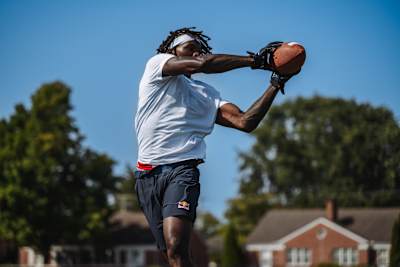
Jeremiah Smith runs a route during training in Columbus, Ohio
© Nick Brown / Red Bull Content Pool
College football conferences can seem overwhelming at first, but understanding them is key to following (and enjoying) the sport. From powerhouse programs in the SEC and Big Ten to competitive FCS leagues across the country, each conference plays a different role in shaping rivalries, rankings and postseason play. Whether you're a casual fan or new and trying to get into the sport, knowing how college football is structured can make every Saturday more exciting.

Part of this story