
Explore the latest football content
College football vs. NFL: What are the key rule differences?
College football and the NFL may look similar, but the rules aren’t. Here are the top differences every fan should know.
Part of this story




College football and the NFL share the same basic structure, but there are some important rule differences that set them apart. From how overtime works to where the ball is placed on the field, these changes affect everything from strategy to game flow.
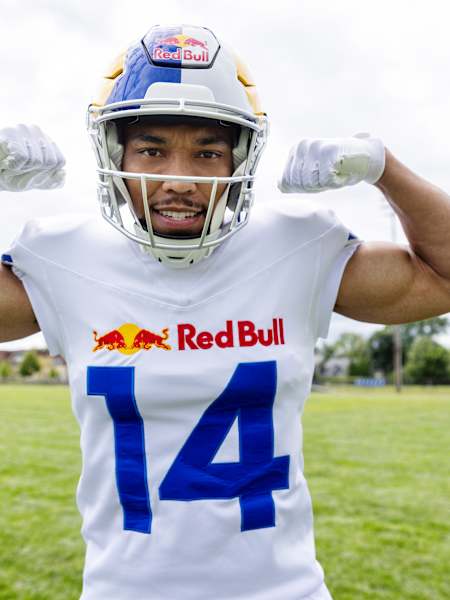
These differences matter for players like college football stars Jeremiah Smith and Arch Manning, who are currently in the college game now and have high potential to be in the NFL in the future. NFL stars like Amon-Ra St. Brown had already made the jump and had to adjust to the professional game.
Whether you're a fan, a player, or just curious about the transition from college to the pros, understanding the top differences between college football and the NFL can give you a better appreciation for both levels of the game.

Each level of football operates under its own unique set of guidelines. Below are some major differences between college football and the NFL, from game play, game length to player eligibility.


Amon-Ra St. Brown, the Detroit Lions wide receiver
© Robert Snow

Jeremiah Smith runs a route in Columbus, Ohio, USA
© Nick Brown / Red Bull Content Pool

Arch Manning
© Red Bull Content Pool
01
Gameplay and On-Field Rules
The gameplay and on-field rules between the NFL and college football have a few notable differences that impact how the game is played.
When it comes to overtime, the NFL uses a modified sudden death system, where each team gets a chance to possess the ball unless the first team scores a touchdown. College football, on the other hand, gives each team a possession starting at the opponent’s 25-yard line, continuing until a winner is determined, with no game clock during overtime.
In terms of downs, NFL players must be touched by an opponent after falling to be considered down, while in college football, a player is ruled down as soon as any part of the body—other than the hands or feet—touches the ground, regardless of contact.
The catch rule is also more lenient in college: only one foot in bounds is needed for a legal catch, whereas the NFL requires two feet.
Pass interference penalties are more severe in the NFL, where the ball is placed at the spot of the foul. In college, pass interference results in a 15-yard penalty no matter where the foul occurs. Another key difference is that in college, the game clock stops temporarily after a first down to allow for the chain crew to reset, giving offenses more time. In the NFL, the clock continues running in most cases.
Hash marks (the lines where the ball is placed) are wider in college, which makes kicks and some plays more difficult. The NFL’s are closer together.
02
Timing and Game Length

Amon-Ra St. Brown
© Robert Snow
Both the NFL and college football have four 15-minute quarters, but there are differences in how the clock and timing rules work. One of the biggest is the two-minute warning, which exists only in the NFL. It automatically stops the clock at the two-minute mark of each half, giving teams a chance for a strategic pause. This rule doesn’t exist in college football.
Also, halftime is shorter in the NFL (12 minutes) compared to college (20 minutes).
The play clock in both leagues is usually 40 seconds, but in college it can drop to 25 seconds after certain plays, like timeouts or penalties.
In overtime, the NFL gives each team one possession unless the first team scores a touchdown, then it becomes sudden death. In college, each team starts at the opponent’s 25-yard line and keeps alternating possessions until there's a winner, with no game clock during overtime.
There is no game clock in college overtime, and teams alternate possessions until a winner is determined. Starting in the third overtime, teams must attempt two-point conversions instead of extra points.
Additionally, college football stops the clock after first downs to reset the chains, giving teams more time and chances for comebacks. The NFL doesn't stop the clock for first downs, except in certain cases like incomplete passes or when a player goes out of bounds.
In terms of length, the NFL season is about five months long, with 17 games over 18 weeks and playoffs ending in the Super Bowl in February. College football lasts around four and a half months, with 12 regular-season games, conference championships, and bowl games or playoffs ending in January.
03
Player Eligibility and Substitutions

Arch Manning training in Austin, Texas
© Justen Williams
To play in the NFL, players must be at least three years out of high school. In college football, players need to be enrolled in school, meet academic standards and have a limited number of years to play (usually five years to play four seasons).
When it comes to substitutions, both NFL and college teams can substitute freely between plays. But college football is more strict when it comes to substitution timing. If the offense substitutes players, the defense has to be given time to match those substitutions before the snap.
College football has a special targeting rule to protect players from dangerous hits. If a player hits someone in the head or neck with their helmet, they can be ejected from the game. The NFL doesn’t have a separate targeting rule, but similar hits are penalized under personal foul rules and can result in fines or suspensions after review.
For replay reviews, NFL coaches can challenge plays (usually up to two times per game). In college, coaches can’t challenge. Instead, all reviews are handled by officials in the booth.
04
Other differences between College football and NFL
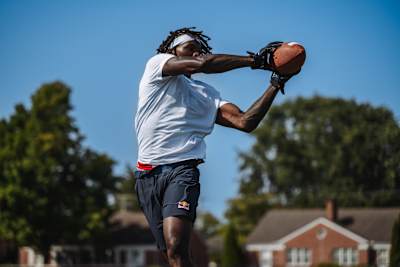
Jeremiah Smith runs a route during training in Columbus, Ohio
© Nick Brown / Red Bull Content Pool
On kickoffs, a fair catch inside the 25-yard line in college results in a touchback, placing the ball at the 25, while in the NFL, a touchback only occurs if the ball reaches the end zone. Additionally, defensive holding in the NFL results in a 5-yard penalty and an automatic first down, whereas in college, it’s a 10-yard penalty without an automatic first down.
NFL teams have a 53-man roster during the regular season, with only 48 players allowed to dress and play on game day, plus up to 16 on the practice squad, totaling around 69 players. In college football, teams can have much larger rosters, typically with 85 scholarship players and often over 100 total when including walk-ons. However, only about 70 players usually travel for away games, depending on conference rules.
While college football and the NFL share the same core game, the differences in rules create two distinct experiences for players and fans. Understanding these key changes helps explain why transitioning from college to the pros requires more than just talent; it also demands adaptability. Whether you're watching Saturdays or Sundays, knowing the rule differences adds a new layer of appreciation to the game.
Part of this story