
DTM
We're totally ready for the start of the new era of DTM
Great news for fans of DTM German Touring Car racing: the most popular tin-top series in Europe is back and begins a new era on June 18-20 at legendary Autodromo di Monza.
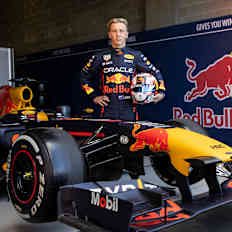

Back in business: Red Bull
Red Bull re-enter DTM as partners of Piacenza-based squadra AF Corse of owner and MD Amato Ferrari (no relation to Enzo Ferrari and his family). The team scored a number of victories and titles in the World Endurance Championship (including the Le Mans 24 hours), the former GT1 World Championship and several GT3 series. The car entered is the stunning 488 GT3 Evo, first introduced in 2016 and having scored 355 race wins and 91 championships to date.
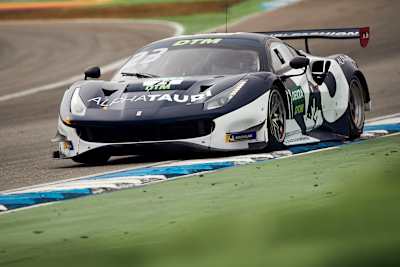
Alex Albon in the stunning Ferrari 488 GT3 in AlphaTauri colours
© Julian Kroehl/Red Bull Content Pool
“This challenge was begun by Gerhard Berger, it was his idea. It did not take us too long to find an agreement with Red Bull. We look forward to entering DTM with a lot of enthusiasm. Our target is very clear: winning,” says Amato.

Lawson won the 2019 Toyota Racing series in his native New Zealand. “GT racing is very new to me”, says the driver who currently sits in eighth place in F2, “but I am hugely happy with this opportunity to prove myself in a high-class series and to compete with experienced drivers such as Alex.” The Toyota series proved to be an excellent development championship for young hopefuls: Among its previous winners are Mitch Evans (now Jaguar Racing’s Formula E championship contender), Nick Cassidy (Japanese Super Formula champion now in FE and DTM), Lance Stroll (Aston Martin’s F1 driver) and Robert Shwartzman (now Lawson’s opponent in F2).
Albon, who was born in London and holds British and Thai citizenship and a Thai racing licence, says: “DTM is an outstanding series with a lot of talented drivers and exciting racing. These cars are totally different to single-seaters I was used to race. The last time I raced tin-tops was in 2015 when I was nominated for the Autosport BRDC Young Driver Award. We have a lot less downforce and have to keep up with the tyre management which demands a different driving style. It will take some time to adjust but I am looking forward to this challenge.”
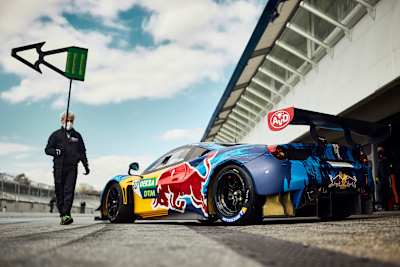
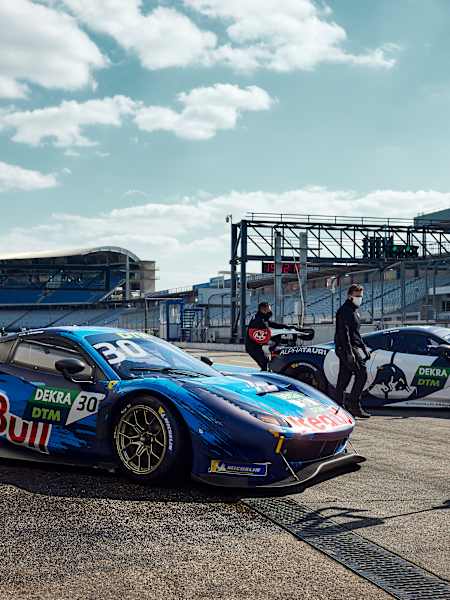
Liam Lawson's DTM car is a Ferrari 488 GT3 Evo in Red Bull colours
© Julian Kroehl/Red Bull Content Pool
The story so far
The original DTM succeeded the Deutsche Rennsport Meisterschaft from 1984 to 1996 (including the final stage as ITC) and was re-invented in 2000 as the German Touring Car Masters (but still widely known as “DTM”). It was conceived as a manufacturers series and involved Audi, Opel (until 2005), BMW (from 2012) and Mercedes-Benz (until 2018). In 2019, Aston Martin Vantages were raced by R Motorsport (St. Gallen/Switzerland) under licence from the manufacturer. However, Audi and BMW announced they were leaving DTM at the end of 2020. This also meant the end of the short-lived Class 1 cars (two-litre, four-cylinder turbos, 650hp, front engine, rear-wheel drive) which were conceived in 2014 but were only introduced in 2019.
Thanks to the vision of DTM boss Gerhard Berger, DTM is now revived on basis of GT3 regulations which are more affordable for privateer teams. “Now as the sport takes over, everything is different compared with the long months of preparations and the tough job to set the series up. What makes me especially happy is the fact we could keep an exceptional team together”, the Austrian explains. And he doesn't try to hide his satisfaction: “We got the best drivers and the best teams with the support of six manufacturers. The new rules based on GT3 cars was the only reasonable solution to keep DTM alive”.
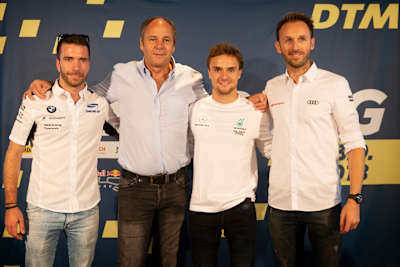
DTM is masterminded by ex-F1 star Gerhard Berger (centre)
© Philipp Carl Riedl/Red Bull Content Pool
The Magic of GT3
The biggest difference to Class 1 cars is that GT3 cars are based on series production sports cars, making them easily recognisable to fans. GT3 cars are heavier than Class 1 (weighing 1300 kilos vs 1000). In GT3, drivers can rely on traction control, ABS and steel brakes (whereas carbon brakes in Class 1). Another difference is the much lower downforce of GT3 cars which demands more skill of the drivers. At around 550hp, the cars are now some 100hp below Class 1. Philipp Eng, former DTM race winner and one of the most experienced GT3 drivers, estimates lap times at Hockenheim will be slightly slower than in Class 1 because GT3 cars don't have the carbon fibre monocoque typical on a Class 1 car.


The rules: What stays the same and what’s new?
The traditional standing start will be replaced by an Indy style rolling start. The race will last 55 minutes plus one lap and feature one mandatory pit stop for tyre changes, with only six mechanics allowed to work two wheel guns. However, for the first weekend at Monza the race time will be reduced to 50 minutes due to the high-speed configuration of the track and its higher fuel consumption. To even up the field in terms of power, a balance of performance (bop) – or handicapping system – will be adopted, including additional weight for the three podium finishers of the race before (25, 18 and 15 kilos – just as with the points system).
The drivers: A great mix of talent
The class of ’21 has a lot to offer: two drivers with F1 racing experience Albon, Timo Glock), three former DTM champs (Gary Paffett, Mike Rockenfeller, Wittmann) and 11 nationalities. There are two female drivers: F3 graduate Sophia Flörsch (20) from Munich who will race an Abt Audi, and Esmee Hawkey (23) from the UK who comes out of winning the Pro-Am category in the British Porsche Carrera Cup last year and raced in the inaugural W Series previously. Paffett however won't be participating in the first two events due to a clash of commitments in ABB Formula E.
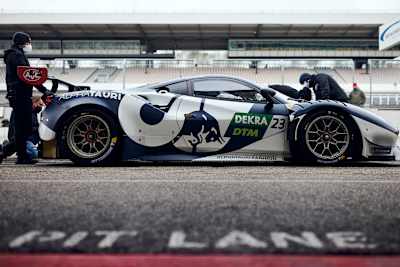
Red Bull, Ferrari and AlphaTauri are Ready for DTM action
© Julian Kroehl/Red Bull Content Pool
Elite manufacturers
Twelve teams will field cars from six manufacturers: Audi, BMW, Ferrari, Lamborghini, McLaren (selected races) and Mercedes.
The tracks: Eight in five countries
- June 18-20: Monza, Italy – hosting DTM for the first time and becoming the 40th track to appear in the series.
- July 23-25: Lausitzring, Germany
- August 6-8: Zolder, Belgium
- August 20-22: Nürburgring, Germany
- September 3-5: Red Bull Ring, Spielberg, Austria
- September 17-19: Assen, The Netherlands
- October 1-3: Hockenheim, Germany
- Postponed: Norisring Nuremberg, Germany
Five pillars of support
The new DTM will offer a broad support programme. DTM Trophy is a junior series for young drivers who want to step up. DTM Electric will feature future-conscious touring car racing. DTM Classic will showcase former cars of glorious times. And gaming fans will be entertained by DTM Esports. “Racing is in a transition period, as is the whole industry. That’s why we put diversity into effect with an offer for a responsible and innovative future”, adds Gerhard Berger.