






Red Bull Motorsports
F1
F1 vs F2: what’s the difference?
Ever wondered what sets these two championships apart? From the construction of the cars to the format of the season, we explain the major differences.
Considered to be the pinnacle of motorsport, Formula One has amassed a huge global fanbase thanks to its enthralling mix of high-octane action and sporting drama. Merging cutting-edge technology with a sense of glamour and spectacle, it has spawned successful TV shows and movies.
Despite its appeal and success, even the most ardent followers of the sport may struggle to explain the difference between Formula One and Formula Two. Some may know that F2 is seen as a stepping stone to F1, but most would be surprised to learn that Oracle Red Bull Racing’s four-time F1 world champion, Max Verstappen, did not even race in F2.
This article will help explain the main differences between the two championships, from the construction of the cars to the format of the season and the driver experience.
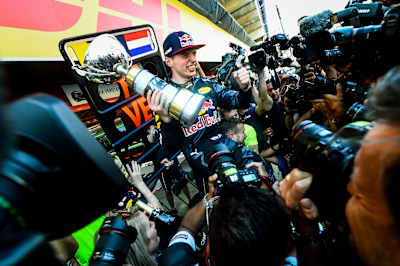
Max after his first F1 race win at the Spanish Formula One Grand Prix 2016
© Getty Images / Red Bull Content Pool
01
F1 vs F2 Cars
Build
In F1, every racing team is responsible for building their own cars, with the teams being named after the manufacturers who built the chassis and/or the engine. In 2021, in an effort to make the playing field more even and more competitive, F1 introduced a cost cap of $153 million. This means the maximum budget a team can spend on all parts of the car, and all the elements needed to run it. The cap was decreased to $151 million for the 2023-2025 seasons and has been raised to around $212 million for 2026.

Max Verstappen driving on track during the F1 Grand Prix of Bahrain
© Getty Images / Red Bull Content Pool

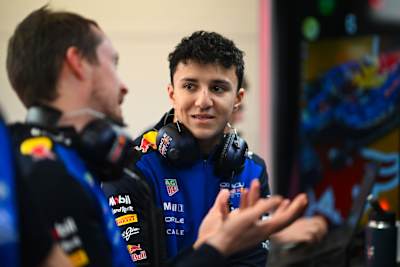
Liam Lawson impressed in F2 before joining Visa Cash App Racing
© Getty Images/Red Bull Content Pool
In F2, all the cars are the same, from the chassis (built by Italian race car manufacturer Dallara) to the gearbox (built by English manufacturer Hewland). This is to showcase the drivers’ true skill sets behind the wheel rather than the abilities of the racing teams to build superior cars.
Weight
F1 cars weigh about 1,759 lbs with the driver.
F2 cars weigh about 1,664 lbs with the driver, meaning they are slightly lighter.
Engines & Speed
The engines in F1 cars are much more powerful than the ones in F2 cars. F1 engines have about 1000 horsepower, while F2 cars max out at around 620 hp. This allows F1 cars to go faster than their second-tier counterparts, about 10-15 mph faster on average. The top race speed for a F1 car is over 230 mph, while the top speed for a F2 car is less than 200 mph.
02
F1 vs F2 Formats
The racing formats between the two series have their differences, from the structure of the race weekends to the configuration of the seasons.
Race Weekends
Most F1 race weekends feature three practice sessions (Friday morning, Friday afternoon/evening, and Saturday morning) and three qualifying periods (all on Saturday after the third practice session). The race is held on Sunday.
However, throughout the season, there are also six sprint weekends where additional points are on offer. During a sprint weekend, there's only one practice session, then a traditional qualifying session held on Friday to establish the starting field for the sprint. The sprint is then held on the Saturday, along with qualifying for the main feature race.

Red Bull Junior Team's Nikola Tsolov will be racing in F2 for Campos Racing
© Ivaylo Donchev/Red Bull Content Pool
F2 uses a qualifying format very similar to F1’s sprint qualifying format for all of its race weekends, but there are two main differences.
- F2 races use the results from the Friday qualifying session to set its starting grid for the main race on Sunday; the Saturday sprint race is instead used as a standalone event for drivers and teams to earn points.
- The starting grid for a F2 Saturday sprint race is based on the results from the Friday qualifying session with positions 1-10 being inverted (1st in qualifying starts at P10, 2nd starts at P9, etc.) and positions 11-22 remaining the same.
Length
F1 and F2 host their races at the same track on the same day, with F2 racing first.
Since F2 races are run earlier in the day than F1 races, they are much shorter in comparison. F2 races are run for either an hour or roughly 105 miles, whichever one comes first. F1 races are run for a minimum of 190 miles, the lone exception being the Monaco Grand Prix.
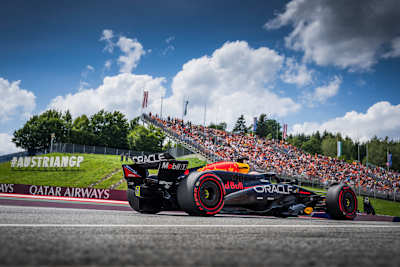
F1 and F2 races share the same event dates and locations
© Philip Platzer/Red Bull Ring
While every F2 race is held before a F1 race, the two series don’t share every single weekend. Last season, the F2 season was only 14 races long, meaning that there were eight F1 race weekends that did not feature F2.
Points system
The points systems for the driver and team standings between Formula One and Formula Two are very similar, but not identical.
The scoring system for the main races in both F1 and F2 are the same. This is how it works:
- 1st place: 25 points
- 2nd place: 18 points
- 3rd place: 15 points
- 4th place: 12 points
- 5th place: 10 points
- 6th place: 8 points
- 7th place: 6 points
- 8th place: 4 points
- 9th place: 2 points
- 10th place: 1 point
- 11th-20th place: 0 points
However, this is where the two points systems start to divide. With F1, one point is added to the driver with the fastest lap if that driver finishes in the top 10 of that race.
Oracle Red Bull Racing's Isack Hadjar excelled in F1 in 2024
© Getty Images
If there is sprint qualifying, eight points are given to the sprint winner, with every position behind them receiving one fewer point. Positions 9 through 20 gain no points.
In F2 however, things are a bit different. It rewards drivers with a point each for the fastest lap in the main race and/or in the sprint race if that driver finishes in the top ten of that race. F2 also awards two points to the driver who qualifies in pole position from Friday’s qualifying session.
The points system for sprint qualifying is also different in F2. Ten points are given to the sprint winner and eight points are awarded to second place. Third place receives six points and every position behind third receives one fewer point, with positions nine through 22 receiving no points.
This means that the maximum number of points a F2 driver can win on a given race weekend is 39:
- 25 points from winning the main race
- 10 from winning the sprint race
- 2 from qualifying in the pole position
- 1 point for getting the fastest lap in the sprint race
- 1 point for getting the fastest lap in the main race
03
F1 vs F2: the drivers
For anyone who competes in formula racing, the pinnacle of the sport is F1. Therefore, those currently racing in F1 have already reached the highest level and the only dream left to achieve is becoming world champion – or in Verstappen's case, adding to his tally of four titles.
Those competing in F2 see the series as a stepping stone to bigger things, with a seat in F1 being the ultimate goal. Many drivers have graduated to Formula One after a successful season in Formula Two, including Ferrari's Charles LeClerc, Mercedes' George Russell and current Visa Cash App Racing Bulls driver Liam Lawson.
F2 is currently loaded with talent, including rising Bulgarian star Nikola Tsolov, who is a member of the Red Bull Junior Team.
