
Explore the latest football content
Football workout plan: Build strength, speed and agility
Unlock your full potential on the field with a football workout plan that elevates your strength, speed, agility, and more.
Professional football players shape their workout plans based on the muscles most important to what they do on the field. For example, quarterbacks need arm strength to throw effective passes. For wide receivers like Jeremiah Smith, agility drills are key to be quick and nimble.
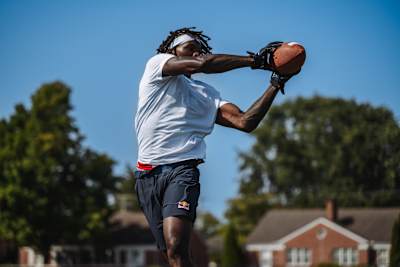
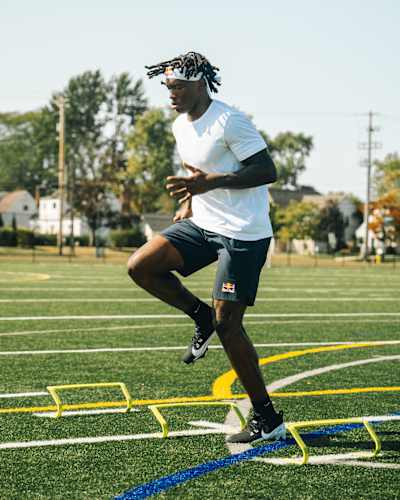
Jeremiah Smith runs a route during training in Columbus, Ohio
© Nick Brown / Red Bull Content Pool
Although a well-rounded football workout plan will include exercises and stretches for strength, speed, agility, endurance, conditioning, and recovery, it should be adapted to the position an athlete plays. Read on for a comprehensive football workout plan that can be adjusted for top-notch on-field performance in any position.
01
Key components of a football workout plan
Strength and power training
Football strength and power is a full-body affair with full-body results. Some coaches encourage weight lifting since footballers with larger, more flexible muscles, tendons, and ligaments can move more weight. Naturally, an athlete who can move more weight will be an all-star tackler — and they’ll be heavier, making them great at blocking.
Great tacklers also need to leap forward forcefully to reach their targets, so a football explosive power workout is necessary too. If anything, football is overall an explosive sport since most plays max out at just 20 seconds. That’s why the best athletes have mastered the art of exerting immense power and strength, then resting, then doing it all over again.


Another reason for strength and power exercises: When football players apply more force to the ground while running, they’ll go faster.
Speed and agility drills
A player’s jaw-dropping ability to quickly pivot in a new direction comes from football agility drills. These exercises are also part (not all) of how these athletes master speed. Common speed exercises in a workout plan for football players include cone drills, ladder drills, shuttle runs, and short but fast sprints.
Endurance and conditioning
Where strength training builds muscle, conditioning focuses on maintaining a fast heart rate. Since footballers spend hours on the field and constantly switch between short bursts of rapid movement and complete rest, conditioning is paramount to great performance. So too is endurance, which is the term for doing something intense for as long as possible. If conditioning is how athletes go back and forth from action to rest, endurance is how they get through the whole game.
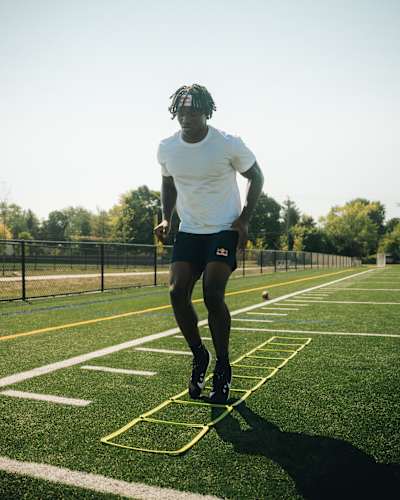
Jeremiah Smith trains in Columbus, Ohio
© Nick Brown / Red Bull Content Pool
High-intensity interval training (HIIT) sprints are often a part of football athlete training since they develop endurance. Wide receivers like Jeremiah Smith might do cone drills with sprint intervals for stamina, whereas linemen might instead opt for sled pushes when focusing on stamina.
Mobility and flexibility exercises
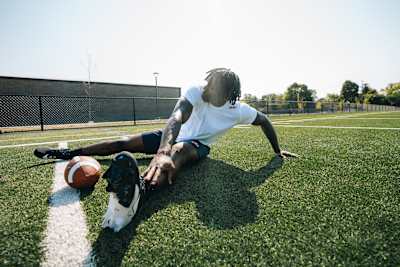
Across sports, mobility and flexibility exercises — namely, stretches — are widely associated with injury prevention. Within football, regularly stretching the hip flexor and hip adductor muscles is especially important. Frequent stretching increases flexibility, enabling footballers to play low, move powerfully, and quickly change direction. (“Playing low” means properly bending at the hips and rotating at the ankles for agility and leverage.)
Dynamic stretching is ideal for football players, and yoga poses can help too. Additionally, for some athletes, foam rolling stretches can help relieve pain, so mobility and flexibility exercises may be associated with injury recovery, not just prevention.
02
Sample weekly football workout plan
Below is an example of a sample weekly football workout plan. Modify it based on positions and what might work best for you.
Day 1: strength and power (upper body)
1. Bench press (4 sets x 4 to 6 reps)
- At a bench press station, place the barbell on the rack.
- Grab the barbell using a shoulder-width outside-overhand grip.
- With an arched back and squeezed shoulder blades, move your body under the barbell, keeping your back flat on the bench (though still arched).
- Bring the barbell to the upper chest and lower it in a controlled, gradual manner.
- Push the barbell back up to its starting point, flaring your elbows to reach the top, in an explosive but controlled manner.
- Once the set is complete, return the barbell to the rack.
2. Dumbbell rows (3 sets x 6 to 8 reps)
- Grip one dumbbell in one hand and no weight in the other hand. Alternatively, grip one dumbbell of equal weight in each hand.
- If standing, bend forward at the hips so that the torso is in line with the floor, arching the lower back.
- If using a bench, place one knee on the bench, holding the dumbbell in the opposite hand. Then, bend forward at the hips so the torso is in line with the floor. Arch the lower back.
- Using the core for stability and the back muscles to pull, bring the dumbbell upward toward your torso in an explosive but controlled manner.
- Return to the starting position in a controlled, gradual manner.
3. Seated overhead press (3 sets x 6 reps)
- At a power rack station, adjust the bench to seated position.
- Place the feet shoulder-width apart, and hold the barbell at slightly wider than shoulder width.
- With the shoulder blades squeezed together and chest pushed out, press the barbell overhead and just a bit backward. Do so in an explosive but controlled manner.
- Once the barbell is aligned with the back of the head at the top of this movement, return to the starting position in a gradual, controlled manner.
4. Tricep dips (3 sets x 8 reps)
- Hold onto dip bars with palms facing inward and arms straightened. If using a machine that allows for adjustable height, start with the hands just above mid-thigh.
- In a gradual, controlled manner, descend downward until the upper arm is parallel to the floor. Keep the elbows aligned with the torso.
- In an explosive, controlled movement, return to the starting position.
Day 2: speed and agility drills
1. Agility ladder drills (3 sets x 1 rep per side)
- Place a hexagonal exercise ladder on the floor.
- Stand at the bottom left edge of the farthest-out hexagon.
- Run sideways through each hexagon, landing the feet in each hexagon one time each. Bring the knees as high as possible throughout.
- Once all hexagons are cleared, repeat the exercise in the other direction. This completes a rep.
2. 5-cone drills (3 sets x 1 rep)
- Create a box out of four cones placed five yards apart. In the middle of the box, add a fifth cone.
- Move to the bottom-right cone and take a three-point stance (football starting stance).
- Sprint toward the center cone, then the top right cone, then top left, then middle again, then bottom left.
3. 6-cone drills (3 sets x 1 rep)
- Create a line out of six cones placed five yards apart.
- Take a three-point stance at the first cone in the line.
- Sprint to the second cone, then run backward to the starting point.
- Sprint to the third cone, then run backward to the starting point. Repeat this pattern for all the remaining cones.
4. 4-cone drill (3 sets x 1 rep)
- Create a box out of four cones placed five yards apart.
- Take a three-point stance at the bottom right cone.
- Sprint to the top right cone, then run around it and sprint to the bottom left cone.
- Run around this cone, then sprint to the top left cone. Round this cone as well, then sprint to the bottom right cone.
Day 3: strength and power (lower body)
1. Squats (4 sets x 4 to 8 reps)
- Start standing, with feet just greater than shoulder-width apart and toes pointed a bit outward. Grip a barbell with hands at roughly shoulder height and palms facing upward.
- Bend the hips backward, then bend the knees and push them outward while moving downward. Move in a gradual, controlled manner.
- Continue descending until your glutes are just below the knees.
- Return to the starting position in an explosive, controlled manner.
2. Lunges (4 sets x 4 to 8 reps)
- Choose whether to do stationary lunges (a power rack is required) or standard lunges (dumbbells are recommended).
- For a standard lunge, begin standing with dumbbells at each side of the body and arms near-fully extended. To lunge, take a step forward and descend to the ground in a controlled, gradual manner with the back knee. Use the front leg to push back up, then repeat the motion on the other side.
- For a stationary lunge, stand upright with the barbell nestled on the trapezius muscles (traps). Raise one leg upward in a gradual, controlled motion until the thigh is just greater than parallel with the floor. Repeat on the other side.
3. Deadlifts (4 sets x 4 to 6 reps)
- With feet shoulder-width apart, bend downward at the hips to squat over a barbell on the floor.
- Grip the bar with hands right outside the legs.
- Using your core for stability, pull the bar upward until you’re standing, keeping the back flat and hips forward while doing so.
- Return the barbell to the ground through this same set of motions.
4. Box jumps (5 sets x 3 reps)
- Stand in front of an exercise box, arms above head.
- Bend at the hips, bend the knees, and pull arms down and backward.
- Pushing into the ground, drive the hips and arms forward while jumping onto the box.
- Step down to the floor and return to the starting position.
Day 4: conditioning and endurance
1. Interval sprints (6 to 10 sprints x 20 to 30 seconds each)
- Sprint for 20 seconds, then walk for 20 seconds.
- As this becomes easier, gradually increase each sprint’s length to 30 seconds and gradually aim for 10 sprints.
2. High-intensity sprints (3 short-distance sets, one long-distance set)
- One set of short-distance sprints encompasses a 10-meter sprint, then a 25-meter sprint, with 30 to 60 seconds of rest in between.
- One long-distance set encompasses a 400-meter sprint.
3. Cycling (30 seconds of intense cycling, 90 seconds of gentle cycling)
- Get into position on a stationary bike.
- Immediately pedal as fast as possible for 30 seconds.
- Once these 30 seconds pass, pedal for 90 seconds at a gentle pace.
- Repeat this two-minute pattern for 20 to 30 minutes total.
Day 5: mobility and recovery
Jeremiah Smith
© Maggie Zerbe
1. Dynamic lunge with rotation (1 set x 5 reps per side)
- Stand upright with feet shoulder-width apart and weight evenly distributed.
- Hold some light weights. Keep arms at sides, with palms facing the thighs.
- Lunge forward with the left foot while keeping the right leg straight.
- While lunging, rotate the torso leftward and move arms outward to the side.
- Reverse this motion to return to the starting position.
2. Duck walks (1 set x 5 reps per side)
- Stand upright with feet at hip width.
- Bend the knees while moving the hips toward the floor, keeping the back straight and core engaged along the way.
- Step forward with the left foot, then move the right foot forward, feeling the stretch in the hips. Keep walking forward until each leg has taken five steps.
3. Back stretch (3 sets x 1 rep)
- Place hands on a bench or wall while leaning forward.
- Straighten the back and extend the hips, feeling the stretch in the back.
- Maintain this position for 30 seconds.
4. Hip flexor stretch (1 set x 5 reps per side)
- With a foam roller under the pelvis, bring the left knee about halfway to the chest and pull it out toward the shoulder. Reach the right leg forward simultaneously and arch the toes as far forward as possible.
- While holding this position, shift weight to the right leg. Roll up or down to find the spot with the strongest stretch.
- Continue holding while breathing, then switch sides when ready.
5. Foam roller glute stretch (1 set x 5 reps per side)
- Sit directly atop a foam roller. Place the left hand and fully outstretched arm as far back as possible.
- Place the right foot directly on the floor, then cross the left ankle over the right knee.
- Roll backward and forward for roughly a minute, then switch sides.
6. Child’s pose (1 set x 3 reps)
- On the floor while on all fours, move backward so that the glutes are directly over the heels.
- Push the tops of the feet into the floor, angling the bottoms of the feet as they face upward.
- Bring the forehead to the floor with the head angled slightly downward. Stretch the arms forward and slightly out to the sides.
- Upon taking this stance, there should be a long stretch in the back.
03
Position-specific workout considerations

Jeremiah Smith
© Nick Brown
The best football players modify the above workout plan based on the position they play. They might repeat a certain day more than once or add different exercises to some days. Below are some considerations for certain football positions.
- Quarterbacks. Upper body strength comes first for quarterbacks since strong shoulders and arms make throwing much easier and injuries less likely. Core exercises matter too for scrambling and for staying upright if tackled or blocked. And since coaches often say that quarterbacking starts from the ground up, footwork exercises such as agility drills are a must.
- Linemen. Explosive power, rapid movements, and muscle strength make for a great lineman. That’s why linemen often add plyometric exercises to their football strength and conditioning program.
- Wide receivers. Agility drills are especially important for wide receivers because fast, nimble movements, paired with great balance, help wide receivers more easily catch, and hold onto, unpredictable balls.
- Running backs. Agility, speed, explosive power, and strength make for the best running backs. This means that upper and lower body workouts, alongside interval training and plyometrics, are the heart of effective football strength and conditioning plans for running backs.
- Defensive backs. These football players need lots of speed and body control to backpedal effectively and react quickly. Hip mobility also helps a ton with body control, so defensive backs definitely shouldn’t skip their mobility and recovery exercises. Agility and speed drills come in handy for defensive backs too.
- Linebackers. For linebackers such as former NFL athlete DeMarcus Ware, tackling is the name of the game. Strength and conditioning give linebackers the power they need, while agility exercises give them speed and the ability to quickly change direction.
04
Tips for maximizing workout results
Football superstars always keep the following tips in mind to make the most of pre-season training and on-season workouts.
- Recovery happens long after exercise. Adequate sleep, hydration, and nutrition are the body’s ways of fueling the biological processes that build strength, agility, conditioning, and endurance.
- Progress is a long-term game. Those dedicated to getting results track how many sets and reps they can do, and how that changes over time. They also change their exercises’ intensity as necessary.
- Rest matters. Scheduling days off from exercise and adequate time to recover ensure that the body doesn’t get overworked. An overworked body won’t be able to achieve the desired results and improvements.
Maximize your game with the right football workout plan
With a balanced football workout plan, football players achieve so much more than just great balance. They maximize their strength, agility, endurance, and condition — but not right away. They keep at it, personalizing their workout plan based on their fitness level and the position they play. After enough time, they see results — and as they keep going, they see even more.