What is motocross? The ultimate guide to MX Racing
Motocross is a sprawling and confusing collection of demanding championships and disciplines. Here’s a handy guide to save you trying to understand the basics.
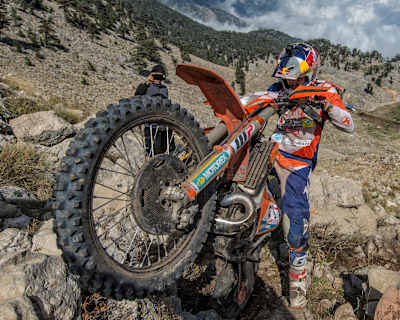
To put it in the bluntest terms, motocross is racing off-road motorbikes through dirt. The sport began when riders rode street bikes off-road as quickly as they could. The sport has exploded over the years with plenty of different disciplines, purpose-built machines and safety equipment, and some of the most stunning competitions and tricks ever seen on two wheels.
But do you know your Coffin from your Cliffhanger? Your FIM Motocross World Championship from your AMA Supercross Championship? Our bluffer's guide will tell you all you need to know so you don't have to scramble around for the essentials.
26 min
ABC of... Motocross
Take an action-filled ride around the world's gnarliest tracks for a look at all things motocross.
English +11
01
Where did it all begin?
Jump into the way-back machine to 1906 when the first motorcycle time trials were held. The event was run by the Auto-Cycle Club and saw bikers racing up dirt tracks, trying to beat each other and their own personal times. This evolved into weekly 'hare scrambles', and in 1924 the first official event was held in Camberley, Surrey, UK. The sport soon became known as motocross, a portmanteau of motocyclette, the French word for motorcycle, and cross-country.
Rigid-framed street bikes were eventually swapped for ones with suspension in the early 1930s, with further developments – such as swinging rear fork suspension – following in the early '50s. After this, motocross boomed in the late 1950s, with the introduction of the FIM Motocross World Championship in 1957.
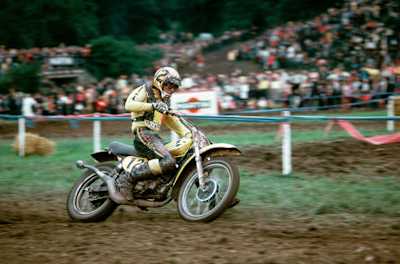
Now in its seventh decade, it has produced many great riders, including Belgian Joël Robert, who's been hailed as one of the most talented riders of all time, Eric Geboers, who made history in the 1980s by becoming the first man to win world championships in all three classes, and five-time motocross world champion Roger De Coster, known as 'The Man', whose fitness and control was so great that he was always able to win comfortably.
Roger De Coster is considered by many to be the greatest racer of all time
Sports that derived from motocross include Supercross, Freestyle, Big Air, Supermoto and Hard Enduro. All differ in terms of track style and terrain – don’t worry we’ll get to that – but each has its own championship series.
Freestyle motocross, also known as FMX, has the FIM Freestyle Motocross World Championship and the X Games, an extreme sports competition that includes FMX, and many, many more.
There are also one-off blockbuster supercross and freestyle events, such as Red Bull Straight Rhythm complementing the major championship series.
26 min
Highlights from Red Bull Erzbergrodeo 2026
Catch up on the highlights of the toughest Hard Enduro race on the planet.
English +5
The FIM Motocross World Championship
Feature
Supercross (SX)
Motocross (M)
SuperMotocrss (SMX)
Terrain
Man-made dirt in Stadiums
Natural outdoor terrain
Hybrid (Stadium + Outdoor)
Obstacles
Steep triples, whoops
Natural elevation, long jumps
High-speed technical mix
Season
Winter / Spring
Summer
Post-season Playoffs
AMA Motocross & MXGP
AMA Motocross:
The AMA Pro Motocross Championship is a US-based series whereas the FIM Motocross World Championship holds events around the globe. The participants in each championship are an international melting pot.
In the late 1960s, star athletes from the FIM Motocross World Championship (such as De Coster and Robert) were invited to America to compete in exhibitions and events. The Europeans trounced all American contenders, but the AMA Pro Motocross Championship series evolved out of these showcases. In April 1972 Braselton, Georgia’s Road Atlanta held what is now recognized as the first round of the AMA Pro Motocross Championship series.
The champions at the conclusion of the first season were Brad Lackey (500cc) and Gary Jones (250cc).
Like the FIM Motocross World Championship, the AMA series courses are constructed in mostly rural areas with natural elevation changes. Today the series has 11 different rounds in 10 different states, taking place between late May and late August.
MXGP:
The FIM Motocross World Championships are colloquially known as “MXGP”, short for Motocross Grand Prix. MXGP is also the name of the premier division of athletes racing within the championship. The MXGP moniker is also to describe each stop on the calendar (MXGP of Sweden, etc.). The series runs for 18-20 rounds between March and late September. The teams (and the majority of the events) are in Europe but ‘flyaway’ races take place in Asia, South Africa, South America and Australia.
AMA Supercross
Supercross is a uniquely American invention, a Hollywood-ized version of motocross. It was created in the 1970s by people who loved motocross and wanted to share it with–and make it accessible to–more people. Imagine: 500 dump truck loads of dirt spread around football (or baseball) stadiums and crafted into racecourses with such a variety of jumps, bumps and humps that riders are in the air as much as they are on the ground.
The best Supercross riders have exceptional throttle control, technique, timing, fitness, and focus. Skillsets vary widely between the 22 riders on the starting gate but the top finishers are often the ones who can combine speed with few mistakes. Crashes happen, however, and they can be spectacular.
Attendance ranges from 45,000 to 70,000 (venue dependent) and the stadium setting allows the promoters the ability to put on a circus-like experience with light shows, music, explosions and fireworks. It’s a fitting because, since 2008, the sport has been promoted by Feld Entertainment, owners of the Ringling Brothers Circus.
The “main event” races in Supercross are the points paying races at the end of the program. The 450 riders race for 20 minutes +1 lap and the 250 riders go 15 minutes +1 lap. Lap times vary from 45-55 seconds.
Today, the AMA Supercross Championship is a 17-round series that begins in Anaheim, California in early January and ends in Salt Lake City in early May.
The SuperMotocross World Championship
The SuperMotocross World Championship is a 31-round, nine-month long series that comprises all 17 AMA Supercross races, 11 AMA Motocross events and a trio of post-season races called the SuperMotocross Playoff rounds. Altogether, it’s called the SuperMotocross League.
The SMX format started in 2023 to unify the SX and MX series and crown one ultimate champion of the sport.
In 2023, Jett Lawrence won the first ever SuperMotocross World Championship in the 450 class and repeated in 2024 and 2025.
The FIM Motocross World Championship
Feature
Supercross (SX)
Motocross (MX)
SuSuperMotocross (SMX)
Terrain
Man-made dirt in Stadiums
Natural outdoor terrain
Hybrid (Stadium + Outdoor)
Obstacles
Steep triples, whoops
Natural elevation, long jumps
High-speed technical mix
Season
Winter/Spring
Summer
Post season playoffs
04
What's the difference between the disciplines?
Motocross, Supercross, SuperMotocross (SMX), Freestyle, Big Air, Supermoto and Hard Enduro can all trace their genesis back to motocross and many riders over the years have completed in multiple disciplines, but they aren't the same...
Motocross (MX)
Motocross racing is a test of endurance and grit. The man-made tracks are carved out of the natural landscape of rural areas with lengths of one mile or more. Lap times range from 1:50-2:20 and course conditions deteriorate throughout the day. The athletes compete twice in one afternoon in two ‘motos’, each of which pay championship points.
Motocross racers compete on the same motorcycles as other off-road disciplines but will adjust their suspension and engine packages to accommodate the course conditions.
Supercross
Supercross racing involves off-road motorcycles on an artificial dirt track, which contains steep jumps and obstacles, and is usually held inside a stadium.
SuperMotocross (SMX)
SuperMotocross courses are a hybrid of Supercross and Motocross tracks and are designed to be faster and tamer than SX but a bit slower and less choppy than a traditional MX.
These races have been held on the spacious infields of superspeedways, NHRA drag strips and stadiums.
Whoops, a defining feature of Supercross, are not included on SMX tracks. Don’t let the words ‘tamer’ and ‘hybrid’ trick you into thinking these tracks are easier. They’re still Gnarly with a capital G.
Freestyle (FMX) and Big Air
Freestyle motocross, also known as FMX, is all about performance and is judged by a panel, which looks for the best tricks.
Big Air is a newer version of Freestyle. It's also know as best trick, and it's where each rider gets two jumps from a dirt ramp. Judges once again evaluate each rider's jump and scores it out of 100. Only their top score is counted and the highest total wins.
Supermoto
Supermoto is one of the newest disciplines to come from motocross, even though its had a world series for over 20 years now.
Much like Rallycross, supermoto has a bit of everything. The bikes are off-road machines, but tend to use slick tires – this can change depending on weather and track type.
The tracks used in supermoto take in three different sports, they use the jumps and obstacles of motocross, the paved asphalt of road racing and hard-packed dirt usually seen in flat-track racing.
Hard Enduro
Hard Enduro is seen as one of the toughest sports in the world. Although it began in the 1960s, the discipline really started to pave its own way in the '90s (although there's no pavement).
The events involve multiple stages with differing levels of difficulty that usually use the terrain that's already there, such as forests mountains and even quarries.
05
Who are the riders?
Hall of famers such as 10-time world champ Stefan Everts, Joël Robert, Roger De Coster and Ricky Carmichael – who won 12 premier class AMA titles in 7 years – once ruled motocross, but they've been replaced in the hearts of motocross fans recently by a clutch of contemporary stars.
Romain Febvre is the reigning FIM Motocross world champion. He reclaimed the 2025 title 10 years after winning his first one in 2015.
The current FIM Supercross world champion is Jason Anderson, who also won the 2018 AMA Supercross champion.
Aaron Plessinger (Red Bull KTM): The "People’s Champ."
Jorge Prado (Red Bull KTM): The reigning MXGP force moving to US soil.
Because riders are extending their careers and racing later, and young stars continue to emerge, the 450 class has never been more competitive. For example, the 2025 AMA Supercross season began with five champions on the starting line, the first time that had ever happened in the sport’s history. Here are a few of the key riders to watch:
Jett Lawrence (Honda HRC Progressive) is an Australian whose family risked everything to compete in America. He’s rewarded them by winning every single championship available: 250SX+MX, 450MX+SMX+SX, some of them multiple times. When Jett moved to the 450 class in the summer 2023, he scored a perfect season, winning all 22 motos (and, of course, the championship) as a rookie. He’s already one of the top 10 winningest riders in SMX League history.
Eli Tomac (Red Bull KTM Factory Racing) is an active legend, still competing in his mid-30s and winning races. The son of John Tomac, a hall of fame multi-discipline cycling champion, Eli is the only rider to win his absolute pro debut (2010, Hangtown Motocross National). He has since climbed the all-time charts in Supercross and Motocross and sits top five in all major categories (starts, wins, podiums and points). In podiums and points, he’s the all-time leader. Tomac is a 5-time AMA Pro Motocross champion and a 2-time AMA Supercross champion.
Haiden Deegan (Yamaha Star Racing) After three years in the 250 class where he won six championships produced an impressive win record, Deegan moved to the 450 class in the summer of 2026 and quickly got into the top three. The son of action sports legend Brian Deegan, “Dangerboy” has a rabidly loyal fanbase and following and an edgy attitude.
Ken Roczen (Progressive Insurance ECSTAR Suzuki) might be the greatest story this sport has ever seen. Now an American citizen, this German-born racer first became the youngest winner (15 years old!) of an MX2 race (2009). Seventeen years later (to the day) he became the oldest AMA Supercross champion at 32, a series he spent a tumultuous and emotional 13 years trying to win. In between all of that, he won the 2011 MX2 Motocross World title (youngest at 17!), two AMA Pro Motocross titles in the 450 class (2014, 2016), two FIM Supercross World titles and nearly lost his arm in a horrific Supercross crash in Jan. 2017.
Hunter Lawrence (Honda HRC Progressive) The older brother of Jett Lawrence, Hunter suffered through years of brutal injuries before finally winning championships in 2023 when he took the 250SX East and 250MX crowns. His move to the premier class has been filled with consistent finishes, including this impressive fact: he’s the only rider in sport history to finish top 5 in his first 25 450MX starts. Hunter lost the 2026 AMA Supercross championship to Ken Roczen by 3 points in a winner-take-all finale.
The 250 Class Rising Stars
Haiden Deegan: 250 MX Title Holder.
Jo Shimoda: 250 SX Title Holder.
Tom Vialle: Two-time MXGP World Champ.
Julien Beumer (Red Bull KTM): The breakout rookie to watch.
A little more chaotic, a lot less consistent, the 250 class is where moto athletes prepare for their run into the 450 class.
Jo Shimoda (Honda HRC Progressive) Japan's Jo Shimoda is one of the coolest, most level-headed people, so calm it doesn’t seem feasible that he’s also a top motocross athlete. The 2025 250SMX World Champion is still looking for his first regular season title, mostly because injuries (major and minor) have derailed his schedule.
Julien Beaumer (Red Bull KTM Factory Racing) A former multi-time world jet ski champion, “Juju” was the Fastest Qualifier in the first Supercross he ever entered. A deadpan and serious sounding contender, Beaumer, who hails from Arizona, is one of the fittest riders on the track.
Cole Davies (Yamaha Star Racing) is a New Zealand teenager, whose mind-bending speed through the Supercross whoops helped him win the 2026 250SX East championship. Equally armed with a witty sense of humor, Davies is destined for greatness in the 450 class in the year 2028.
06
What are the rules?
Each of the 18 events in the FIM Motocross World Championship and 11 events in the AMA Motocross Championship consist of two races of 30 minutes plus two laps in each class. Points from these two brutal races are combined to crown an overall race winner.
AMA Supercross is different. At each of the 17 events, held between January and May, there are two heats, with the top 22 riders qualifying for the Main Event points-paying race. That race runs over 20 minutes plus one lap for the premier class 450cc riders. Riders competing in the 250cc class are divided into East and West Coast divisions, with eight events in each leading up to one all-star final in Salt Lake City at the end of the season.
Classes: 250cc vs. 450cc
The top riders in 450 Motocross and Supercross racing are the premier athletes in the sport, the superstars and future hall of famers. There is no minimum age; riders ‘graduate’ when ready, earn a spot on a topflight team or ‘point out’ of the 250SX division (250SX champions get one year of title defense and are then forced to move up). The riders in the 450 class tend to ride with more maturity, consistency and strategy.
The 250 class in AMA racing is a steppingstone to the 450 class and operates as a developmental division but there is no age limit as there is in MX2 (where riders must move out in the calendar year after they turn 23). The riders in the 250 class are historically more inconsistent and impatient, all of which provides for exciting racing. Some riders spend most or all of their careers in the 250 class as there is no requirement to move out.
The Moto format and scoring
Motocross event winners are never ‘one hit wonders’ because they race twice on the same day. Consistency is key; 40 motocross racers compete in two 30-minute +2 lap motos with only one hour of rest and recovery between.
Each moto awards championship points (25 points for 1st, 22 for 2nd, 20 for 3rd, 18 for 4th, decreasing by 1-pt. all the way to 21st place). The rider with the most championship points after two motos is the winner (ties are broken via the better Moto 2 finish).
Starting Gates and the Holeshot
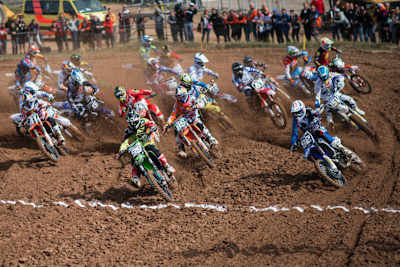
Although Supercross and motocross races are over 20 and 30 minutes in length, a good start is key to winning. Riders line up behind one of 40 (22 in Supercross) individual backward falling gates. Riders with the best qualifying times are allowed to select gate position first. The starting grid is the widest portion of the entire course but when the gates fall, the entire field rockets off the grid, down a flat straight away that continues to funnel into a narrow corner that is less than 40 feet wide.
Being first to that corner is vital to winning a motocross or Supercross race. The rider who crosses the white first (painted near the exit of the first corner) is credited with the ‘holeshot’. The advantage is in having a clear track ahead, no riders holding them up or crashing in front of them and putting them at risk.
Getting the holeshot vs. starting behind and working through traffic is the racing equivalent of the old adage ‘work smarter, not harder’.
07
What exactly is a motocross bike?
Motocross bikes have developed over the years from street bikes with knobby tires, to high-end, super-light specialized machines the professionals use today.
They come in many engine sizes depending on the competition, but very few are 'stock' machines. Especially in the world championships. And although they look very similar in each discipline, they will all have very different aftermarket parts to suit each competition.
Compared to a standard 'off the shelf' dirt bike, a bike purpose-built for motocross will see several changes made to it. These will include narrower gear ratios as the motocross tracks have sharp turns and call for hard acceleration; stiffer suspension to cope with the huge jumps and quick turns at speed; an aftermarket exhaust to offer more power and many other customisable parts which will change for each individual rider.
Comparison Table: 250cc vs. 450cc
Feature
250cc Class
450cc Class
Engine type
250cc four-stroke
450cc four-stroke
Average horsepower
~40–45 hp
~55–65+ hp
Weight range
~220–225 lbs
~235–245 lbs
Riding style
High RPMs, momentum-driven
Throttle control, immense torque
Target audience
Rising stars, lighter riders
Elite pros, heavy hitters
08
What is the terminology?
Every sport has phrases that can easily confuse a new fan. It can even confuse some people who have been following the sport for some years, so here are a few terms for you to get your head around...
Arm pump
Arm Pump is a symptom riders get from gripping the handlebars tightly during a race. This causes the muscles in the arm to restrict blood flow and begin to throb.
Block Pass
This is when a rider overtakes another rider before a corner and then makes them slowdown and lose momentum.
Frontside
The surface of a jump facing the rider. Trust us when we say you don't want to land on this side of the jump.
Holeshot
This is the spot every racer wants in a race. The holeshot describes the action of the first rider to getting to the painted white line that is at the exit of the first turn.. After a dash off the line at the start, the holeshot is important because it gives the athlete the best chance to take, and keep, the lead.
The line is the path you want to be on during the race. It's often the quickest and where the track has been packed-down by other riders, making it easier to navigate.
Powerslide
Getting the bike sideways in a turn while accelerating.
Wash out
To lose the front end of the bike. This happens when the front tyre loses traction and causes the rider to fall.
Additional terms
Casing:
Refers to how a rider lands after jumping a multi-obstacle feature; the bike’s wheels straddle the crown of a jump instead of landing on the downside, or ‘sweet spot’. Casing often results in a rider crashing or losing much of their momentum.
Roost:
Dirt/rocks thrown from the rear tire of a motorcycle after twisting the throttle. Imagine the spray emitted from a jetboat or jetski.
Whoops:
A course section unique to Supercross racing, whoops are a series of 9 to 11 identical bumps, typically 1-2-ft. tall, evenly spaced, but deceptively treacherous to navigate. The best riders ‘skim’ across the tops of them (fastest but riskiest) while some riders leap through them 2-3 at a time (slowest).
Scrubbing:
Perfected by James Stewart in 2003 as a way to jump faster and keep his bike lower to the ground, riders who ‘scrub’ a jump lean the motorcycle sideways up the face of a takeoff. It looks like they’re shaving down the face of the takeoff. The effect on the trajectory is not soaring as high into the air but still getting the distance required and getting the machine back to the ground. Beware of burying a footpeg on the top of the takeoff!
09
The 2026 major events calendar
All 31 events within The SuperMotocross World Championship are part of the NBC family of networks and can be streamed on Peacock.
International customers can purchase the SMX Video pass, available in English, Spanish and French broadcasts.
An 11 round championship consisting of 22 points paying motos, run exclusively at iconic American motocross facilities in 10 different states. Two national championships (250/450) run concurrently through the summer, starting Memorial Day weekend and wrap before Labor Day. Historic venues include RedBud MX and the Hangtown Classic, which have been hosting rounds since the 1970s.
FIM Motocross World Championship (MXGP)
The FIM Motocross World Championship (also known as MXGP), is exclusively an international motocross series that visits 5-6 continents over 18-20 events spread across seven months.
Motocross of Nations (MXoN)
The Olympics of MX, the Motocross of Nations is a standalone team event at the conclusion of the FIM Motocross World Championship. Each competing country sends three riders to compete in three different classes (MX1, MX2 and Open).
The top 20 countries after qualifying compete in a 3-moto finale (MX1/MX2, MX2/Open & MX1/Open) where the combined scores amongst each country’s riders are totaled. Lowest score wins the Peter Chamberlain Trophy.
The United States won its first MXoN in 1981 and is the all-time leader of this event. The Motocross of Nations was first held in the Netherlands in 1947.
SuperMotocross World Championship Playoffs
The SuperMotocross World Championship Playoffs run on three consecutive weekends in September on hybrid courses that aim to combine key elements from both Supercross and Motocross tracks (minus whoops sections).
The first two rounds are called Playoff 1 and Playoff 2. The third round is called the SuperMotocross World Championship Finale.
The racing format in the Playoffs is two 20-minute +1 lap motos but the individual motos do not pay any points. Instead, the overall finish (lowest combined moto scores) wins. The points awarded in Playoff 2 are double from Playoff 1. The Finale pays triple points, guaranteeing that the champion is not decided until the conclusion of the final moto.
The SMX format started in 2023 to unify the SX and MX series and crown one ultimate champion of the sport. The only way for riders to compete in the ‘post-season’ is to amass enough points in the first 28 races and finish the SX+MX seasons ranked top 20 in accumulated points. The rider who finishes the regular season with the most combined points is the #1 seed and starts the Playoffs with a 25-point advantage. The lower the seed the fewer points, all the way back to the 20th seed, which gets two points.
The financial stakes are high because the total purse just for the Playoffs is $5.5 million with $1 million going to the 450 champion and $250,000 up for grabs for 450 riders at each individual round.
Jett Lawrence has been the biggest benefactor of the series. He won the first three SuperMotocross World Championships in the 450 class and took home nearly $3.7 million in post season prize money alone.
Be sure to download the free Red Bull TV app and catch the MX action on all your devices! Get the app here