



Skateboarding
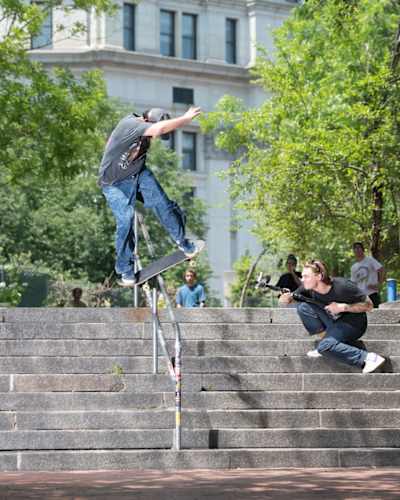
Skateboarding
Brooklyn Banks and the new era of New York City skateboarding
From its rise as skateboarding's most legendary street spot to its full restoration ahead of Red Bull Origin, Brooklyn Banks remains the beating heart of New York City skateboarding.
The Booklyn Banks is open, finally. “We would get here one day,” said Steve Rodriguez. “I always had faith . . . ”
“But we could . . .” He trailed off and shook his head, weathered from a lifetime of all-season skating around his native New York. “We could never have imagined it would be like this,” he said.
A father, executive, and community activist (who still skates) Rodriguez was a teenager in the 1980s when he first rolled into “Red Brick Park,” a nine-acre no-man’s land beneath the Brooklyn Bridge.
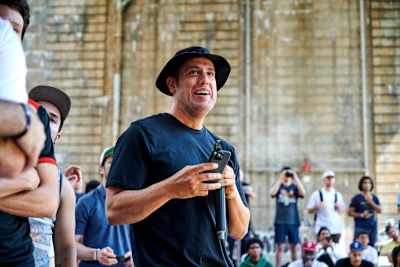
Steve Rodriguez helped lead the effort to preserve Brooklyn Banks
© Jonathan Mehring / Red Bull Content Pool
Since then, he has seen a lot at the Banks:
The forming of NYC’s first core skate scene in the 80s, to the rise of iconic art/music/hip-hop collectives like Zoo York in the 90s, to Tony Hawk’s gaming franchise in 2000, to Banks’ first–then second–closure in 2010, to community meetings with the DOT and mayor’s office, a debricking in 2020, and the viral petition to Save the Banks, to a partnership with Tony Hawk’s non-profit.
But on Saturday, September 19, 2026 marks a passage like no other at Red Bull Origin. It’s when the city will gather to celebrate the Banks not only as an iconic skate spot, but as a living cultural landmark.
Rodriguez will host the party. Generations of skaters, artists, musicians, and community advocates will gather to skate, tell stories, and discuss the endeavor to preserve the Banks as a historical destination and (still) a really great place to roll.
Three years have passed since Rodriguez spoke from the iconic “nine-stair” set, alongside then-New York City Mayor Eric Adams, to celebrate the Banks’ first re-opening, a $160 million, two-decade effort that in truth was only half-finished.
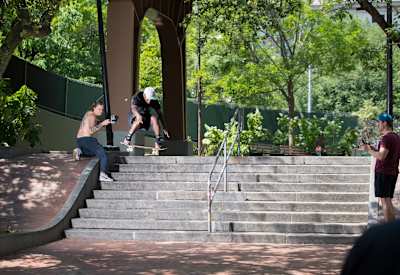
Zion Wright skating at the Brooklyn Banks
© Cole Giordano
Coverage was glowingly positive, but, as always, skaters asked questions, one even Rodriguez couldn’t answer: “Would the Banks ever be fully restored?”
That was 2023, AKA phase one.
In 2024, restoration continued–a collab between the city’s Skatepark Project (Hawk’s non-profit) and Gotham Park (NYC’s non-profit), and in June of 2025, for the first time in 15 years, the Big Banks (the biggest transitions, which once housed a homeless encampment) were open to the public. This checked off phase two of three. A year later, the Banks was functional enough to host Go Skateboarding Day, but final kinks of phase three were still being worked out.
Phase three marks completion on September 19, 2026 in time for Red Bull Origin.
Upon completion, the Brooklyn Banks will be as safe, secure, and celebrated as Central Park–a true New York landmark.
To understand why so many see it as a landmark, one needs to understand the history of New York Skateboarding, which until the Banks came along and gave skaters a gathering place, existed in the darkest corners of NYC’s shadowy, gritty, often dangerous sub-cultures.
Quick facts: Brooklyn Banks
Fact
Detail
Location
Lower Manhattan
Opened
1979
Known for
Brick banks and transitions
Closed
2004, 2010
Restoration restart
2023
Big Banks reopened
2025
September 19, 2026
01
The origins of skateboarding in New York City
1960s
While 50 million skateboards were made in America during this legendarily mysterous “first wave,” no one in NYC skate circles recalls a scene. The era seemed to go more toward Roller skating, and Roller Boogie, so it makes sense these cultures overlap in future generations.
‘70s
This changed in the ‘70s, when the first tiny clusters of skaters appeared around the city, then converged in Central Park. By 1975, skateboarding was an established NYC counterculture—attitude and all. Descriptions from that time could match a skater’s experience today. There were spots, locals, and territories presided over by crews that didn’t like outsiders.
“Back then it was dicey,” says, JJ Veronis, who grew up in the ‘70s scene, and appears in Full Bleed, a best-selling book of NYC skate photography.
The scene’s epicenter was the Alice in Wonderland statue by East 74th Street. Skaters would gather, then disperse throughout the park and beyond, bombing hills by Tavern on the Green or at 9th Ave and 78th street, or—before security appeared—ride the brick transitions at Lax and 53rd or 89th and Madison (which remain today).
But most spots were DIY: short-lived and usually near construction sites, where plywood was accessible. In a dead-end 79th street alley, skaters built a multi-sheet plywood wallride, out of sight from authorities. A construction site at 96th and Riverside became a two-block succession of plywood ramps (graffiti taggers dubbed it “The Wall.”).
A very select few stores sold gear: A ski shop on 57th street sold boards. A stationary store on the Upper East Side kept pads and helmets in a single glass case. Paragon Sports in Union Square was reportedly the first to sell everything. In 1978, City Skateboards opened on East 83th Street—New York’s first real skate shop, run by Kevin Levine, father of local ripper Mark Levine.
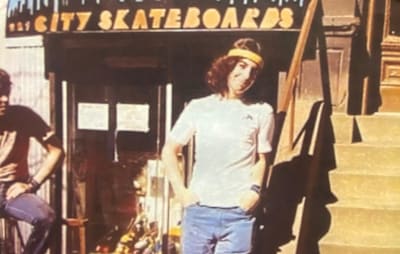
City Skateboards opened on East 83th St - New York’s first real skate shop
© Courtesy of JJ Veronis
New Lincoln High School at 70th and Lexington hosted what was probably New York’s first “official” contest; events included the “gorilla grip” highjump (just look it up).
A skatepark no one can name opened in Queens. And another in Riverdale. An empty pool off the last stop on the #1 line (242nd Street) was known as the Deathbowl.
“When you hit those, you went with a crew,” says Veronis, fondly, reiterating that ‘70s skate scene was less a sport and more like a branch of street culture: energized, dangerous, and “entangled” with drugs, live music, and especially graffiti. “Skating and graffiti were married.”
Perhaps this is why Andy Kessler remains the ‘70s central figure in NYC skateboarding.
A local pro, Kessler was a graffiti writer and member of the seminal upper west side crew, Soul Artists of Zoo York. Featured in Full Bleed and canonized when he died in 2009, Kessler best-represented skateboarding as street culture, in the ‘70s, a time that was already changing by 1979, when something happened in lower Manhattan.
02
How Brooklyn Banks became NYC's skateboarding epicenter
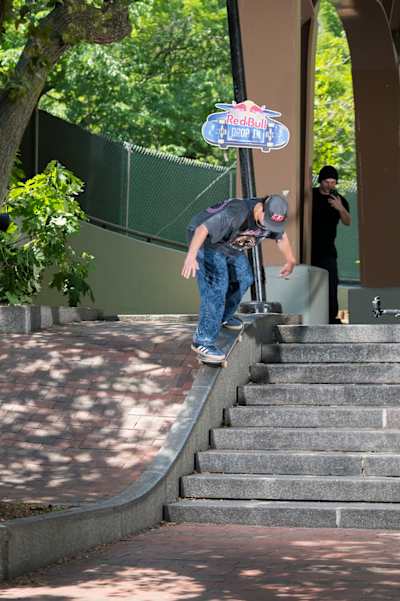
Alex Sorgente skating at the Brooklyn Banks
© Cole Giordano
‘80s
No one knows when the first skater rolled through Chinatown, crossed Pearl street, and started down the smooth brick basin that is now the most iconic skate spot in the world. It was probably 1979, the year “Red Brick Park” officially opened—a slim, block-long basin in this Lowest East Side neighborhood, complete with chess tables, a basketball court, and a tetherball station with no ball. “Kids would steal it,” says Rodriguez.
Indeed, this was not Central Park. What quickly became known as the Brooklyn Banks hosted as much a cultural template as a skateboarding. Skaters mixed with hustlers, homeless, crackheads, car jackers, graffiti artists (and sightings of Keith Haring and Basquiat)—who gathered here on public property that was removed from traffic, but definitely not a pedestrian or tourist destination, since there were no vendors or bathrooms.
What there were was transitions. Brick waves between the walls and floor. They ran the length of the park, starting at the northern end (small banks), where short brick hills abutted a low barrier separating the park from off-ramp traffic. Farther down, the banks grew, and were more like full transitions that grew into the Bridge’s huge vertical pillars (big banks).
Other spots and stores appeared around the city—a full-size, 12-foot half-pipe sprung up in Riverside Park, and downtown there was SoHo Skates, across from an abandoned gas station with a plywood wallride. But all paled in comparison, Rodriguez told Red Bull.
“By 1985, the Banks was the absolute epicenter of New York City skateboarding.”
This was the year the banks was canonized: First in Thrasher, then in Future Primitive, a film by Stacy Peralta, a ‘70s pro who created the iconic Bones Brigade skate team, and today is an award-winning documentarian. To film at the Banks, Peralta says, was both a nod to this new mecca and to this new genre: NYC skateboarding, that stood a world apart from its Southern California brethren.
“I wanted to show East Coast skaters that we respect them, that we believe in them, and that they have as much to offer as we do,” Peralta told Red Bull. “The history that took place on those walls—the evolution that happened there—it couldn’t be more important to skateboarding.”
The history Peralta mentions is key. It’s what made the Banks a skate mecca. The time—the 1980s—like the Banks itself, was unique in the history of skateboarding. No one could ollie. Yet. Instead, skaters planted a foot and launched themselves, or sought ramps or transitions to leave the flat ground—making the Banks’ brick waves a worldwide skate destination.
Yet all the while, a young Florida prodigy (and future Bones Brigader) was adapting the trick to flat ground, emulating an elder pool rider, who could thrust his tail over the pool’s coped edge, catching a second of air. His name was Alan Gelfand, but everyone called him “Ollie.”
03
The rise of Zoo York and New York street skate culture
‘90s
The flat-ground ollie—synonymous with 1990s skate culture—changed everything. Once airborne, skaters began flipping and spinning their boards—then taking tricks off-of and onto new surfaces.
“The possibilities were endless,” said Rob Rodriguez, a downtown ‘90s skater, who saw the NYC skate scene change and the Banks depopulate, as skaters sought new terrains.
Rodriguez would later partner with Rodney Smith, founder of the seminal ‘90s urban company Zoo York—a nod to the iconic ‘70s crew.
Among other ‘90s skate companies, Zoo York used graffiti artists to make board and t-shirt graphics.
Some say this was the beginning of streetwear (a $300 billion industry today) and it makes sense, considering that in 1994, a tiny shop on Lafayette street that sold decks, hardware, and t-shirts screened with one word: SUPREME. (In 2020, the holdings company VF Corp bought Supreme for $2.1 billion.)
Local companies like Supreme, 5boro (est. 1996) and Zoo York illustrated ‘90s skate culture: tiny, urban, and independent. They boasted an urban, anti-skatepark (some argue anti-West Coast) ethos that enhanced its status as a branch of street culture. Seen in videos like Zoo York’s “Mixtape,” identity was forged thru music (hip-hop), fashion (streetwear), and of course the skating itself—which was now taking place throughout the city, with new gathering spots.
Seen in videos like Zoo York’s “Mixtape,” identity was forged via music (hip-hop), fashion (streetwear), and of course the skating itself—which was now taking place throughout the city, with new gathering spots, like Washington Square Park.
Still, in photos and footage from the 90s–the Banks is there.
The scenes drew a new figure, photographer Larry Clark, whose iconic photos hang in the Whitney. Clark hung around Washington Square and the Banks, and started shooting skaters. He would soon make the dark cult film “Kids” (1995), starring Zoo York rider and Banks regular Harold Hunter, and written by NYC newcomer and skater Harmony Korine, who based the film’s gruesomely unforgettable fight scene on a fight he’d seen at the Banks.
04
The closure and restoration of Brooklyn Banks
‘00s and Beyond
And eventually, so did New York City.
The 2000s saw the first official skateparks open in New York. McCarren Park (Brooklyn) to Rockaway Park (Queens) to River Ave Park, across from Yankee Stadium (Bronx).
And then Coleman Park, aka LES. The city installed some ramps and ledges circa 2005, but it wasn’t until a full redesign by Steve Rodriguez that LES became NYC’s new skate center. The park re-opened in 2012, three years after the Banks was abruptly shut down.
This was when Rodriguez first started working with the city, exercising more trust in authorities than any skater before him, even when the Banks were suddenly debricked in 2020, during Covid lockdown.
He points to Tony Hawk as a savior of the Banks, since it was Tony’s non-profit, The Skatepark Foundation, that helped make the Banks an official skateboarding site, finally.
Rodriguez and his son skate the LES park most Sundays, oft with other dads and sons.
But on May 26th, LES was curiously sparse. Skaters were at the Banks to see Steve Rodriguez usher in a new era—one where skate culture is not criminalized, but celebrated.
“The Banks has always been about community connectivity and the freedom of open public space for everyone,” Rodriguez said. “I’m excited for what’s to come.”
05
How Red Bull Origin celebrates New York skateboarding history
What’s next? Red Bull Origin on September 19, 2026 should give a glimpse into a new era and a very bright future.
“The Banks has always been about community connectivity and the freedom of open public space for everyone,” Rodriguez said. “I’m excited for what’s to come.”
