

Athletics
Long jump vs. high jump
The long jump and the high jump both take incredible strength, speed and control.
There’s an art to track and field — the high jump and long jump have a level of grace and finesse that mesmerize anyone who watches. As high jumper Vashti Cunningham puts it in an interview with Red Bull, “Our body is our instrument.”
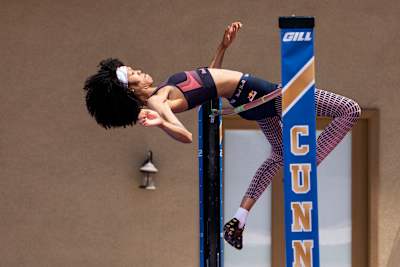
Vashti Cunningham trains in Las Vegas, Nevada
© Damien Noble Andrews / Red Bull Content Pool
Whether you’re using your instrument to reach new heights or go the distance, the long jump and high jump are a thrill to compete in. Read ahead for a guide to long jump vs. high jump, from technique differences to training tips for powerful jumps.


01
What is the long jump?
The long jump is a track and field event that tests how far you can go. You’ll sprint down a 40-meter runway until you reach the take-off board. Using the momentum of your running speed, you’ll spring as far as you can into a sand pit. If you want to achieve a lot of distance on your long jump, you need to be fast on the approach.
Once upon a time, the long jump was also known as the running broad jump. Out of all track and field events, it’s one of the best-known — possibly because it’s been part of the sport for centuries. Long jumping goes back at least as far as ancient Greece. The current world record for greatest distance on a long jump, set by Mike Powell at the 1991 World Championships, stands at 8.95 meters. (That’s 29.36 feet!)
Long jump take-off techniques

Ivana Vuleta at the European Championships in Munich, Germany
© Phil Pham / Red Bull Content Pool
Long jumpers use one of three techniques to get as much distance on their jump as possible. The most commonly used technique is the hitch-kick, which gives the illusion of an athlete running through the air. It’s the most complicated of the three, but it’s worth it for the extra distance.
Once you take off from the board, you’ll fold your take-off leg beneath your hips as you straighten and swing your non-take-off leg back and down. Keep moving your take-off leg forward as the other leg finishes the swing around and then bends back up. Both legs should be out front and slightly bent as you land.
The other two methods for getting extra distance are known as the stride jump and hang style. The stride jump, also known as a sail, requires you to move your body into a toe-touch in the air. Hang style is all about extending both your arms and legs mid-air, elongating your body until you’re ready to land.
02
What is the high jump?

Vashti Cunningham trains in Chula Vista, California
© Damien Noble Andrews / Red Bull Content Pool
The high jump is a track and field discipline that involves catapulting yourself off the ground and over a high-set bar. It dates back to the 19th century as a world-stage track and field event, and it remains one of the most exciting events to watch. High jumpers also don’t get the extra assistance of a pole vault. You have to generate as much explosive power as possible with only your own momentum and strength.
You’ll get a running start down a 15-meter runway before launching yourself over a large horizontal four-meter bar. Your aim is to clear, or get yourself over, the bar and onto the landing mat without knocking the bar out of its holder.
The height of the bar is adjustable, so it can be gradually raised each round until one jumper is left standing as winner. The world record for highest jump ever is currently held by Javier Sotomayor, who cleared 2.45 meters, or eight feet and 0.46 inches.
High jump take-off technique
Most high jumpers clear the bar by using a technique known as the Fosbury Flop. Introduced by high jumper Dick Fosbury in the 1960s, the Fosbury Flop requires turning your back to the bar before clearing it. Fosbury’s revolutionary technique involves a diagonal sprinting approach, then turning on a curve so your back is pointed toward the bar. This technique allows you to lower your center of mass so you get more height.
03
The physical demands of long jump vs. high jump

Vashtin Cunningham trains in Chula Vista, California
© Damien Noble Andrews / Red Bull Content Pool
For both the high and long jump, you need to be fast — and great at generating a lot of power. You’ll also need good flexibility, core strength, and balance for a smooth landing. Both the high and low jump are extremely high-impact, so overall strength is key to making sure your body can stand the pressure.
The difference between the long jump and the high jump is which skill is the most important. Speed is a higher priority for the long jump, while power is the driving force of a strong high jump. For the high jump, extra-strong calves are needed for that explosive force. Long jumpers should also work on hip strength, which is essential for a fast sprint to the take-off board.
04
Training techniques for long jump and high jump
Training tips for long jumpers
There are plenty of ways you can increase your long jump speed, including:
- Posture. When doing drills, be mindful of your posture. A straight spine means better jumps.
- Warm up. Body weight exercises and stretching are essential before doing any long jump training drills.
- Wall acceleration drills. This simple drill is a great way to boost your speed. You’ll brace yourself with both hands on a wall and move in place. On each step, your feet should land exactly in the same spot where you started. Gradually go from walking to marching to running.
- Partner acceleration drills. This is essentially the same as a wall drill, but you’ll use a partner for support instead of a wall or gate.
- Take-off drills. Simple single-leg skipping drills can also work wonders for improving your take-off.
- Bilateral training. It’s easy to focus on building strength in your take-off leg, but it’s important to train both sides of the body evenly.

Larissa Iapichino
© Gabriele Seghizzi / Red Bull Content Pool
Training tips for high jumpers
High jump training exercises help you improve speed while honing all your explosive power for take-off. These are some great exercises to try out.
- Squat drills. Practice drop squats while throwing your arms behind you and then up in the air. This helps strengthen your quads and improves your landing and your jumps’ propulsion.
- Jump drills. One of the best ways to put some extra spring into your high jump is the 180-degree jump drill. You’ll jump in the air and rotate 180 degrees into your landing.
- Running drills. Acceleration drills are essential for a better take-off. Start by running five steps in a straight line. Then, run in two or three circles of any distance to practice turning. You can also combine the two, running in a straight line and transitioning after the fifth step to running in two or three circles.
- Standing bar clearance drill. Get used to the sensation of clearing the bar without the approach. You’ll stand with your back facing the bar and power yourself over.
- Hamstring strengthening. High jumpers can easily injure their hamstrings if they aren’t careful, so good strength training is key for prevention. Back and front squats are a great addition to a high jump training regimen. You should also include bench presses and standard military presses in your weightlifting routine.
- Rest routine. Part of Vashti Cunningham’s success is because her coach doesn’t allow her to push beyond her limit. She only does a fixed number of jumps in training while focusing on improving her speed and overall strength. Applying this mindset to your own routine will give your body time to recover between high jumps.
05
Long jump and high jump rules
Long jump rules and scoring
Your long jump score is measured from the edge of the take-off board to the mark your feet make in the sand upon landing. Keep the following rules in mind at competitions so that all your hard work counts.
- Don’t cross the foul line. Your toes must be behind the foul line marked on the take-off board for your jump to be valid.
- There’s a time limit. Once you’re on the runway, you’ve got one minute to complete your jump.
- Your best jump is the one that counts. Long jumpers get multiple attempts, usually three, to get their jump right. The attempt with the longest distance is the one that counts toward your score.
- Wear compliant shoes. Spiked cleats are allowed, but you can’t wear a shoe sole greater than 13 millimeters thick.
High jump rules and scoring
Clearing the bar isn’t the only thing you have to think about on the high jump. Here are the rules you need to follow.
- Take off on one foot. You can only use the force of one leg to push yourself up and over the bar — not two.
- Three strikes and you’re out. You get three attempts to clear the bar, and you’re eliminated if you fail all three. You are, however, allowed to pass a height and go to the next round, but that means an even greater height increase between jumps.
- Touching the bar is permitted. Your jump is still counted if you graze the bar with your body as long as you don’t dislodge the bar. This is a rare feat, though — the bar is sensitive to even the slightest touch.
- Breaking a tie. High jump competitions keep going until one jumper remains. In the event of a tie, the jumper with the fewest misses gets the gold. This can be either least misses for that particular height or for the whole match.
Get started in the long jump or high jump today
The long jump and high jump are even more fun to do yourself than they are to watch. Both take incredible strength, speed, and control. One of the best ways to get started is to find a track and field program near you so the experts can guide you. It takes a lot of dedication and practice, but commit to a regular training routine, and you’ll be flying high (or long) in no time.