
Stockcar
NASCAR pit stops explained: Roles, rules and strategy
Racing teams can’t be successful without a great pit crew. How do pit stops work? Here’s the lowdown on rules, roles, and preparation.
Part of this story




Watch any movie featuring racing with a pit crew - whether it’s Formula 1 or NASCAR - and it’s easy to see the movements are highly choreographed. Each person has a specific job and they stick to it with laser-sharp focus. If they fail to do so, the team risks making a mistake that can at best result in a minor issue and at worst serious injury or even death.
Over the decades stock car racing has existed, pit stops and pit crews have evolved along with cars and tracks. One thing remains true: while the driver is the rock star, front and center with the fans, he or she could not achieve any level of success without a good pit crew. As drivers Connor Zilisch and Shane van Gisbergen know, pit teams are invaluable. In less than 15 seconds, every pit stop has to achieve maximum efficiency with very little room for error.

01
NASCAR pit crew roles and responsibilities explained
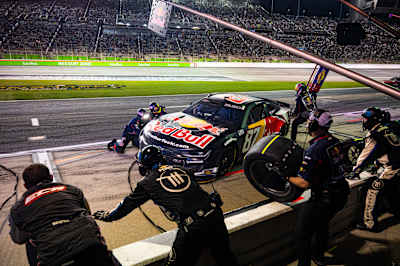
Connor Zilisch with his pit crew at Echo Park Speedway
© Daylon Barr / Red Bull Content Pool
Each pit crew has a total of five people:
- Two tire changers
- A tire carrier
- A jackman
- A fueler
That’s one fewer person than there was before November of 2017, when NASCAR adjusted the rules to reduce the over-the-wall crew from six people to five. The stock car governing body said it changed the rule for safety reasons and to highlight the athleticism of the crew members, making the pit crew even more of the racing story.


Tire changers
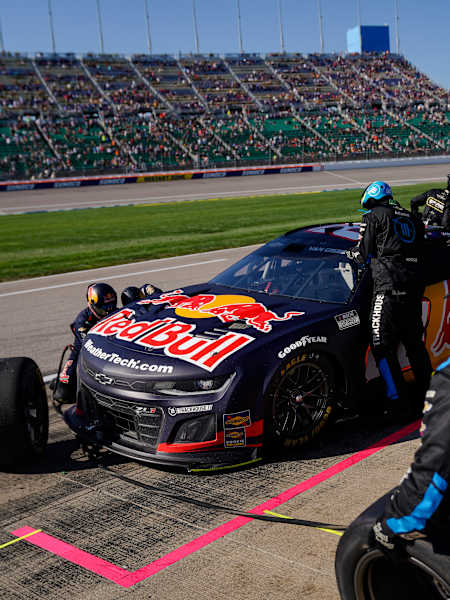
As the driver reaches the target for its pit stop, the entire crew is poised to leap into the lane in front of a car that may be moving at speeds of up to 60 miles per hour. Two tire changers jump out front with inches to spare, each wielding a powerful impact wrench (also called an air gun) that removes the single lug nut in the blink of an eye. Then, they pull off the used tire and retighten the lug nut once the new tire is hung on the hub.
Tire carrier
Tires weigh 50 pounds each, and the tire carrier totes two of them. Tire carriers must be fast and agile, perfectly coordinated to ensure the tires are ready for the tire changer. They grab the used tires and quickly move them out of the way.
Jackman
The jackman oversees jacking up the car so the tires can be removed. Carrying a 30-pound jack, this team member sprints around the front of the car as it pulls up. The equipment must hit the jack post precisely for accuracy and efficiency, then raise the 3,400-pound racecar with one pump. No more, no less. Before dropping the car back down, the jackman hangs the right front tire and runs around to hang the left rear tire. NASCAR calls this the “most challenging position on pit road” for good reason.
Fueler
The final member of the crew is the fueler, who is prohibited from any other pitstop duties. Per NASCAR rules, the fueler must be positioned close to the pit wall and remain there until the vehicle is one pit box away from its assigned pit box. If absolutely necessary, the fueler is allowed to re-direct a wayward tire with their leg.
02
NASCAR pit stop rules and equipment changes over time
When NASCAR was formed in the late 1940s, part of its mission was to create actionable rules that would encourage fairness and consistency. As times changed, so did the rules. Sometimes those rule changes were small, and sometimes they were extremely impactful. For instance, in 2022 NASCAR changed the number of lug nuts from five to one, decreasing pit time drastically.
Other rule changes were designed to improve safety: when changing all four tires, crew members must change/remove the outside tires first unless otherwise determined by the Series Managing Director. Regulations refer to equipment as well; the most recent rule book says if a vehicle runs over or under its air hose within its assigned pit box, the driver may be instructed to return to the assigned pit box for potential inspection. Per the latest rules, neither a crew member’s feet nor pit equipment can touch the pit road surface before the vehicle is one pit box away from its assigned pit box.
Just like pro football and basketball, pit-road officiating is monitored with a camera-based replay system. Put into play before the 2015 season, the replay system may be called up if there are any questions about impropriety. Starting in 2025, NASCAR issued standardized air wrenches, air hoses, regulators and control boxes to teams at each race and collected them at the end of each race weekend.
03
Why athleticism matters for NASCAR pit crews
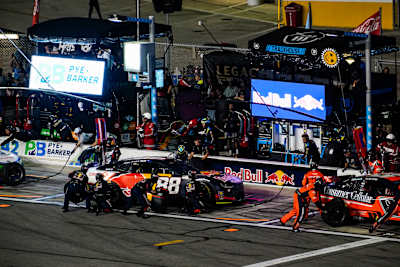
Shane Van Gisbergen makes a pitstop at Daytona International Speedway
© Daylon Barr / Red Bull Content Pool
A great pit crew can make the difference between winning and losing. Drivers and pit crews must work together seamlessly, because while a good driver can get the car into position, a fast pit stop can move the driver up the standings with impeccable preparation and coordination.
Phil Horton, the pit crew coach for the NASCAR Drive for Diversity Crew Member Development program and the strength and conditioning coach for Rev Racing, has recruited pit crew athletes for several years. He first spotted Brehanna Daniels when she showed up at a NASCAR pit crew tryout. Daniels was a point guard for the Norfolk State University’s basketball team and displayed the kind of quickness and athleticism needed to be successful on pit road. Now a tire changer for NASCAR, Daniels became the first Black woman in a NASCAR Cup Series pit crew in 2017.
Former college athletes make excellent recruits for the pit crew, because by virtue of being on a team they have proven they’re open to coaching. They’re also already in shape, a requirement for each member of the team.
“Teams are building state-of-the-art gyms and hiring top trainers, chefs and yoga instructors,” reported The New York Times in a 2024 story about pit crew recruiting. “They are also paying hefty salaries — some can reach $200,000 or more — to sign top athletes and lure pit crew members away from rivals.”
While that’s a fraction of what a top driver may earn, that’s still a good living. And an opportunity to be very close to all the action.
Part of this story