






Gaming
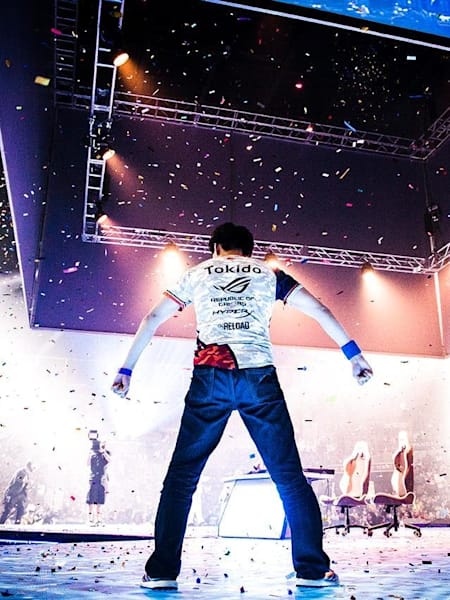
esports
Ohsu Akira captures the magic of the FGC through his camera lens
Photographer Ohsu Akira's February exhibition shone a stunning light on the Japanese fighting game community, giving fans a look into the scene's colourful and storied history.
It's finals day for Ultra Street Fighter IV at Evo 2014, and a massive crowd of fighting game players and fans have gathered around the Top 8 stage to watch the action. In the mix are notable pros, like Hajime 'Tokido' Taniguchi and Daigo 'The Beast' Umehara, surrounded by a throng of cheering viewers while they give a polite round of applause. Two players nearly throw themselves onto the stage out of excitement, while Keita 'Fuudo' Ai rests his elbows on the edge out of apparent exhaustion.
This photo the captured the moment (shown below) lays bare the passionate heart of the fighting game community, as captured by photographer Ohsu Akira.
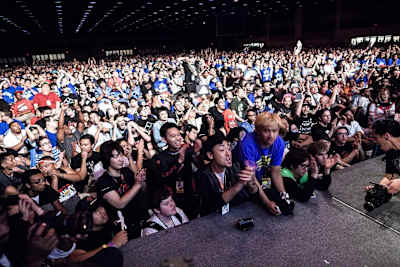
The aforementioned moment at Evo 2014, away from the pixels and polygons
© Ohsu Akira
Stepping into photography
Akira began his foray into photography more than two decades ago, thanks to his interest in camera technology. "I started taking photos in 1997 when I bought Sony's compact digital camera," he explains (the DSC-F3, 350K pixel, to be exact). "I was interested in a lot of these high-tech gadgets to begin with, so I still remember being hyped about taking photos digitally back then."
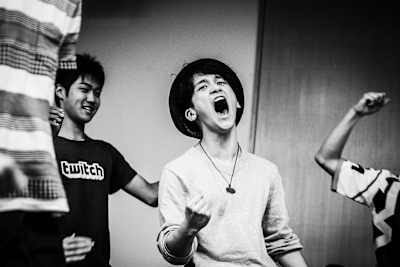
This moment from John Takeuchi showcases the excitement of FGC tournaments
© Ohsu Akira
However, Akira's tech hobby wasn't his only inspiration for taking photos. He also wanted to see the Japanese FGC better represented in popular media, and set out to do so himself. "I began taking photos of the Japanese FGC when I bought a Digital SLR camera in 2010," he continues. "I'd had a little bit of break from FGC then, and I couldn't see any media covering FGC in a way that represented the players properly, at least in Japan. So, I thought I'd do it myself."
Capturing the moment
While Akira hails from the Virtua Fighter fold, one of his first photos in the exhibition captured a one-of-a-kind moment from SFIV's glory days, showing Street Fighter pro Naoto Sako against an intense, crowded backdrop of onlooking players.
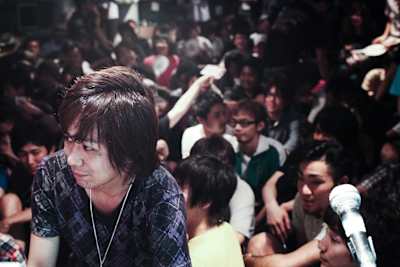
Ohsu Akira caught Naoto Sako during a crowded tournament in an arcade
© Ohsu Akira
"I had been an avid Virtua Fighter player, so I had basically only covered the Virtua Fighter scene – this photo was one of my first to feature the 2D fighting game scenes," Akira says of the shot. "I didn't have much experience taking photos with a SLR camera, so I took this opportunity to learn how to better capture the FGC moments. The venue, as you can see, was very small, but it gives that unusually tight sense of space. I love it, because it really represents the FGC in Japan back then."
Other photos in the exhibition show a young Hajime 'Tokido' Taniguchi astride a bike in the street, alongside a touching moment between Bruce 'Gamerbee' Hsiang and his wife, as well as a still from MenaRD's explosive run in Capcom Cup 2017.
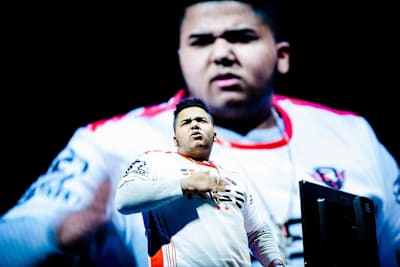
MenaRD's explosive run at Capcom Cup 2017 was caught by Ohsu Akira's lens
© Ohsu Akira
"I actually don't pay attention, or remember at all, what the atmosphere was like, or how the audience was reacting to what was happening because I'm so focused on capturing the moment of my subject," Akira says of MenaRD's photo.
“To me, MenaRD already was a very attractive subject for my photography, because of the way he represents himself as a player. He's such a character. I had so much fun capturing him in and out of the competition, because he shows so much emotion."
The science behind FGC photography
Akira's mission for his recent exhibition was to introduce viewers to the FGC in a way that was easy to understand, helping onlookers to appreciate the hype of tournaments, despite a possible lack of exposure to the scene.
"For this exhibition, I selected photos that are easy to understand," Akira explains. "I feel that there are many newcomers who don't play the game, but spectate and watch the stream a lot nowadays. So, I chose photos that they could emphasise with even without being players themselves."
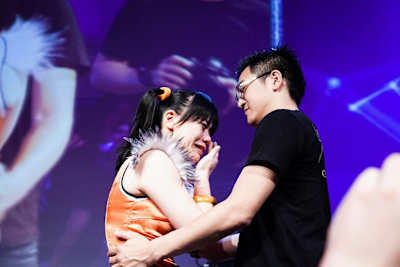
This emotional moment of Gamerbee and his wife was shot at the right time
© Ohsu Akira
Akira has captured moments in crowded arcades and sprawling Top 8 stages alike, both of which require a distinctive approach from other event photography. According to him, competitive fighting game events generally supply dim lighting, which presents a unique challenge for photographers, as opposed to other kinds of competition.
"Video game tournaments usually have very dim venue, so that's something very special," he explains. "I can't think of any other competition that uses such limited amount of light. So, you need to have a build of equipment that can do well in dark places, and you need to carefully set your camera up. I guess it becomes easier if you can use the latest and most expensive gear available."
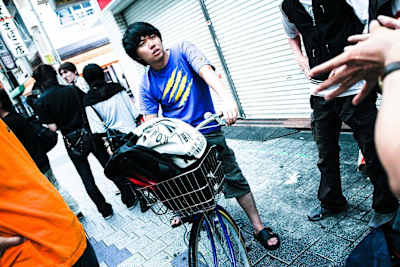
Tokido's youth was also part of Akira's photography
© Ohsu Akira
Esports and the FGC
Since Akira's photography debut in 1997, he's managed to capture a plethora of scenes from Japan's early days in the fighting game community. Within that time frame, he's witnessed the rise of esports amidst grassroots slobberknockers at the arcades, and thus possesses a transparent opinion on the presence of esports in light of traditional arcade play.
"I think the esports has a positive effect on the Japanese FGC generally," Akira says of the issue. "FGC has a longer history when compared to other genres in esports, so the average age of the top players is also a bit higher in FGC, and they know how to best represent themselves."
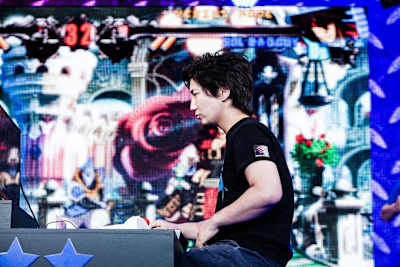
Daigo 'The Beast' Umehara in his element here
© Ohsu Akira
For those involved in the FGC, Akira's photos provide a one-of-a-kind look into Japan's fighting game scene. From crowded venues in old-school arcades to legendary pop-offs at major tournaments, each moment in the exhibition brings the best of the FGC to viewers through his legendary camera lens.

*WHILE SUPPLIES LAST. Ends 9/30/26. US; 18+. To redeem, click SPIN and START above to complete quiz, and provide req’d info. Std. data rates apply. Access to game and Ubisoft acct. req’d to redeem. Limit: 1 item/person. Add’l info: redbull.com/assassinscreed. Sponsor: Red Bull North America, Inc., 1740 Stewart St., Santa Monica, CA 90404.
Assassin's Creed Black Flag Resynced
For the leap of faith.
How well do you know the Credo? Take the quiz, test your knowledge, and a unique in-game reward* awaits those who complete the challenge.

