



Gaming
Games
How Ooblets aims to reinvent the farming sim
Rebecca Cordingley and Ben Wasser’s new RPG is expected to be this year’s Stardew Valley, but it couples its cute factor with a tutorial on building your own reality.
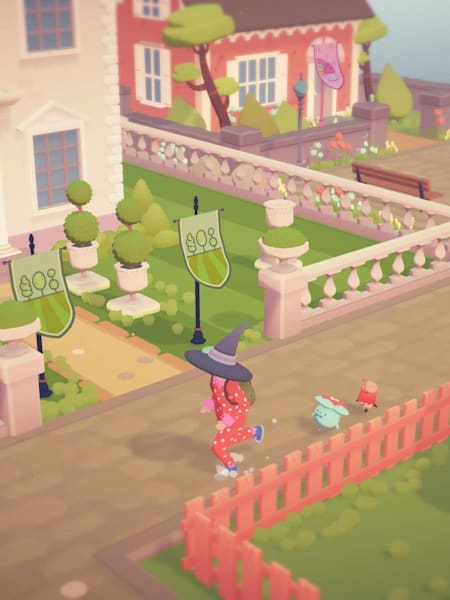
The first thing you will likely notice about Glumberland’s Ooblets is that it’s absolutely gorgeous. It falls in line with other releases from the hippest echelons of indie gaming – from System Era’s Astroneer to Ben Esposito’s Donut County – but underneath its Katamarian exterior is a robust variety pack of systems. Ooblets itself tackles farming, shop management, exploration, and lite turn-based RPG battles, and it does it all while free-falling into the kind of “fuzzies” you would normally associate with In-N-Out burgers and five-hour Pinterest holes.
Its overall charm however is just a byproduct of pure, unadulterated passion. Ooblets creator Rebecca Cordingley had been working at a smaller Pittsburgh studios called Schell Games but when a relatively unknown Steam release named Stardew Valley hit nearly two million copies sold in 2016, she traded in her 9-to-5 game dev job to work on an entirely new concept with her partner Ben Wasser. The pair then implemented a "marketing first" tactic – skipping playtesting, white boxing, and expanding on "dumb ideas" that required you to “play as an average person living in an approximation of real life”, and it worked. Their Patreon caught on and their adorbs aesthetic made Ooblets one of the most talked about games at last year’s E3 2017 show.
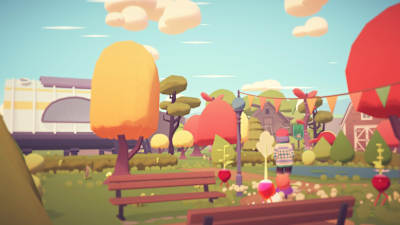
Explore towns in Ooblets
© Glumberland
"We originally had this impression that 1,000 Twitter followers would be a good audience size to launch the game with," says Cordingley. "Besides the fact that we had never been able to get anything close to a game made by the time we hit that, it shows just how far off our expectations were." Despite struggling with constantly feeling out of their depth, the twosome hung around – using their apartment and nearby coffee shops as a homebase for an evolving bucket of ideas.
The main concept of Ooblets itself is simple. You start with a rundown farm in the world of Oob, growing crops and tiny creatures you then use to battle other Ooblet trainers as you explore and encounter new types of biomes. Ooblets can be leveled up through battles and by feeding them crops, but they can also unlock moves based on their functional type – think healers and tanks with their own status effects, buffs, and debuffs. Your main character's appearance can also be customised and personalised further via accessories, outfits, upgradeable houses, furniture and decor, "Ooblets Clubs", and new shops and buildings that become available as you explore and finish quests. The core mechanics are still very much a work-in-progress, but the fluidity adds a sense of depth to systems that are normally overshadowed by collectibles and visual fidelity.

Party hard in Ooblets
© Glumberland
"Farming is something I spend a lot of time going over again and again to improve the feel of," says Cordingley. "The gameplay has sort of stayed the same throughout development but how you interact with the farm keeps evolving. The battle system keeps improving in terms of animations, moves, and UI. There's this big and adaptive battle gym-like system we have planned to fit into Badgetown that's on the horizon. As well as an expanded introduction sequence that will be a pretty major overhaul if we decide to go with it."
Since its reveal, Ooblets’ approach to farming RPGs has drawn comparisons to time-killers like Pokémon, Harvest Moon, and Animal Crossing. But appealing directly to those audiences has never been a priority due to the sheer size of said franchises and the teams and budgets behind them. In fact, Cordingley and Wasser are primarily focused on playing to their strengths – "being a bit sillier, less restricted, and more communicative" in what they do while working within their own community to make it the game fans not only hoped for, but actually wanted post-release. Being featured on one of the biggest stages at E3 is a milestone they'll never forget, but this far in the development cycle – and with artists Karen Texeira, Casey Uhelski, Bree Lundberg, and Sander Verdickt on board to assist with concepts and 3D models – refining details and bringing each little Ooblet and NPC design to life is more of a shared necessity than a choice.
"When we first started, Rebecca and I would just spitball ideas and she would model them on the fly," admits Wasser. "I'd say 'What about an onion with a face?' and Unnyhunny was born. Or she would imagine a bear wearing pants and Pantsabear was born. We try to make compelling characters that are sort of one-dimensional on the outset but with a bit of hidden depth – maybe a quirk that defies expectations, and normal character things like flaws and hopes and plans. On top of all that, a lot of my writing ends up reflecting how Rebecca designs the visuals for each character. As an example, [the townsperson] Rugnolia was originally meant to be a shy scientist but Rebecca's design had this sort of hipster look so I leaned into that and made the character a confident, flippant, too-cool-for-school scientist."
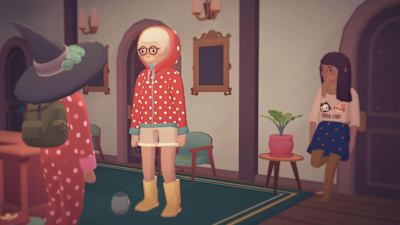
A look at Glumberland’s debut title Ooblets
© Glumberland
That attention to detail is what makes Ooblets a universal treasure. Its story isn't as fleshed out as Stardew Valley, but it will be home to a cast of more than 40 Ooblets and 40 neighbourhood characters (by launch). It also sticks to the core values of the farming and town-building genre -- presenting a form of escapism that doesn’t lack personality, familiarity or the ability to swap your day-to-day stressors with a cheerful “not-quite-Earth” world. Cordingley and Wasser still have a job to do – a 2018 release date to hit, Steam and Xbox communities to manage, plus a gazillion questions to answer regarding Double Fine and Nintendo ports (something they remain tight-lipped on) – but for them, instilling a little bit of Ghibli in everyone means everything. Even if it involves having to sort through the endless piles of fan art and the illustrations, watercolours, sculptures, and plushies that come their way.
"In the indie game scene, it's easy to get a big head and feel like a complete, hopeless loser depending on the time of day," says Wasser. "We’ve flipped between those feelings a lot but we've learned that we have to try to take our egos out of the equation and just make the best thing we can. Like be ourselves, and [make sure] we have fun with it."
"Be prepared to do the heavy lifting yourself," adds Cordingley. "You can't wait around for someone else to build things for you. Figure out what you need to do to make your own thing a reality and start building it."
Ooblets is coming to Xbox One and PC in 2018.

*WHILE SUPPLIES LAST. Ends 9/30/26. US; 18+. To redeem, click SPIN and START above to complete quiz, and provide req’d info. Std. data rates apply. Access to game and Ubisoft acct. req’d to redeem. Limit: 1 item/person. Add’l info: redbull.com/assassinscreed. Sponsor: Red Bull North America, Inc., 1740 Stewart St., Santa Monica, CA 90404.
Assassin's Creed Black Flag Resynced
For the leap of faith.
How well do you know the Credo? Take the quiz, test your knowledge, and a unique in-game reward* awaits those who complete the challenge.

