




Gaming
esports
Why QuakeCon is still going strong 22 years later
Pro players, id Software and Bethesda employees reflect on the legendary con's competitive origins and staying power in 2018 and beyond.
On the surface, the modern-day QuakeCon might seem unrecognisable to those who pioneered the competitive convention back in 1996. After all, the first QuakeCon was run independently out of a hotel near id Software's Texas headquarters, and the loosely-planned event featured mere dozens of participants.
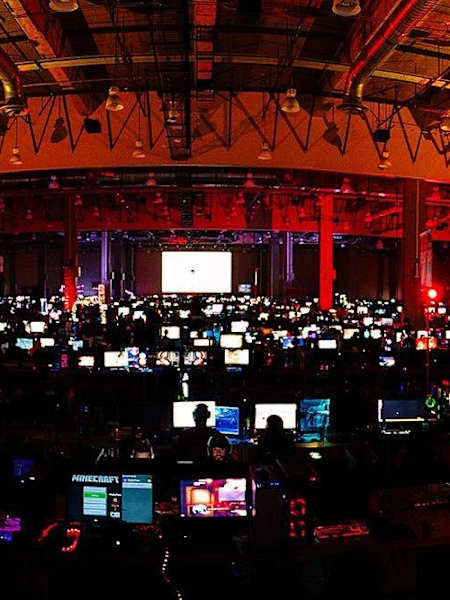
Today, the Bethesda-funded QuakeCon is a juggernaut of an event, drawing thousands of attendees to the lavish Gaylord Texan Resort for well-funded tournaments, splashy game reveals, and the largest bring-your-own-computer (BYOC) LAN in North America. It's changed, certainly – but look a little closer, and much remains the same. QuakeCon is still largely volunteer-run, it seeks to champion the world's best Quake players, and it encompasses such a love and appreciation for games of all sorts.
Over the years, QuakeCon has expanded and evolved, but so much of what people loved about the early events still thrives today – and it will continue on for some time to come. At QuakeCon 2018, we spoke with employees from id Software and Bethesda, as well as pro Quake players, about what the event means to them and why it's still such an essential experience over two decades later.
Dramatic evolution
Before the days of Discord, Twitch, Reddit or other rapid forms of social media, QuakeCon's humble origins tie back to the classic IRC chat room channel #quake on the long-running EFnet server. Quake released back in 1996, kickstarting the multiplayer era for first-person shooters, and the moderators and fans in the chat room wanted to meet up to play the game in person and determine the best player in those seminal early days. And they chose to do it at a Best Western hotel outside of Dallas, in the hopes that id Software developers might show up.
"They decided, 'Let's go to Dallas, and maybe some of the id guys will visit us.' About 30 guys showed up at this hotel down the street from id, and they're like, 'This is QuakeCon, it's a convention,’" explains Tim Willits, id Software studio head and longtime employee. "So we went down there and met with them, we played some Quake, and it was a ton of fun. From there, it just grew."
QuakeCon remained a fully community-planned event the following year, albeit one which had "some id guys just sliding a credit card under the door every now and then," says Travis Bradshaw, lead programmer, during a panel discussion on the convention's history. In 1999, however, QuakeCon aligned with the budding Cyberathlete Professional League, and issues with both the venue and partner created what Bradshaw called "a question about the identity of QuakeCon in that situation."
That's when id Software stepped in, and QuakeCon 1999 featured id as both the primary sponsor and a wrangler of other sponsors. From there, attendance gradually climbed year after year, as the late-summer event delivered the year's top tournament for whichever Quake was the competitive standard at the time, along with other id Software first-person shooters of the era – like Doom 3 and Return to Castle Wolfenstein.
After ZeniMax Media acquired id Software in 2009 and id became aligned with Bethesda Softworks, longtime fans might have feared another identity crisis or awkward changes. Instead, Willits stresses, Bethesda helped elevate QuakeCon while letting id retain its unique spirit.
"They let id continue to run the event the way we wanted, but they were able to bring in more resources," Willits explains. "Bethesda could have come in and hired an event company and changed everything, but they didn't and they were great."
Pete Hines, Bethesda's senior vice president of global marketing and communications, affirms that Bethesda's main influence was providing resources and offloading some of the responsibility from id and volunteers. However, they have also tried to gradually tweak QuakeCon to build more excitement for both id and Bethesda games.
"The keynote used to be, 'Here's everything that's going on at QuakeCon,' and then [John] Carmack gave a really technical talk for an hour and a half that, if you understood it, I'm sure it was awesome. I didn't; I didn't understand most of what he was talking about," Hines admits. "We've shifted that now to like, 'Hey, we're gonna show you some games.' It feels almost like a mini-E3 showcase."
It's the classic soul of QuakeCon, a bit of the glitz and early hands-on experience of E3, and a whole lot more spread across four days at the Gaylord Texan.
Who's the best?
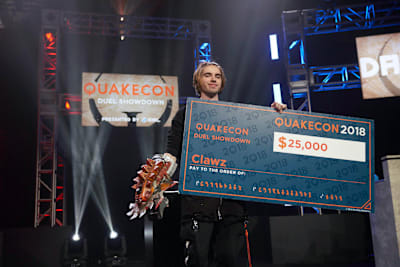
Clawz is the back-to-back Duel champion
© fred.camera
Even as QuakeCon grows to encompass many more things, including board games, comedy performances and developer panels, the event still has its heart in competition. And that has only ramped up over the years, with last year's $1 million Quake World Championship arguably marking a new high point.
"Even at the original QuakeCon, competing in Quake was a sport. Quake was one of the games that pioneered esports, because it's all about competition. People love the 1v1 style of Quake. People like to say, 'Who's the best Quake player now?' So we've run Quake tournaments, esports events from 1996 to this year," says Willits. Because it's skill-based, it's fast, and it's fun to watch these Duel matches, it has always resonated with our fans. And I say once you've fallen in love with Quake, you'll love it forever."
The annual tournament has remained a primary focus of QuakeCon even during the years in which there wasn't a big, new Quake game to build buzz around the competition. For several years ahead of Quake Champions' early access release in 2017, the main tournament revolved around Quake Live, an updated version of the classic Quake III Arena. Id Software had a few quiet years in that stretch, but the world's best pro players kept coming back to compete and find out, as Willits says, "Who's the best Quake player now?"
"QuakeCon has always been prestigious, no matter what Quake they had here. Even when I was young and wasn't competing, you wanted to see who was playing in the big tournament on the final day," says Team Liquid's Shane ‘rapha’ Hendrixson. "For me, being able to come from that and to be a QuakeCon winner, and trying to continue that into Quake Champions from Quake Live, that's what I want to do."
"It's the biggest event of the year, typically, and so it's something to always look forward to. It's going to be there," adds DaHanG. "The only reason I continue to play at my age here is because I'm still interested in competing. Since this is the biggest event of the year, it means a lot to be able to compete at the highest level and hopefully take another championship home."
As Quake Champions grows as a modern-day esport, QuakeCon is no longer the only significant event on the calendar. However, it remains the gold standard: all of Quake's true legends emerged from the QuakeCon gauntlet, and etched their names in its competitive history because of they did it on the game's biggest stage.
"QuakeCon is the mecca of places for the true Quake believers," says Willits. "If you ever want to become one of the world's best Quake players, you need to come to QuakeCon to compete."
Looking forward
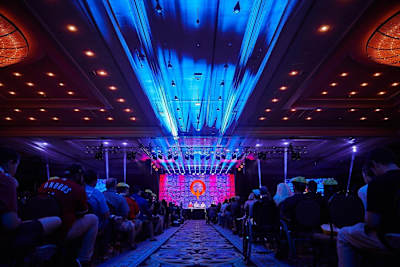
The Doom Eternal reveal was the main stage highlight
© fred.camera
Given its origins and the 20+ years of annual action to date, it seems certain that high-level competition will always remain the core of the QuakeCon experience. And this year, Bethesda added The Elder Scrolls: Legends Masters Series to the fray, showing potential for expansion beyond id Software's own games – or even shooters in general.
However, there's so much more to QuakeCon now. Just this year, id Software unveiled the first gameplay footage for the upcoming Doom Eternal, and while the keynote was also streamed online, there was a palpable energy and excitement in the room that Twitch chat and Twitter just couldn't match.
Hines says one of his most memorable QuakeCon moments came when Bethesda showcased a live demo for The Elder Scrolls V: Skyrim in 2011 – and the crowd went wild. That can be "a very energizing" experience for developers, he claims. "It was like today [with Doom Eternal], where they were like frothing at the mouth with excitement and passion for something," he recalls of the Skyrim reveal. "They just lost their minds. It was insane."
That's the higher-profile, corporate-led side of things, but so much of the feel and fun around QuakeCon comes from its community side. It's still heavily volunteer-run, and some of the people attending in 2018 have been going to QuakeCon for years – or maybe even decades at this point. And while QuakeCon was built around shooters, it has grown to be something that kids and families can appreciate, too.
"There are people here at QuakeCon that came to QuakeCon, met their girlfriend or boyfriend, got married, had kids, and now they come back as a family. And the whole family shows up, and this is where they take their vacation," says Willits.
Even as gaming-centric conventions multiply, including the likes of PAX and DreamHack, QuakeCon remains very much its own thing. "It's just this really interesting community feel that is unique. I'm not saying better or worse – it's just different. There's a real passion and excitement and inclusiveness," says Hines. "Where this one comes from, in terms of love for certain kinds of games and a certain studio, just gives it a slightly different slant."
What does the QuakeCon of the future look like? Probably a lot like the QuakeCon of today, at least in broad strokes, but Hines suggests that they're always looking for ways to build upon that experience without shedding its one-of-a-kind allure.
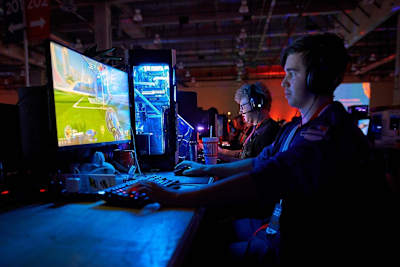
The BYOC was buzzing well into the night
© fred.camera
"We're not, by any stretch, done," he declares. "We still want to think about and figure out what is a longer-term path for QuakeCon. What does it need to look like in subsequent years while still retaining what QuakeCon is right now?"
And what QuakeCon is right now, and has long been, is a place for the community to feel whole. Whether that's competing in Quake, making new friends, seeing the next big games on the horizon, or just enjoying time with the family, QuakeCon holds a lot of meaning for a lot of people. When we asked Quake Champions community manager Joshua Boyle about it, he echoed a comment that Tim Willits said in a separate interview, but then was clearly emotional about his response.
"This is the mecca. This is the place to be, where, not only did it all begin here, but it continues," Boyle says. "This is the place where Quake began and where Quake will always live as what brought us all together, and what we still love to get in and have fun and play together."
