

Surfing
The Shape of Water
Photographer Ben Thouard captures extraordinary images of the legendary waves around Tahiti, and those bold enough to ride them. Here he shares just how he got these otherworldly shots.
The glass wave, December 2015
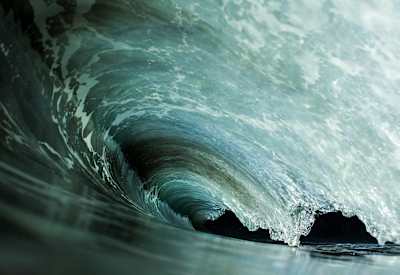
The Glass Wave
© Ben Thouard
“This is the north coast of Tahiti, with swells coming from Hawaii and even further away. A big wave—what we call a shorebreak—forms at the edge of the black sand beach and this gets stirred up, creating a variety of colors. We’re at sunrise here with a cliff behind, so it looks black. The first rays of sunlight shine out over the cliff and light up this lip of water, providing strong contrast, as if it were glass or lace. I’m at the edge of the beach, with the tips of my fins almost touching the bottom. You don’t want to get caught by the wave—it can hurt. I’ve lost my camera and fins before. You can actually get dismembered by the impact of the lip on the sand.”
Emergency exit, August 2017
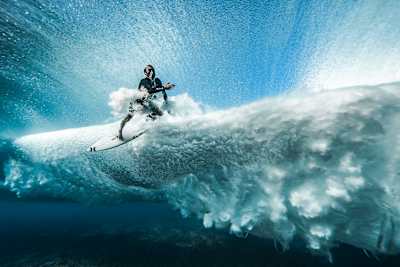
"I’m underwater with Australian surfer Adrian Buchan"
© Ben Thouard
“I’m underwater with Australian surfer Adrian Buchan, beneath the famous Teahupo’o wave [routinely considered the world’s most dangerous due to its size and power, and because it breaks over a sharp coral reef]. Often with waves that break on the shore, there can be a sandy bottom that stirs up, but here, several hundred meters offshore, it rolls over a coral reef devoid of sand and particles and we have exceptional clarity. Here you can see it’s crashing and the wave doesn’t ‘open,’ so Adrian decides to get out by going through it—he slips under the lip. I was about to shoot Adrian through the tube and then he popped through the wave as it crashed. That’s what makes this unusual shot: Adrian is standing on his board, but underwater.”
Blind mode, April 2016
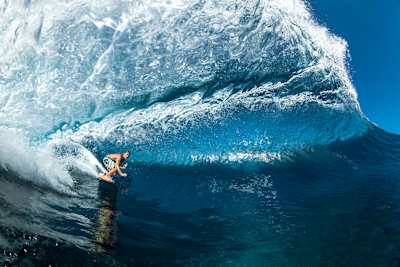
Blind Mode
© Ben Thouard
“I’ve always liked shots close to the action, so here, with French surfer William Aliotti at Teahupo’o, I’m just under the lip of the wave, and it’s about to crash completely onto the waterproof case that contains my camera. I’m already completely underwater, starting my dive to escape the impact, but my arm is still out of the water to shoot. And then—hop!—I pull my arm under. I have to get beneath the surface to avoid being thrown. I shoot blind and play with risk, getting fraction-of-a-second shots before everything explodes.”
Slab hunter, April 2020
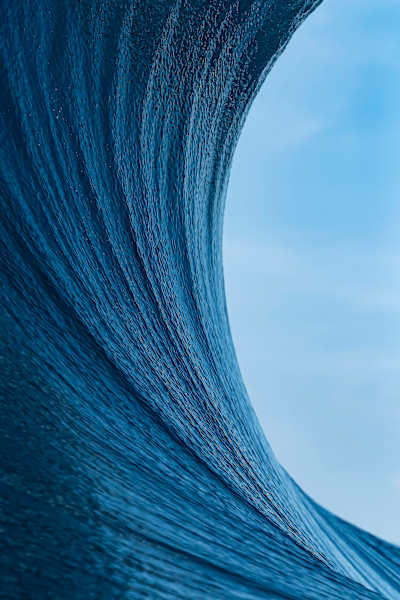
Slab Hunter
© Ben Thouard
“In addition to my work as a surf photographer, I got interested in locations that are not necessarily surf spots, where the waves become incredible shapes. Here, not far from Teahupo’o, is an overhang of reefs where the waves break into tubes. I’m in the water with a 300 mm [telephoto zoom] lens, which isn’t common to shoot swimming but it allows me to have this concentration on this curve, this detail. I love the texture on the surface, and this gigantic majestic curve. You can’t see the bottom of the wave on the right, but it’s 4 to 5 meters high. This kind of atypical shape has a name: a slab.”
The wait, May 2019
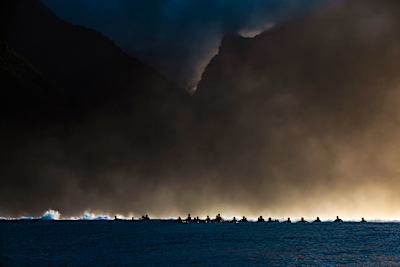
The Wait
© Ben Thouard
I shoot blind, getting fraction-of-a-second shots before everything explodes
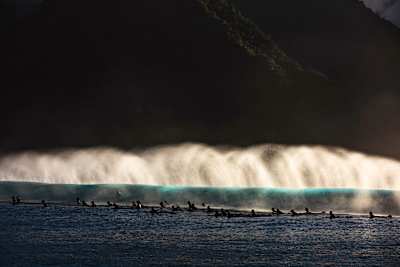
The morning breeze ripping the foam off the lip of the wave
© Ben Thouard
“These two pictures are the same place, same day: Teahupo’o at 6 a.m. The morning breeze is ripping the foam off the lip of the wave, the low-angled light of sunrise illuminating the flying foam, with big mountains in the background. In the top photo the surfers wait, eyes riveted to the open sea. In the photo below, a surfer has rolled out with a wave, and the others are positioning for the next one. I work a lot on a jet ski, because it allows me to be very mobile, reactive and, above all, alone and autonomous. Here I’m behind the waves, looking toward the shore. It gives me a completely opposite angle.”
The belly of the beast, July 2015
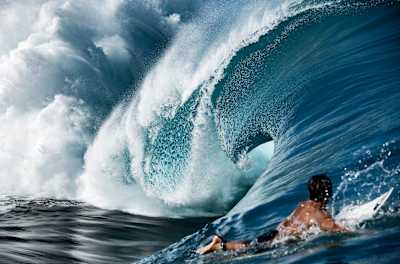
In the belly of the beast
© Ben Thouard
“This swell was so big, surfers were being towed in by a jet ski. You can see tons of water coming down on the reef. Despite these conditions, Tahitian surfer Matahi Drollet surfs with the strength of his arms, just managing to get over this rolling monster. I’m on a boat, really close. The success of this photo is in the hands of the boat captain, a local fisherman who knows the Teahupo’o wave very well.”
The believer, May 2013
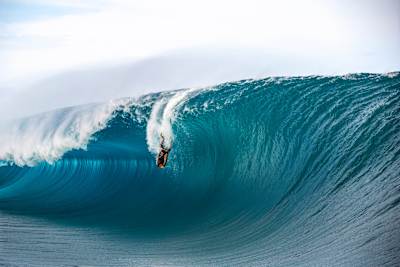
The Believer
© Ben Thouard
“Teahupo’o again. Australian Dan Ryan went for a wave that nobody else wanted. He believed it all the way, but when the wave hit the reef, the lip threw him up in the air before crashing down the next second. The wave took him into the lagoon without too much injury.”
I took thousands of images before I got this—years of failed photos
Master, May 2019
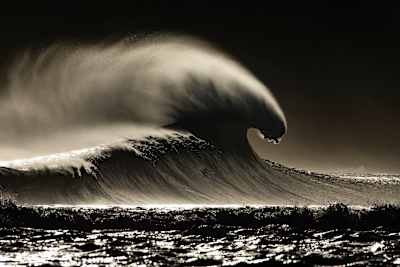
Master
© Ben Thouard
“People ask if I’ve doctored this picture. Not at all. We’re an hour before sunset, with a mountain behind us, looking in the direction of the sun, with offshore wind pulling spray from the swell. This creates a play of light: droplets of reflected water contrasting with a background in shade. Two elements fighting—water and wind.”
The unknown surfer, May 2019
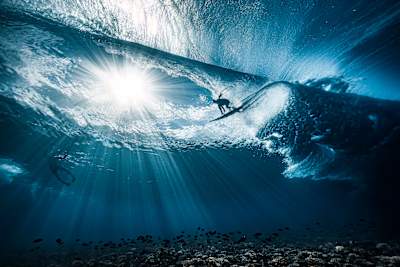
The Unknown Surfer
© Ben Thouard
“Under the Teahupo’o wave. On this day, the wait between waves was very long, sometimes 25 minutes, but with big waves creating a lot of water clarity—you can see the fish and coral in the foreground. I shot all morning to get two or three photos, placing myself at the bottom of the water. You have to anticipate the wave, dive at the right moment, turn around and prepare your settings and framing—all underwater. It looks like the surfer is flying, with the sun hitting the fish. This image may be relaxing to look at but not to shoot. I still don’t know who this surfer is.”
“If you make a mistake, the ocean is unforgiving
The Red Bulletin: How did you get your start?
Ben Thouard: I’ve been a surfer since I was very young, but I lived in Toulon [on France’s south coast], which isn’t the best region for surfing, so in my teens I started windsurfing, then took up photography, doing an internship with Bernard Biancotto, one of the pioneers of windsurf photography. At 19, I got the chance to go to Hawaii to take windsurfing photos. I had my camera and a waterproof housing I’d made myself. That took me to Tahiti in 2008 and it was love at first sight. The culture, the people, the quality of the waves, the clarity of the water, the changeable light and different atmospheres in the same day—everything was attractive. I settled here to develop photography around surfing. I was 22 or 23.
At what point did you decide to take pictures of waves without surfers?
About six years after I moved to Tahiti. There was a gradual evolution in my work. It may sound sad, but surf photography is more of a job; wave photography has become a personal work, a reverie. I wanted to free myself from the constraints of the press or brands that commissioned me and communicate what attracts me about the ocean; to make images that are timeless. The surfer’s outfit and board will date a surf photo, but a good shot of a wave will still be good 20 years from now. I worked hard on the subject, shooting waves in all kinds of conditions, then started selling the photos online. I self-published my book dedicated to waves, Surface, in 2018. This November I will be bringing out a new book, probably titled Turbulences.

Why do you choose to photograph something so untameable?
What fascinates me about waves is capturing a single, fixed image that can be aesthetic, graphic or simply beautiful; one that communicates the power of the ocean—a majestic shape, an explosion, a vortex that appears under the water as the wave breaks up. It’s fabulous to convey the beauty of nature and its strength, which can be frightening.
What do you feel when you’re in the waves?
Excitement. And when it’s a big wave, a bit of fear, of course. I’m also awestruck to be in front of so much beauty. When you’re under the waves of Teahupo’o, it’s an extraordinary sight.
There’s a high level of physical fitness to what you do. What’s your routine?
I surf as much as I can. Also, I shoot several times a week, and when we have great conditions I’m in the water for three hours in the morning and three in the evening—that’s a lot of swimming on the spot, waiting with my camera. Then suddenly a series of big waves arrive and there’s a sprint, either to escape the wave or to get in the right place to shoot, before diving under—it’s a dynamic kind of freediving.
If you make a mistake, the ocean is unforgiving
What kind of camera do you need to shoot above and below the water?
I use a Canon, but not a special waterproof camera. It’s a classic from the professional 1D and 5D series, which can shoot bursts of 15-20 images per second with very fast autofocus. There’s not only one way to shoot surfing. I use classic lenses: a fisheye, wide angle, or others when the waves are bigger. You can also use a big telephoto lens that fits inside the Aquatech waterproof housing. I have a little under 5kg of equipment at my fingertips.
Do you use a grip?
Yes, it’s a bit like a speargun, for shooting with my arm out of the water to get those last moments. There are also interchangeable windows on the waterproof housing to swap lenses, and buttons for camera adjustments and to operate the shutter, because I shoot manually. It’s all attached to my arm with a leash like the one on a surfer’s ankle. You have to swim, position yourself, frame and focus, and when the surfer breaks into the wave at Mach 12, don’t miss. And if you make a mistake, it’s unforgiving.
What do you mean?
I’ve found myself thrown onto the reef as if plastered to a floor of razor blades. You feel torn apart. It can rip your fins, or your leash can throw the camera into your face. The goal is to be in the heart of the action without being locked inside the wave, and to always have an exit.
Ever feel like you’ve had enough?
I’ve been on the water for more than 15 years, but I’m still amazed by what I see. It’s always moving and changing, so it’s exciting. That’s the power of passion.
