
Surfing
Caity Simmers: Calm in the Chaos
At 18, Caity Simmers has risen to surfing stardom with dizzying speed—and she’s doing it with a style that’s all her own.

There’s an image of Caitlin Simmers sliding through a dark-blue cavern at Teahupo’o in Tahiti. The wave towers over her with a face that’s easily 8 feet tall, maybe more. She looks perfectly poised. She folds her 5-foot-3-inch body over the thin fiberglass of her board and grasps her outside rail as she holds a precarious balance against the ocean’s force. Simmers looks at home there, slipping through a dream, deep in the embrace of one of the world’s most dangerous waves. She is where she’s meant to be. And she hopes to be right back there, gliding through that mesmerizing tube when the very best surfers return to Tahiti this summer with the whole world watching.
Growing up in Oceanside, California, Simmers never expected to become one of the best surfers in the world. She spent weekends playing in the waves at the end of Cassidy Street and ate tacos at Primos. She imagined becoming a professional boogie boarder. She tried BMX, hip-hop dancing and skateboarding, but her family gravitated to the beach. Her father, Jesse, surfs, and soon Simmers learned. Eventually, a friend suggested she sign up for a contest. Simmers only made one heat that day, but it didn’t matter. The lure of competition hooked her.
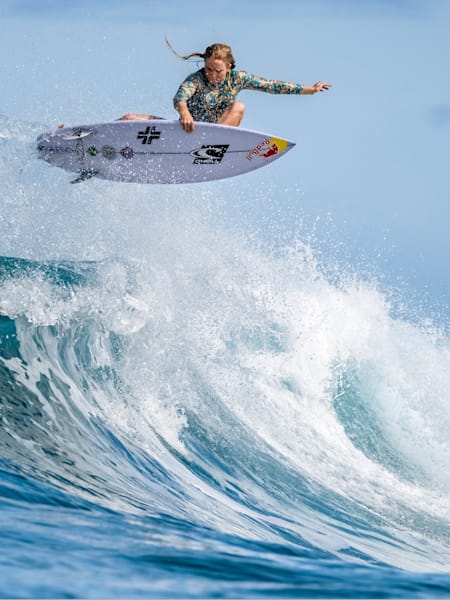
Since that first contest, Simmers has made a stunning ascent through surfing’s ranks and developed a dynamic, expressive style. At 15, she won the prestigious U.S. Open of Surfing at Huntington Beach. By the end of the year, she had become one of the youngest surfers ever to qualify for the Championship Tour, which is surfing’s highest level of competition. After delaying her Tour debut for a year, Simmers won two events and finished an impressive fourth in the world in 2023. She also found time to release a creative video edit that she called Bell Jar.
Then in February came her biggest accomplishment yet when Simmers opened her 2024 season with a win at Pipeline. On what’s widely considered to have been one of the best-ever days of women’s contest surfing, Simmers beat hard-charging Australian Molly Picklum in a hotly contested final. Her defiant and triumphant cry—“Pipeline’s for the f*cking girls”—ricocheted around the internet. Women had only competed at the fearsome North Shore wave for three years. Simmers made it clear that they were there to stay.
When The Red Bulletin caught up with Simmers late in April 2024, she stood at the top of the world rankings. She spoke candidly about both the challenges and joys of competing, about the fear that waves like Pipeline and Teahupo’o inspire, and about how she came to name a surf video after a Sylvia Plath novel. Simmers is creative, funny and thoughtful by turns. For her, surfing is more than contest heats and more than world rankings. Surfing is art and self- expression, and Simmers is determined to carve out her own path, one wave at a time.