Big-wave surfers aren’t professional paramedics, but when something goes down in the ocean they often have a chance to save lives. Go inside the movement to make surfers skilled first responders.
By Christine Yu
12 min readPublished on
Jamie O’Brien couldn’t decide whether to surf. It was December 31, 2019, and the North Shore of Oahu was gifted with a long-period swell—a solid 12 to 15 feet. But it looked funky.
As he watched the waves from the third floor of his home near the famous surf break Pipeline, he saw a surfer take off and roll-in from second to first reef. As the surfer trimmed across the wave, it clamped and he went up and over. It didn’t strike O’Brien as a bad wipeout, but he caught a glimpse of something that didn’t look right. “He was kind of up and it didn’t look like he was moving. It looked like his board hit him on the head,” he says. The surfer was worked by the next wave and O’Brien heard whistles from next door.
“Right then I knew I needed to act,” he says. He cinched his gray sweatpants tight, ran down the stairs and grabbed a soft-top board on his way out the gate. At the beach he saw jet skis and lifeguards bringing the surfer to shore. Only then did O’Brien learn that it was Kohl Christensen, one of the North Shore’s best big-wave surfers.
O’Brien says his instinct to do something in a life-or-death situation is in his blood. “I pride myself on living here and being a waterman. If I can help someone in a not-so-good situation and I’m ready to go, I’m going to go. I’ve saved a few lives over the years by acting,” he says. “I would hope someone would do the same for me.”
Christensen fractured his skull and was unconscious when he was brought to the beach. He was rushed to The Queen’s Medical Center in Honolulu, where surgeons cut a baseball-size hole in his skull to repair his ruptured dura layer and remove blood between his brain and skull. He did not sustain any brain damage or lose motor skills. He is expected to make a full recovery, thanks in large part to the swift response of the North Shore lifeguards and others on the scene.After five days in the hospital, Christensen returned home to his family.
Ironically, Christensen’s passion is teaching others the same rescue skills that saved his own life. In 2011, spurred by the death of his good friend Sion Milosky at Mavericks, the famed big-wave spot in California, he and fellow charger Danilo Couto started the Big Wave Risk Assessment Group (BWRAG). Their mission is to educate and train surfers in ocean risk management and safety protocols and to make the lineup safer for everyone.
In the early 2010s, surfers like Christensen, Couto and Milosky were scoring gigantic bombs at Cloudbreak, Teahupo’o and Pe’ahi and helped usher in the resurgence of paddle-in big-wave surfing. “We grew up running it pretty loose. Between 2010 and 2012, everyone was pushing it really hard. It was right before the advent of any real safety system and any inflatable vest had come out,” Christensen told me late last year before his accident.
We’re dealing with life risk all the time and we’ve lost friends. We know every time we go surfing big waves, we face those risks again
Big-wave-surfing legend Carlos Burle
In March 2011, a group that included Couto, Milosky and Nathan Fletcher flew to California to catch a late-season swell at Mavericks. On March 16, Milosky rode some of the best waves of the day, with faces around 20-feet Hawaiian. Late in the afternoon he took off on a wave, made the drop and bottom-turned before he went down. No one saw him come up. Later, his body was found at the mouth of Half Moon Bay Harbor, roughly a mile from the break.
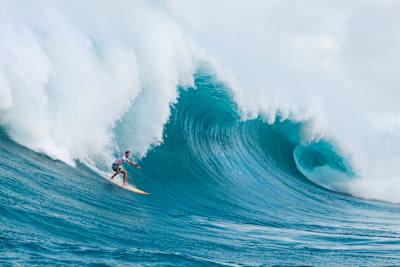
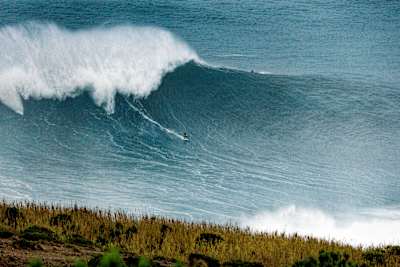
Every sport has risks. In surfing, there are hazards like currents, reefs, sea creatures, rocks and surfboards themselves. To chase the biggest waves on the planet, surfers travel to remote locations miles offshore, potentially hours from lifeguards and medical help. While that’s part of the appeal, the discipline poses unique dangers. It can be hard to keep track of everyone in the turbulent environment, and there’s a small window of time—a few minutes—to rescue a surfer in trouble. “We’re dealing with life risk all the time and we’ve lost friends,” says big-wave-surfing legend Carlos Burle. “We know every time we go surfing big waves, we will face those risks again.”
And if you go down, it can be violent, your body thrashed like a rag doll. In 2003, Burle was surfing perfect 18-foot waves at Pe’ahi on Maui when he had his worst wipeout. “I had just fallen from one wave and as I was trying to cross the next, I was caught and thrown to the bottom of the sea,” he says. He heard his bones fracture. He broke his back, sacrum and femur.
While avalanche training and wilderness medicine courses are de rigueur for skiers, snowboarders and others heading into the backcountry, there’s nothing comparable in the world of surfing. There’s no universal language or safety protocols, and surfers traditionally haven’t been methodical about safety. “I remember the irst time I saw someone wearing an impact suit. We all laughed at the guy. It looked like a muscle-man suit,” says Christensen.
For Couto, Milosky’s death was a wake-up call. Couto and Milosky were at the top of their careers, both winning XXL Big Wave awards in 2011 (Milosky posthumously). “I was right next to him when he took off on his last ride. It shook me hard. Seeing someone close to me die, I felt like I had to do something and honor him,” says Couto. He began asking everyone, “What are we doing about safety? How many more athletes have to be sacrificed because of a lack of organization and mobilization?”
That year, a group of roughly 20 surfers gathered at Christensen’s farm on the North Shore and learned CPR. Christensen describes seeing a thirst for more lifesaving knowledge and skills. He and Couto just had to figure out how to quench it.
Two and a half weeks before Christensen’s New Year’s Eve accident, he and Couto are gathered with a group of 50 people in a conference room at Turtle Bay Resort on Oahu’s North Shore for day one of BWRAG’s Global Training Summit. It’s the day after the Big Wave contest at Pe’ahi and a lay day for the Billabong Pipe Masters contest. At the front of the room stands Brian Keaulana, son of Buffalo Keaulana, a pioneer surfer and iconic Hawaiian waterman.
Keaulana recounts surfing Pipeline in the pre-jet-ski days. One day, between catching waves, he rescued three people back-to-back and brought them to shore using his surfboard. “Everyone sitting back in the lineup said, ‘Wow Brian. I feel so safe when you’re around.’ I look around at everyone and thought to myself, ‘Who the fuck is going to rescue me?’ ” he says, chuckling.
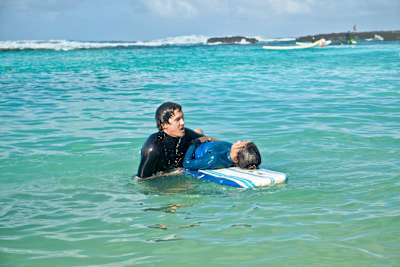
Greg Long demonstrates how to bring an unconscious person onto a surfboard
Keaulana is the main reason BWRAG has continued since that first CPR class in Christensen’s barn. He’s largely considered one of the most venerable ocean safety experts. At Mākaha Beach, where Keaulana grew up on the West Side of Oahu, surfing and lifesaving go hand-in-hand. If someone goes down in the water, everyone stops and focuses on making sure that person is safe. “We are stewards of the land and water,” he says. “Making everyone safe is just a by-product of who we are.”
So it makes sense that when Couto and Christensen approached him about creating a safety training program, Keaulana had one request: Share the knowledge. “My whole goal is to make [the surfers] better than me, to plant the seed so they can bear the fruit later,” he says. “We want to make sure husbands, wives, kids, grandpas and grandmas all come back home. To save someone’s life, it’s an amazing gift.”
Keaulana experienced his own tipping point years earlier. He was supposed to be part of the fateful trip to Mavericks in 1994 when legend Mark Foo drowned, and he’s lost other close friends. Keaulana began training people all over the world, from lifeguards to military personnel to government agencies. “When Kohl and Danilo approached me, I was already thinking we need this, that I should focus on surfers and train them to be elite lifesavers,” he says.
“We know in big-wave surfing, the first person to get to the victim is a surfer,” says Burle, who has attended past BWRAG courses. “You don’t want to see your friend need your help and put their life in your hands,” he says when recalling his 2013 rescue of Maya Gabeira at Nazaré in Portugal. “The better trained you are to avoid these situations and, if they happen, know how to deal with them, the better it is for everyone in your community. We can avoid losing a friend or even getting an injury.”
Carlos Burle, seen here at Nazaré, rescued fellow pro Maya Gabeira in 2013
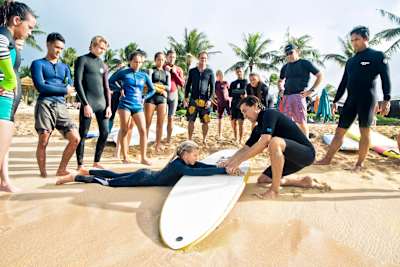
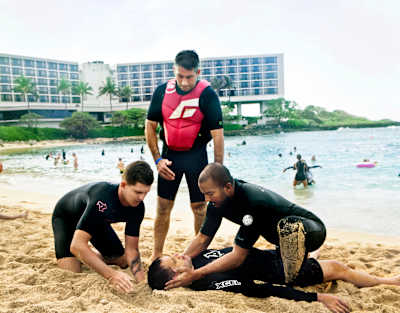
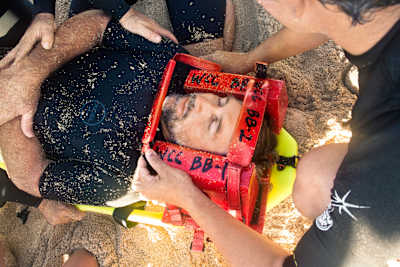
While there are lifeguarding courses, they can be time intensive and expensive. BWRAG offerings are accessible and affordable. With the help of Keaulana and Pat Chong Tim, an ocean risk and safety specialist, the courses have evolved to teach people to become skilled risk technicians who are aware, ready and able to handle the simplest to the most complex situations in the water. They’ve brought on noted big-wave surfers like Greg Long, Mark Healey, Andrea Moller and Jon Hoover to provide hands-on and in-water training. Over the course of two days, they teach surfers how to create risk management and emergency action plans; how to perform medical interventions like CPR, C-spine stabilization and tourniquets; how to communicate in the water via hand signals; and how to perform surfboard and jet-ski rescues. They talk about safety equipment like inflation vests.
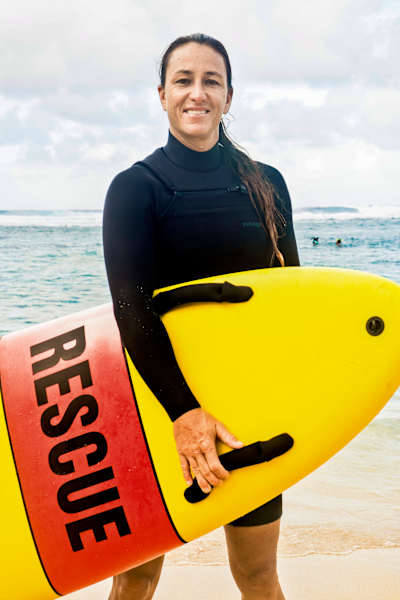
That’s why Emelia von Saltza signed up for the December summit. The North Shore resident has winged a couple of surf rescues in the past, most recently picking up someone who dislocated his shoulder. “If he was unconscious or a clean-up set came in, I wouldn’t have known what to do,” she says. “I feel like it’s my responsibility. If I’m going to be a part of this crew [who have all completed BWRAG’s course], I should have the same training as them.”
Couto says the thirst for BWRAG’s expertise continues to grow. In 2014, they brought the training to Mavericks for the first time. Since then, they’ve taken BWRAG on the road to the Azores, Australia, Ireland, Chile, Brazil, Puerto Rico and other parts of California. They have 14 trainings on tap for 2020. Christensen’s vision is to eventually create the equivalent of the training courses conducted by the American Institute for Avalanche Research and Education (AIARE) but instead for the ocean, complete with different levels.
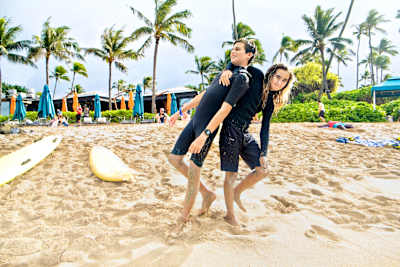
“Groms” Jake Maki and Nalu Deodato practice a cross-chest carry
The program isn’t just about learning lifesaving skills, and it’s not just for big-wave surfers. “We teach about life, respect and culture,” says Keaulana. “We’re not divided by land. We’re connected by water. The land is where I sleep and eat. The water is where I live. All of us—that’s my ocean family. That’s who we’re guiding and protecting. That’s the real movement of BWRAG.”
Train. Go home. Refresh your knowledge. Pass on the knowledge
Danilo Couto
Since BWRAG’s inception, there’s been a shift in the culture in the lineup. “I’ve 100 percent noticed people are more confident and able to react faster,” says pro surfer Eli Olson, who has attended several BWRAG summits and won last year’s lifesaving award. “It seems like the community is more aware and is looking after each other, whereas a handful of years ago people might have stood around longer or waited for someone else to do something.”
Throughout the two-day training summit, instructors keep returning to the idea of kuleana—the Hawaiian value of ownership and accountability. They ask, “What are you going to do? How are you going to respond?” It’s this new level of consciousness that Couto is most proud of. “Train. Go home. Refresh your knowledge. Pass on the knowledge,” he says.
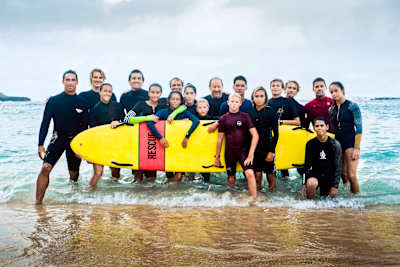
They’re planting the seed with the next generation, too. There are 11 “groms” in attendance at the December summit, hard-charging boys and girls. “Just knowing what to do in certain situations is useful. The biggest takeaway is it’s better to do something than nothing at all,” says Ty Simpson-Kane, 15, from Maui.
And it’s paying off. Five days after they earned their BWRAG certificate, groms Maikai Burdine and Diesel Butts were in the water when 13-year-old Hayden Rodgers went over the falls at Pipeline and hit his head on the reef. Burdine and Butts used the hand signals they recently learned to alert lifeguards to Rodgers’ location.
“We didn’t expect it [to grow into a movement] but we’re overjoyed. I mean, look at this,” says Tim, gesturing to the crowd of people on the lawn behind the Turtle Bay lagoon, who are enjoying some beer and music as the sun sets. “It’s amazing for us to be in the presence of this.”
As the light fades, Christensen says he keeps thinking that they’ll reach a saturation point, but the demand hasn’t stopped. “Every year, people come back with stories about how they’ve used the skills they learned at BWRAG and it saved someone’s life. That’s why we keep doing it. It’s been one of the most meaningful things I’ve been a part of,” he says.
When asked his future hope for BWRAG, Couto shakes his head and says, “It’s happening. I don’t need to hope anymore.”
In mid-February, Christensen is still trying to find the words to describe his shift in consciousness since his life-threatening injury at Pipeline. “I’ve been on the rescuer side but I’ve never been in a position where I would be dead if it weren’t for the action of others. A lot of stars aligned,” he says.
Christensen feels even more connected to BWRAG’s mission and plans to redouble his commitment to spread lifesaving knowledge to more people. “A lot of us have the passion because we’ve had friends die. That’s why we’re involved. But it gets taken to another level when you almost die and get rescued,” he says.
There’s clarity in Christensen’s voice, a sense of contentment he says he’s never felt before. While he hasn’t lost the desire to surf or chase swells, his mantra is day by day. “Before, I felt like I was living in the future or the past,” he says. “It wasn’t until this injury that it became clear to me on multiple levels that I have a real gift, and my gift is my family, my friends and my life. Every day is a bonus now.”