
Surfing
Surfer School of Rock
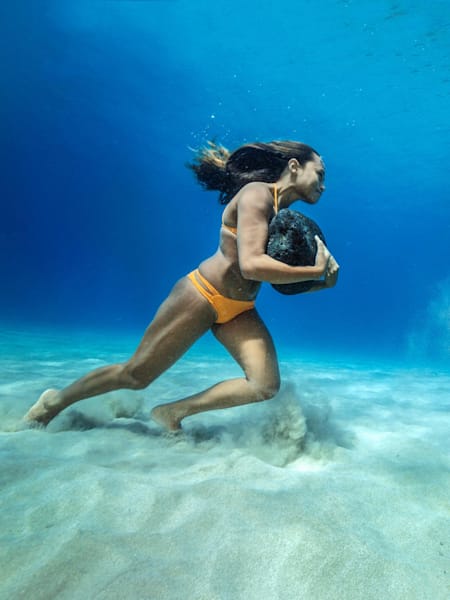
Hawaiian surfer Ha'a Keaulana was taught that running along the ocean floor with a 50-pound boulder could prevent her from drowning.
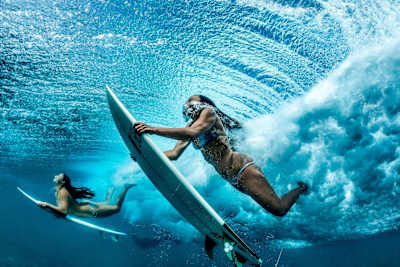
Keaulana and best friend surfing
© Paul Nicklen/National Geographic/Getty Images
For the watermen and women of Hawaii, surfing is a way of life. And sometimes death. The rolling thunder of the infamous Pipeline on Oahu’s North Shore can grab surfers off their board, slam them into the reef and hold their injured body underwater for more than a minute. It’s no wonder the ancient Hawaiians asked a priest, the kahuna, to anoint their boards and pray for good surf.
Modern islanders, such as Ha’a Keaulana, still observe tradition but are also more practically minded. The 26-year-old surfer, from Mākaha in the west of Oahu, trains by diving 30 feet to the ocean floor, grabbing a boulder and running for more than a minute. She learned the technique from her father.
“I was very young and didn’t really know what it was for," Keaulana says. “It was just fun at first, and then I realized, ‘Oh, it’s training for if we get held under.’” With around 12 seconds between waves, being able to stay under for a minute after a wipeout can mean surviving a four-wave hold-down. “Doing that and moving fills your lung capacity, and the depth prepares you for the pressure if a wave were to push you deep underwater.”
Her father, Brian Keaulana, knows his stuff — the big-wave rider has appeared as himself in "Baywatch: Hawaii" and "Hawaii Five-O," and, in his capacity as a lifeguard, pioneered Jet Skis for sea rescue. But his place in surfing legend is eclipsed by that of his own father.
I connect with my Hawaiian ancestry through my surfing.
“My grandfather is one of the original beach boys of Waikiki, the birthplace of surfing,” Ha’a says. “That’s what they call the guys who introduced surfing to visitors.”
For most of the 1950s, Richard “Buffalo” Keaulana was the Mākaha International Bodysurfing Champion, and in 1960 he took the surfboard title, too. He was one of Mākaha’s first lifeguards and in 1976 was steersman of the Hōkūle‘a, the double-hulled Polynesian canoe that sailed from Hawaii to Tahiti using ancient navigation methods.
Now, Buffalo is 83 and recently hosted the 42nd year of his Big Board Surfing Classic event in Mākaha. “It’s called that because the board can’t be any smaller than 10 feet,” says Keaulana. “That’s my grandfather bringing back the cultural connection — not so much radical, just having fun, reading the wave and feeling a connection with the ocean.”
Pro surfers often come in search of enlightenment. “Kelly Slater competed a couple of years ago in the canoe surfing,” Keaulana recalls. But this year brought something else: “Hōkūle‘a surprised us on the first day by sailing into the bay. It was beautiful and spiritual to have it there.”
That moment is a reminder, as if she needed one, of her family’s deep connection to the sea.
