
Rugby
Personal Capital
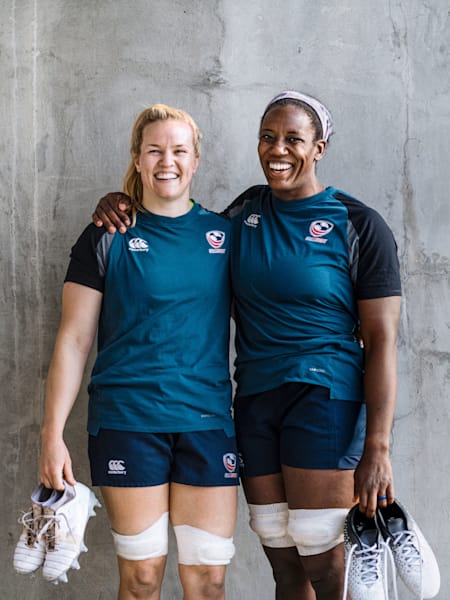
When USA Rugby lacked funding and failed to dole out equal pay for its all-star women’s team, two players took matters into their own hands.
There’s a formation in rugby called a “scrum” that’s a perfect blend of human bodies and physics. It involves players “packing” into a bunch by linking arms and shoulders. They push against an opposing team locked in the same position. The point is to gain control of the ball after one team “infringes” on one of rugby’s laws (throwing a ball forward instead of backward, for example). Men’s scrums are exactly the same as women’s scrums, as is every other element of the game. But for every week a male rugby player attends a national-team training camp, he receives seven times more money in living expenses than a female player doing the same thing. And that kind of inequity makes USA Rugby women’s team players Alycia Washington and Kristine Sommer want to scream.
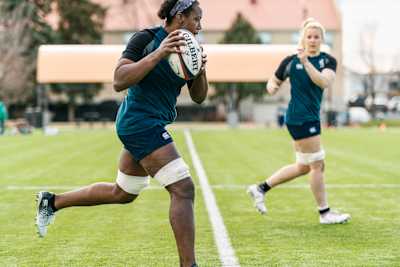
Players Alycia Washington and Kristine Sommer run hard at practice.
© Greg Mionske
Washington and Sommer are long-timers on the USA women’s team—both playing since their first year in college. Both were top-level high school athletes—Washington in track and field, gymnastics and field hockey; Sommer in volleyball and soccer. When both were college freshmen, they stumbled into rugby.
“I went to a social event with rookies and veterans, and I had never felt the camaraderie I did then,” says Washington. “I was a wee 17-year-old and all of a sudden I had 40 new friends.” Washington had never been told her physique was beneficial before, but now, “people were like, Oh my god, your size [6 feet tall, 200 pounds] is amazing.” Sommer recalls her first practice as a “crazy inclusive environment in which someone just threw me a ball, and the next week I was in full-time training. It sounds cliché, but changing sports was the easiest decision I’ve ever made.”
If the men had gotten fourth in the world cup, it would have been national news.
The two competed their way to rugby’s most elite level, and that’s where things got interesting. Rugby is on the brink of breaking out in the United States, in part because it was included in the 2016 Olympics. What little girls saw when they watched it with their parents was “a contact sport for women that embraces their size and power and doesn’t make them feel the need to be smaller or skinnier,” says Washington. “That mindset of ‘strong is the new skinny’ pulls girls into the sport, and culturally it helps out the rugby community hugely.”
The game is identical for men and women. “The ball is the same size, the field is the same length, and the rules are the same,” a player told me when I went to observe a USA Rugby women’s practice at the Infinity Park sports complex near Denver, Colorado. But a major difference between the USA men’s and women’s teams is that the women’s team has been more successful. At the 2017 World Cup, they placed fourth overall, while the men failed to win a single game. And according to World Rugby, women’s rugby is one of the fastest-growing sports in the world, with a 28 percent increase in registered players since 2017.
“If the men had gotten fourth in the World Cup,” Sommer says, “it would have been national news, and they would have gotten thousands of dollars from sponsors.”
What’s more, USA Rugby still supports women athletes at a fraction of the level it does the men. To participate in a camp, the women’s team receives just $100 per week per athlete for living expenses, while the men’s team receives $100 per day, says Sommer. Training for the World Cup is a long process and can be disruptive to daily life. “When you have a job or two that you rely on at home, relocating to camps becomes very hectic,” says Washington. “Our average age is late 20s, a point in life when you’re wanting to have things figured out. That’s hard when you’re chasing a dream that’s a moving target,” she adds, referring to the next World Cup getting pushed back to 2022 due to COVID-19.
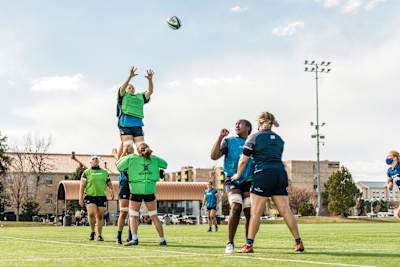
The USA Rugby women’s team during a practice session outside of Denver, Co.
© Greg Mionske
Instead of waiting for USA Rugby to pay them more, Sommer and Washington decided to tackle fundraising on their own. In January of 2020, they created the XV Foundation to raise money for their team. When they started, they googled how to do philanthropy and cold- called people they found on LinkedIn. But they found their donors—more men than women, they say, and many whose “experience was same as ours,” Washington says. “Being involved in [USA Rugby] really wrecked their financials for the next decade of their lives.”
By the end of 2020 they’d raised $200,000, and so far this year they’re at $30,000, toward a goal of $150,000.
That’s great, and Sommer and Washington say they’re honored to be able to help keep their players afloat. But they add that they don’t necessarily want to be doing it—they’d rather just focus on training. Now that they’re bringing money into the organization, though, they’re able to advocate for more equity in their sport. That’s important, says Washington, because “if we want this to be a sport for the [little girls who find it and feel welcome in it], there has to be something sustainable for them to look forward to.” To that end, they’ll keep the XV Foundation going, even though running it amounts to their “fourth and fifth jobs.”
“It’s bizarre,” says Sommer, “but we love the damn game so much that we are stretching ourselves to the absolute max so that players can be here and play to the best of their ability.”


