
Travel
Jump from the edge of Space
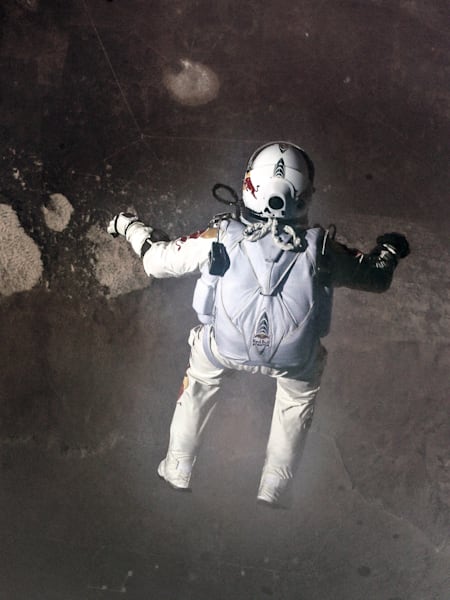
Ten years ago, BASE jumper Felix Baumgartner rose to the Earth’s stratosphere to leap from 39 kilometers, becoming the first human to break the sound barrier in freefall.
Let’s relive his fantastic journey.
Today, many commercial businesses eye space as their next great frontier, but in 2012 no private company had ventured to the edge of Earth’s atmosphere. That an energy drink company would be the first to do so is surprising. That the objective was scientific research is perhaps even more astounding. “We’d already climbed the highest mountains, crossed the Atlantic, and there’d even been men on the Moon, but no human had yet broken the sound barrier in freefall,” says Austrian skydiver Felix Baumgartner of this historic project. He should know—it was he who undertook this daring mission for Red Bull. It took more than five years to make this adventure a reality. A central challenge: How do you get a person to such a great height that they can break the sound barrier in freefall? The answer lay in a specially designed capsule elevated to at least 36 kilometers by a gigantic balloon made from a film just 0.02 millimeters thick, yet capable of holding 850,000 cubic meters of helium. There had to be zero wind at launch—the slightest breeze could have caused the membrane to tear.
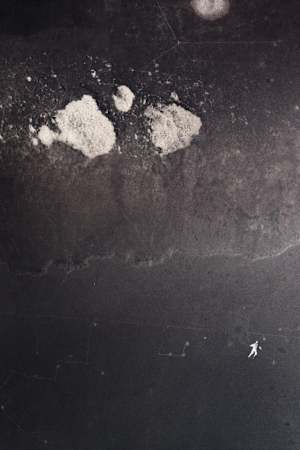
Up in space: The landing site new Roswell, New Mexico.
© Jay Nemeth
But getting into the sky was just the first obstacle. There is, of course, virtually no breathable air in Earth’s stratosphere, and at 19 kilometers above the planet’s surface the atmospheric pressure is so low that without a high-altitude suit an adventurer’s exposed bodily fluids—tears, saliva, moisture in the lungs—would begin to boil at normal body temperature. The altitude at which this occurs is called the Armstrong limit.
But it was precisely this life-protecting pressurised suit that set the Red Bull Stratos project back by years. Baumgartner, already one of the world’s boldest BASE jumpers—he had jumped from the Christ the Redeemer statue in Rio de Janeiro, crossed above the English Channel using a carbon-fiber wing and leapt into a pitch-black cave in Croatia—found that he panicked whenever the visor on his astronaut helmet came down. He needed the help of a psychologist to develop the mental stability required to jump from the edge of space.
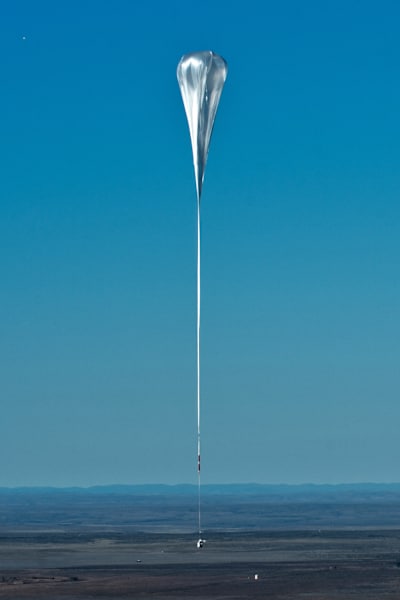
In 2012, no other private company had ventured to go to Earth’s atmosphere.
© Pedrag Vuckovic
And even his experience as a BASE jumper wasn’t enough. In the stratosphere, the air pressure he normally used to steer himself didn’t exist. Dr. Jonathan Clark, medical director of Red Bull Stratos, spoke of what he called a “flat spin” around the pilot’s own axis: “Half the blood goes to the feet, the other half to the head. The heart gets too little blood, and you become faint.” Tests on dummies from a height of 9 kilometers measured up to 120 rotations per minute—likely to render a human unconscious, at the least. Baumgartner edged his way towards the great adventure in multiple test jumps from increasing heights, learning how to move in the pressurized suit under controlled conditions.
The big day was October 14, 2012. Exactly 65 years after American test pilot Chuck Yeager became the first man to break the sound barrier in an airplane, Felix Baumgartner was to become the first to achieve the same feat in freefall.
At 4:45 a.m., Baumgartner, in the pressurized suit, began “prebreathing” pure oxygen, which he did for two hours to eliminate any nitrogen from his bloodstream. In the stratosphere, nitrogen would behave like carbonic acid when you open a bottle of sparkling water. At 7:45 a.m., he got into the capsule. “Now we had to wait for Don Day, our meteorologist, to give us the okay to start,” he recalls. “The trucks could only start filling the balloon with helium once there was no wind.” Several previous attempts had been called off because the risk of a faulty launch had been too high. At 8:44 a.m., the all-important signal finally came. It launched at 9:30 a.m. That was the point of no return. The first 1,200 meters were particularly dangerous—if anything had happened then, Baumgartner wouldn’t have had enough time to exit the capsule and open his parachute. But everything went to plan.
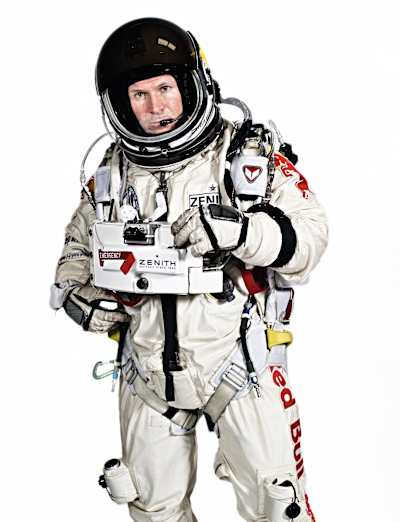
Baumgartner in his space suit.
© Joerg Mitter
At 12:07 p.m., the balloon stopped ascending. The altimeter showed 39,068.5 meters. “It’s hard to put into words what you feel at that moment,” says Baumgartner. “Nothing can prepare you for the moment when the sky above is pitch black and you see the curvature of the Earth 39 kilometers below. You become humble at times like that.”
Then he leapt, with the world watching in real time. “I didn’t feel anything in the first few seconds. No air, no sound, just nothingness. I broke the sound barrier but didn’t notice. You could only hear the sonic boom on the ground. Then came the dreaded flat spin. I was spinning uncontrollably for about 40 seconds, until I could finally assume a controlled flying position by repositioning my arms. At 1,585 meters, I opened my parachute and landed gently in the New Mexico desert at 12:16 p.m.”

Under pressure: Baumgartner undergoes training.
© Balazs Gardi

Ground Control breaks into celebration at a mission accomplished.
© Joerg Mitter
Red Bull Stratos was much more than just an adventure. As Art Thompson, the technical project leader, says, “The data we gathered will help develop future treatments for dealing with supersonic accidents.” Felix Baumgartner set three records that day: the fastest speed achieved without external propulsion (1,357.6 kph), the highest jump altitude (38,969.4 meters) and the greatest distance traveled in freefall (36,402.6 meters). The years of hard work in the name of science and adventure paid off.
Check out the interview between Felix and Star Talk's Neil deGrasse Tyson and watch the new documentary celebrating this monumental Red Bull moment:

1 min
Space Jump
Never-before-seen images and perspectives commemorate the legacy of Red Bull Stratos and Felix Baumgartner.

Explore more of the Stratos 10 year Anniversary!
