
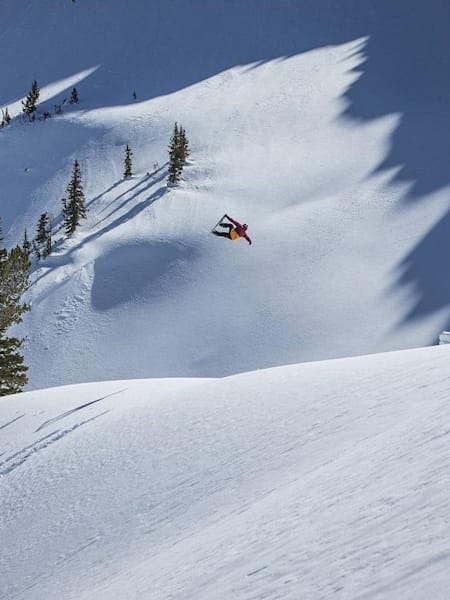
Snowboarding
Meet the man behind the biggest snowboarding films
Travis Rice has a relentless drive to go big and take centre stage. But what happens when big air isn’t enough? Here’s how he upped the movie-making stakes and produced The Fourth Phase.

Though Travis Rice is at the centre of two snowboarding films that have forever altered the sports-documentary landscape, he remains an enigma of sorts. For two decades, the American has been the byword for going big in the backcountry. He chooses lines down peaks that only a handful of his peers would conceive of, let alone attempt. That’s It, That’s All (2008) and, five years ago, The Art of Flight, brought his skills on a snowboard to mainstream audiences with a cinematic treatment typical of Hollywood blockbusters.
But very little was revealed about Rice himself, a deep-thinking young man who chooses his words carefully. In The Fourth Phase, which has its debut on Red Bull TV on October 2, Rice’s snowboarding vision, and the drive that allows him to break boundaries, is firmly in the foreground.
The narrative of his quest – which took three-and-a-half years – to follow a weather pattern is the backbone of The Fourth Phase. His journey has taken him from Tahiti to Japan and then all the way to Russia before venturing to Alaska and finally ending up in his home state of Wyoming. This is the story of The Fourth Phase, but it’s also the story of Rice, a seeker attempting to come to the grips with the fact that the relentlessness that’s defined his career might have a few limits.
THE RED BULLETIN: You grew up in Jackson Hole, Wyoming, a place that features prominently in all of your films. A career in snow sports must have been a given.
TRAVIS RICE: My dad was a ski patroller. My mother was the first one to get me on skis when I was two or something. I skied until I was 12 or 13 years old. I wanted to try snowboarding. It looked super fun, and I was kind of torn because I had skied forever.
Also, your dad being a lifelong skier.
The unsaid was kind of, ‘Are you sure you want to do that?’ In the end it was the simple fact that I didn’t get much pleasure from just turning on skis – it had to be an epic powder day. When I was snowboarding and starting out, it was a challenge; the simplicity of making a turn. There was a joy and thrill about getting the nuances of a turn dialled. Snowboarding is asymmetric. It’s a little harder than skiing and it’s more awkward, but with that comes this sort of art form of leaning into a single rail turn.
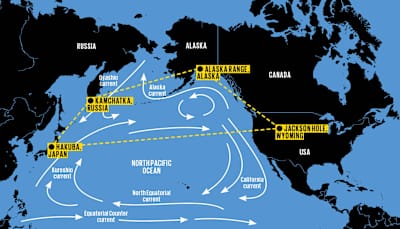
The North Pacific Gyre
© The Red Bulletin
Is it like trying to find a rhythm, trying to find the music in it?
One hundred per cent; and the beauty of finding a rhythm with the turn is, if you listen to a song it usually stays to this 4/4 measure and there’s something consistent about it. While there are patterns, Mother Nature is not consistent. You find the rhythm, but it’s spaced differently than a structured song. Because as you’re going down, you’re playing with the topography of the land, so your rhythm is constantly in flux.
Translating that approach to the big mountains you ride – do you have to have some sort of topographical recall in order to know what’s next?
You get really good at eyeing things up, and through trial and error you get better. The lines we ride, we are rarely winging it. When you scope your line from afar, it’s about picking out landmarks and monuments. As you go down, you have a lot of blind rollovers – you can see maybe 6m in front of you, but after that you can’t see anything except the bottom of the valley. So you focus on sections. So you know that blind rollover, that’s a landmark. You remember that landmark and you let go of any type of fear of going over it. And once you go over it, you find your next landmark. That’s how it works.
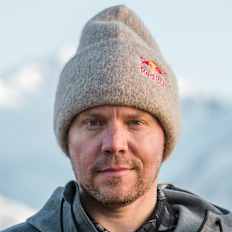
Travis Rice at home in Jackson, WY
© Zimmerman
But we’re talking about mountains with 30m drops off cornices and cliffs and incredibly steep angles. How do you make those quick adjustments?
That’s the beauty that we’re trying to find up there. People are trying to discover that flow, where you’re not trying to cognitively compute. It’s just action, reaction.
At the top, how much nervous energy is there? Is it about controlling fear?
It’s a beautiful thing where you have to make fear your ally. Because fear is not a bad thing, it’s there to keep us alive. The primal fear that is there, it’s there for a reason. I love it. You’ve got to love it. It’s like an old friend you’re embracing again. I’m definitely not fearless. I have a healthy relationship with that fear.
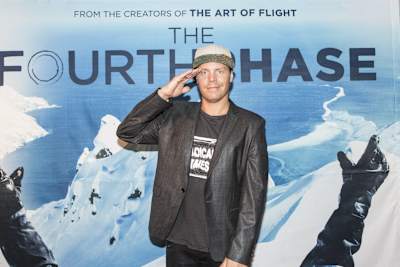
Travis Rice
© Red Bull Content Pool
“You run the thing over and over in your head; you convince yourself you can’t do it”
How do you actually work up the courage to drop in?
You run the thing over and over in your head; you convince yourself that you can do it. Fake it till you make it [laughs]. You kind of let doubt wash out. For me it’s crucial to always let it all go. The 10-15 seconds before I drop in, I’m thinking, I’m analysing and I’m doing all these geometric equations in my head, but then I’ve got to let it all go, I have to clear my mind. The last couple of breaths are to bring that angst and energy from your cranium, throat and upper chest, and bring it back down into your stomach. It’s more a place of certainty.
The Fourth Phase is about you coming to terms with being a seeker – as someone constantly looking for the next big challenge on untouched terrain. When did that begin?
I think it started for me at a young age. In the summer, my father was a fly-fishing and backpacking guide, so we were always doing adventuring on some level. I would work for him in the summer when I got older, when he did pack trips. I was the llama boy. I would lead the llama train and take care of them. It’s still one of my favourite jobs of all time. It was so simple: you were the caretaker of these beautiful, majestic, ornery, stinky creatures that would spit at you.
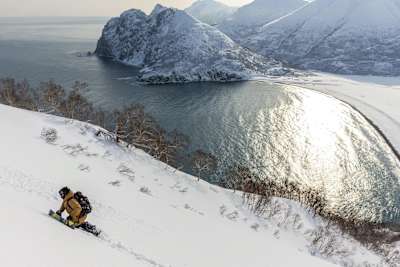
The Fourth Phase
© Red Bull Content Pool
But secretly, they probably appreciated you being around.
By the end of the trip they would know I was responsible for their food and their water and they spat on other people. So going into the backcountry was the product of a lifetime of adventuring.
So what are you seeking?
We’re looking for these geological oddities. We want weird. Weird is good. You spend enough time in the mountains to look for weird topography or features to play on. The glimpses of weird are few and far between, but you know they exist. You know that if there’s a small example of weirdness and it’s perfection, there is more out there. Ultimately, it’s about finding these topographical oddities that are aligned with other elements like the right amount of snowpack, the right temperature, protection from wind… the factors have to all line up.
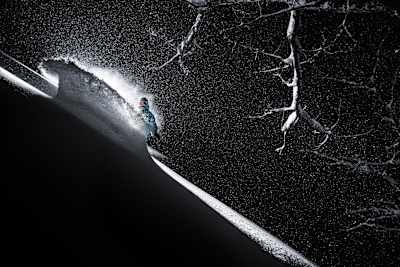
Hakuba, Japan
© Scott serfas, Tim zimmerman
But is it about being the first to descend that particular mountain? Or is it about finding solitude?
It’s the fact that we, as snowboarders, are trying to find creative expression, an interpretation of how to ride the mountain. When you ride a beautiful flat mountain face, you can work on the nuances on how you turn. But the weirder it gets, the more you have to interpret. It’s these strange perversions of landscape that provide this puzzle that you have to pick apart – and that’s what I love about the weird factor. Now, the solitude aspect, that’s one of the reasons everyone I know likes to go into the backcountry. It isolates you, and usually a couple of your dearest friends, and lets you get together and experience and problem-solve and co-create. It’s that magic of being separated out and getting to do things as a small group.
There’s a great quote from you in the film: “There’s something amazing about being with someone who’s gone somewhere they never anticipated going.” Expand on that.
I think it’s about sharing human growth, as individuals. In my own life, I’m constantly presented with things that I’m not comfortable doing. It’s so easy to just walk away and say, ‘Naw it’s cool, I’m not into that.’ Because, deep down, there’s this deep-rooted fear with any of us of getting it wrong or looking like an idiot. And if you’re willing to try you always get something out of it, even if it’s not positive. And I have done a lot of the going into the uncomfortable zone. That’s why I’m good at snowboarding. I went there at one point. I think it’s amazing to witness someone move past and basically say ‘F–k it’, and give it a try.
Or, how wonderful it is to suck at something again?
Yes, amen, whether it’s your first time or whether it’s something you’ve done your whole life, but maybe not thought you were capable of. I’ve lived a life where I’ve had incredible breakthroughs doing that, and being with friends and knowing that they’re capable of it, they just don’t see it. For me, there’s almost nothing more rewarding than being with somebody and helping them into this place that they didn’t know they could go.
That’s one of the threads running through the film, too. You’re bringing people to these unique locations based on what you think their potential is on a particular mountain.
Yeah, and this is the tough thing with this film. I set out for this film to be about not just me but about my people, my brothers in arms, the fellas I look up to and like to ride with. But it’s always tough when the film, at this final stage, narrows its focus. This film is about these places we go to, these people we’re with.
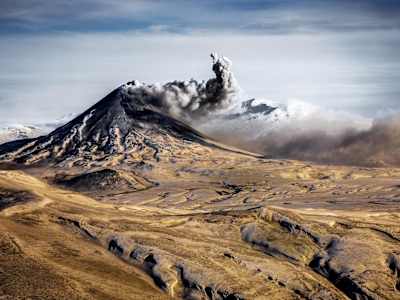
Kamchatka, Russia
© Scott serfas, Tim Zimmerman
You don’t think your life is interesting enough to merit a film?
I think I’m the wrong person to ask. If it were up to me – which is probably good it’s not – this film would be more equally distributed, and unfortunately there’s just not enough time. I created and conceived this journey that we go on, and I was lucky enough to have the privilege of inviting these other guys on these trips, and I do that because I’m a huge fan of all the other guys in this film. They’re all dynamic and unique humans in their own way, and I love them very much. But maybe that’s the next chapter.
These guys also say of you that you don’t stop until you get what you want. What is it you want?
I want an idea to go from nothingness to somethingness. Aren’t we here to create and show and to share?
Sure, but you seek it out on 3,000m peaks and ridges with deadly drops.
That’s something that’s been progressive. It’s something I’ve done for so long and you get comfortable doing things one way and you want to take it a little bit further… Ultimately, we want to keep it interesting, to keep it challenging and it evolves into this ‘little bit further, little bit bigger, little harder’, trying to prove mind over matter. It just progresses.
That sounds taxing.
They’re all dynamic and unique humans in their own way, and I love them very much. But maybe that’s the next chapter.
“We want to keep it challenging and it evolves into this ‘little bit further, little big bigger, little bit harder’, trying to prove mind over matter”
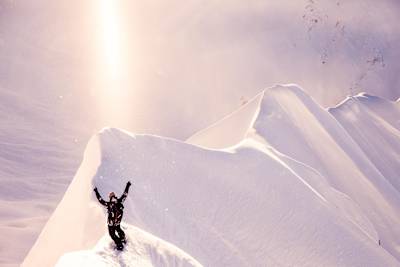
Travis Rice sizes up a ridge for The Fourth Phase
© Scott Serfas/Red Bull Content Pool
When did you arrive at that place?
I’m still trying to hit it. The realisation first rose quite a long time ago, because I’ve been driven to explore and I’ve been a seeker for quite some time. I think at a certain point I realised that my early innocent, open-minded, open-hearted exploration had shifted into a little bit more of an escape. I could either deal with the blandness of answering emails and dealing with the mediocre madness of my day-to-day existence or I could go and do something more exciting. It became more of an escape.
Could you have a day job? When did you realise that you could make a living from doing this?
I didn’t realise that I was going to be a snowboarder until quite late on. I was doing construction in the summer, so I could afford to do some travel during the winter. Beyond that, I was interested in the natural sciences.
Your respect and love for nature is a constant thread throughout, but how do you get closer to that by snowboarding down mountains?
The snowboarding aspect is just the vessel, just the tool to be able to spend time outdoors, spend the time to be able to go into the eye of these storms and see nature at its rawest.
You’ve run into your fair share of avalanches as well. What are the after-effects of those encounters?
It’s a beautiful reminder of the raw forces that exist that we’re constantly trying to dance around out there. We have a big crew and we have a lot of people on the mountain, especially in a camp-type situation where everybody is hiking, everybody is walking. It’s a lot of exposure. For us, the most important element is getting people home at the end of the day. For me, that experience was this gift – bring this with you on your next journey to keep everyone out of harm’s way.
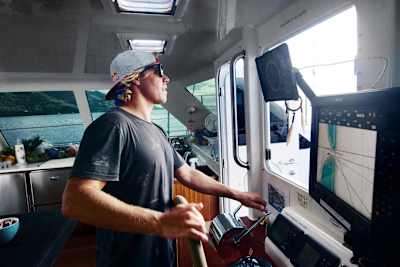
Tahiti, French Polynesia
© Scott serfas, Tim zimmerman
You start off sailing around French Polynesia, where this hydrological cycle you’re following begins. You seem more at peace out there than in the mountains, where you’re always searching for the next big thing.
You’re forced into slowing down – you’re forced into dealing with all the inputs you have at that particular time and keep a boat going at its slow speed. The wind’s constantly shifting, the weather’s constantly moving. And you are just a caretaker, captaining this boat. There’s something beautifully simple about that.
The last two films you made were about capturing the spectacle of what you do on a mountain – was this one meant to be different?
With the last two films we felt that we did a good job of bringing crazy cinematography with incredible locations… the aerials, being able to immerse people and bring them along for the ride. After we finished The Art of Flight, I didn’t feel the need to spend years making that film again. I think our crew were ready to try something a little more challenging. Ultimately, with a documentary-style process like this, we didn’t know where the end of this movie was going to take us. We didn’t know we were going to get shut down from doing this camping trip in the amazing region of Alaska. We thought that three years was enough time. We had these goals and principles we wanted to touch upon, but we definitely didn’t know how the film was going to turn out.