

Red Bull Motorsports
F1
Top 10 liveries in F1 history
Explore how iconic F1 car liveries shape teams, ignite fan loyalty and leave their mark on motorsport history.
Formula 1 cars make a statement in both the literal and figurative sense. It’s not just the impressive, boundary-pushing engineering that captures the attention of fans around the world — it’s how the cars look and feel as they zip around the track.
F1 liveries, which are the design and color scheme of the cars, help fans identify cars at events like the Red Bull Showrun as they zoom past at lightning speeds. But they go beyond that — liveries drive team identity and deepen fan engagement. The right design can even cement a car a place in F1 livery history, regardless of performance.
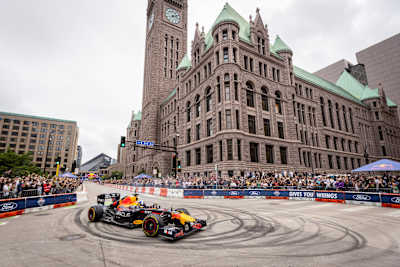
David Coulthard in the RB7 F1 Car at Red Bull Showrun in Minneapolis
© Robert Snow / Red Bull Content Pool
A brief history of livery in Formula 1
The F1 livery fans know today was not a part of the sport during its earliest years. From its first days and into the 1960s, teams mainly opted for simple designs and chose colors inspired by their home country. Italian cars were painted the bold Rosso Corso red and French cars were decked in the country’s bleu de France, to name two examples. Britain was a notable exception; since red, blue, and white were already taken, those teams adopted a color that came to be known as “British racing green.”
By 1968, colors by country faded in favor of advertisements, known as Formula One Sponsorship Liveries. The first sponsored cars from companies like Marlboro and Gulf introduced new color schemes inspired by the brands, opening a door to new possibilities for all kinds of creativity. In fact, cigarette brand John Player Special was responsible for the iconic black and gold debuted with the Lotus 72 car. Advertisers kept up the creativity as new advancements in car design were introduced in the 1980s.
The 1990s saw the return of some classic liveries, like British racing green on Aston Martin cars and silver paint on German-made Mercedes cars. Still, though, the advertising-influenced liveries continue to reign supreme.
The top 10 most iconic F1 liveries
01
Renault R26
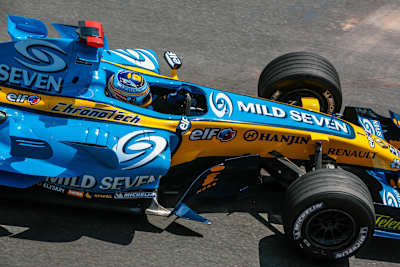
Fernando Alonso in the 2006 Renault
© Wikimedia Commons
Driven by Fernando Alonso during his 2006 championship-winning season, the Renault R26 featured a striking blue and yellow design. Renault’s famous yellow envelops the front and the sides of the car, while the bright blue of cigarette company Mild Seven (now Mevius) covers the rest of the body.
As for the car itself, the R26 is the R25’s predecessor. At first glance, the cars may look the same, but this model adopted a wider nose and left the red tip of the R25 behind. The Renault R26’s boldness mirrored Alonso’s dominance from that year, and the car secured Renault’s second consecutive championship.
02
Red Bull RB15
Red Bull’s first car with a Honda engine, the RB15, debuted in 2019 sporting a special one-time-only launch livery. The Aston Martin’s deep, dark blue body was punctuated by the Red Bull logo in its instantly-recognizable red and yellow. Its bold paint scheme and team colors embodied the cutting-edge performance and creativity of Red Bull Racing.
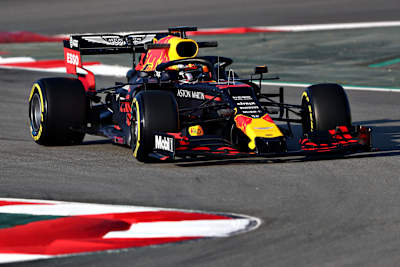
Launching the RB15
© Red Bull
The car — driven by Max Verstappen, Pierre Gasly, and Gasly’s mid-season replacement, Alexander Albon — made its debut at the Australian Grand Prix in Melbourne. Behind the wheel of the RB15, the racing team clinched crucial victories and podiums for the 2019 season.
“I was really excited to jump in the car…. It felt good, we had no problems, … and the livery is very beautiful,” Verstappen said.
The RB15 was the first Honda-powered car to win a race in 13 years. It placed first for three races with six additional podium placements. It further made history by placing third in the Constructors’ Championship, clinching two pole positions, and five fastest-lap achievements. It was also the first time a Honda engine power unit had the first grid position.
03
Brawn BGP 001
Highlighter yellow and neon green are not common F1 colors, but it’s only one of the factors that made the Brawn BGP 001 unique in the 2009 season. This car, led by Jenson Button, shocked the world by dominating the Drivers’ Championship — his only career title — with his team winning the driver’s title and the constructors’ title. He did so in Brawn’s one and only F1 season.
The simplicity of the design contrasted sharply with the complexities of the season. The Brawn BGP 001 initially had zero sponsors, leading to the very simple design. But as the season progressed and sponsors came through, red was added into the design.
04
Lotus 98T
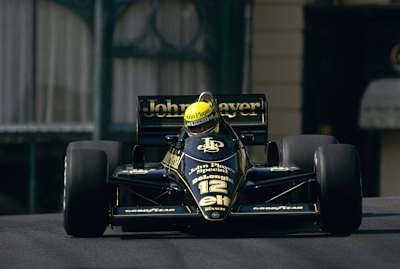
The Lotus 98T is a stone cold classic F1 car
© GEPA pictures/Red Bull Content Pool
The British Lotus 98T only won two races — the Spanish Grand Prix and the Detroit Grand Prix — but its color scheme still earns it a place in F1 history. The John Player Special-inspired deep black with shimmering gold accents became a fan favorite for its beauty.
The car, debuted in 1986, is notable for its performance despite the then-new restriction on fuel allotments. Driven by Ayrton Senna, the car finished fourth in that year’s Constructors’ Championship. The Lotus 98T also racked up four second-place wins, two third-place wins, and eight pole positions.
05
McLaren MP4-23
The McLaren MP4-23 is famous for being the car Lewis Hamilton drove when he scored his first World Championship win at the 2008 Brazilian Grand Prix. But that’s not the only reason it stands out — its futuristic silver body took home winning compliments of its own. Striking red accents, representing sponsor Vodafone, are on the front, spoiler, and sides of this car.
This car’s build focused on improved aerodynamics in an attempt to dismount Ferrari as the world F1 leader. A higher nosecone, T-wings, and a perfected wheelbase are among the fine-tooled features that got the McLaren MP4-23 zooming to the finish line.
06
Scuderia Toro Rosso STR12
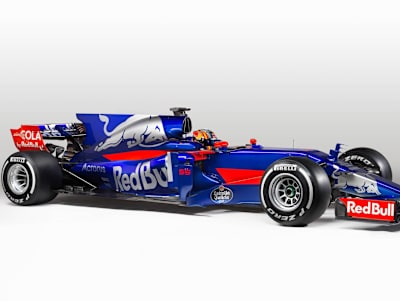
New car, new look: Carlos Sainz in his new STR12
© Guido de Bortoli / Red Bull Content Pool
The smart use of the car body’s space made this one of the most memorable F1 cars of its time, showing how livery can reflect team and brand evolution in one neat, bold package. Carlos Sainz finished seventh in the Constructors’ Championship and fourth in the Singapore Grand Prix driving the Scuderia Toro Rosso STR12.

3 min
Carlos Sainz's first STR12 lap
Ride along with Carlos Sainz as he takes the new Toro Rosso STR12 F1 race car out for a first spin.
07
Jordan 191
The Jordan 191 is one of the most famous liveries in F1 history simply because Michael Schumacher made his F1 debut in this stunning emerald and blue car at the 1991 Belgian Grand Prix. The fresh, deep green color, inspired by sponsor 7Up’s can, is considered to be among the most beautiful F1 cars of the era — and of all time.
08
Mercedes W10
Famous for dominating the 2019 season and for its looks, the Mercedes W10 made an impression on the track in every sense of the word. The black and silver paint scheme, the vibrant shocks of teal and orange — it was a bold livery for the car’s even bolder accomplishments on the track. With Lewis Hamilton and Valtteri Bottas at the wheel, the Mercedes W10 led the famed auto maker to an impressive win percentage of 71.4%.
09
Ferrari F2004
Ferrari’s F2004, driven by Michael Schumacher and Rubens Barrichello, is painted in the iconic red that Ferrari cars have donned for decades. But what sets the F2004 apart is sheer performance. The car won 15 out of 18 2004 season races, the last title-conquering car during the Schumacher era.
The F2004 was built with a lower center of gravity and improved weight distribution, all while clocking in at a lower weight than prior models. The aerodynamics of the F2004 were unsurpassed, and that showed in the car’s impressive winning streak that season.
10
Red Bull Racing RB16B
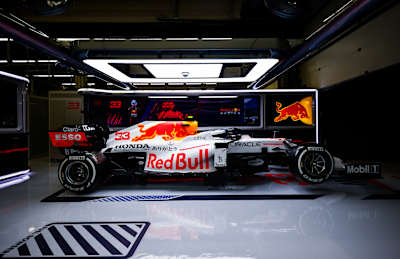
A unique look for the 2021 Japanese GP
© Getty Images/Red Bull Content Pool
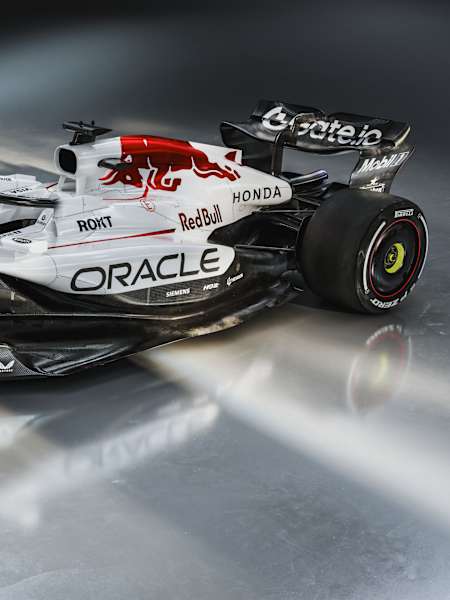
The 2021 livery debuted at the Turkish Grand Prix was a tribute to the Honda-Red Bull alliance. The cars — there were two of them, each driven by Max Verstappen and Sergio Pérez — sported a clean white look inspired by the Honda RA272. This was chosen over Red Bull’s usual dark blue to honor the auto-maker’s first F1 win at the 1965 Mexican Grand Prix.
The design and branding impact of F1 liveries
Ever since F1 departed from country-specific hues, designs and colors have been directly influenced by the sponsor brands that finance the sport. Whether Red Bull’s dark blue, yellow, and red, 7Up’s emerald, or John Player Special’s black and gold, F1 is where ingenuity, engineering, and creativity meet to the delight of fans the world over.
Fans follow through with buying merchandise that matches the cars, too. For example, 1:8 scale models of the most iconic and beautiful F1 cars are hot collectors items. Apparel and accessories often match the color schemes of the cars, too, so fans can wear their favorites wherever they go.
Beyond the paint: Legacy of F1 liveries
Liveries in Formula 1 transcend aesthetics — they are symbols of a team’s heritage, success, and ambition. From Ferrari’s classic red to unforgettably-bright neon yellow to one-off tributes that subvert fan expectations, these paint schemes are just as big a part of motorsport history as the vehicles themselves.
