

Running
Choosing between track and cross-country spikes
Read ahead for a complete guide to track vs. cross-country spikes, along with tips for picking the best spikes for you.


When it’s time to run your big race, you want to set yourself up for success. Disciplined training and proper nutrition will optimize your performance, but there’s one piece of equipment that can really help your speed on the big day. Running spikes are made to make you fast — as long as you choose the right ones. Whether it’s a short sprint, or you’re going the distance, good spikes make all the difference.
01
Understanding track spikes
Track spikes are designed to help with grip and responsiveness, so when your race starts, you’re ready to blast off at full speed. They’re not meant for training, but when it’s time for an event, track spikes can seriously give you a leg up.
There’s science behind track spikes. Essentially, the better traction you can get, the easier it is to get enough momentum to propel forward. Track spikes are especially helpful on rainy meet days when the track might be extra slick.
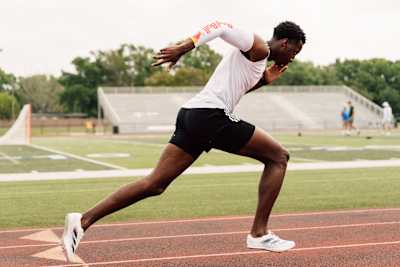
Erriyon Knighton at University of Florida
© Hana Asano / The Red Bulletin
Track spikes are generally pretty lightweight, but the variety of spikes available isn’t a one-size-fits-all situation. Different track spikes are available so you can get the best possible performance at whichever event you’re competing in. Unlike other athletic spikes, such as soccer cleats, track and field shoes allow you to remove and replace your spikes as needed. The number of spikes you’ll need will also depend on which event you’re running in.

These are the main varieties of track spikes you’ll find.
- Sprint spikes. These spikes keep you on your toes — literally. The best spikes for sprinters are tight-fitting and placed just under the front of your foot, so you get lightning speed and power. Sprinters need between seven and 11 spikes for optimum performance, the most number needed for any track event. If you run in hurdle events, your track competition footwear should also include sprint spikes.
- Middle-distance spikes. If you’re running for longer periods of time, you need more flexibility than a sprint spike offers. Middle-distance spikes have more cushion and elasticity, so your feet can stay comfortable in a more natural position. They’ve also got a bit more torque for turning. You’ll only need six to eight spikes if you’re in a middle-distance event, which is usually between 400 and 1500 meters.
- Long-distance track spikes. For races longer than 1500 meters, you’ll need a spike designed for endurance. Long-distance spikes have the greatest flexibility and durability, so lap after lap, neither you nor your shoes will tire out. For long-distance races, you’ll place just four to six spikes around the outer perimeter of your track shoes. This will help with traction on each turn and also provide some extra support for your heels.

Elijah Hall runs at Fort Bend Christian Academy track in Houston, Texas
© Michael Starghill / Red Bull Content Pool
02
Exploring cross-country spikes
Cross-country spikes are made with the same principle in mind as track spikes — better grip equals better speed. But cross-country spikes are made to withstand different running conditions, including significantly longer distances and rough ground. The heavier, longer spike pins can handle uneven terrain, such as grass or mud.
When it comes to cross-country footwear, you should consider your environment when choosing the size of your XC spikes.
- 1/4 inch spikes. This is generally the standard size in cross-country running, as long as the ground is mostly dry.
- 3/8 inch spikes. If you’re headed off-road, these are the spikes you’ll probably try first. This cross-country spike size is made to tackle grassy or dusty trails.
- 1/2 inch spikes. If you need mud-running spikes, this is the size to get. These spikes are designed to help prevent slipping.
- 5/8 inch spikes. Running somewhere extra muddy? To handle the terrain, these are the running spikes you’ll need.
03
Can you use track and cross-country spikes interchangeably?

Elijah Hall trains in Houston, Texas
© Michael Starghill / Red Bull Content Pool
If you’re using running spikes, you always want to use the ones designed for your specific event. However, you may find some similarities in track and cross-country spike designs. For instance, of the many different running spike shapes, pyramid spikes can work for both track or cross-country runners.
But there’s still quite a difference in how each type of running spike affects your performance. A lot of it is about the materials used. Cross-country spikes have additional padding and rubber for flexibility, while sprinting spikes are typically reinforced with a hard plastic plate.
Sprinting in cross-country spikes that are too soft will slow you down. Running on a long cross-country trail on more rigid spikes will cause discomfort and could put you at risk for injury. You really don’t want all the pressure on your toes that a sprint spike causes on a cross-country trail. If you try to use sprint and cross-country spikes interchangeably, you could develop painful conditions such as plantar fasciitis or Achilles tendinitis.
In addition to the risk to yourself, you could damage the running surface with the wrong kind of spike. If you try to run a middle-distance race while wearing longer cross-country spikes, you could tear up the track.
04
How to choose the right spikes for you
It’s not just about your preferred running event. Once you’re ready to get running spikes of your own, there are some additional factors to consider. The great thing about running spikes is that you can always swap them out for a different size or shape. Don’t be afraid to try different spikes to see what works best for you or what’s best for the event at hand.
There’s variation within each category of running spike, so they can accommodate every skill level. For instance, advanced sprinters can find super stiff elite-level spikes that might not suit a beginner who’s still learning to generate power on the track.
You can also use your shoe size as a guide for finding running spikes, but spikes do run slightly smaller than standard running shoe sizes. You might have to try on a few to find that sweet spot of spikes that aren’t too loose or too tight. For the right fit, you want some room between your shoe and your toes, but not as much room as without the spikes.
05
Maintenance and care for your spikes
Running spikes can give your performance a big boost — if you take good care of them. Install them just before your event and take them off once you’re done. Keeping spikes on for the whole meet could wear them down, which means you’ll need to replace them sooner than later.
It’s also important to keep your spikes free of moisture and debris so they don’t rust. Don’t leave your spikes in your shoes and be sure to give them a thorough cleaning after every competition. You’ll start by scraping off excess dry dirt with a cleaning brush before soaking them in warm (not hot) water and soap. Once you’ve put them in water, you can use a clean toothbrush to remove any dirt that didn’t get dislodged when you started. Then dry with a clean towel.
Proper maintenance practices can extend the life of your running spikes, but you’ll still need to change them eventually. Spikes tend to reach their maximum shelf-life around three months. Some experts recommend switching out your current spikes after four races. You don’t want to do that with brand new spikes, though.
While running spikes aren’t for training, they do need to be broken in before a race. It’s also smart to have spare spikes on hand at every competition. You never know when the weather might change the terrain or you’ll need to adjust for your comfort level.
Take your performance to the next level with running spikes
Running spikes can help you find the power you need, whether it’s on a short sprinting track or a long cross-country trail. Choose running spikes that are made for your event and suit your personal skill and comfort level. You might have to try a few different sizes and shapes to get it right — but once you find the right fit, you’ll get winning results.