
Volleyball
Volleyball tips: Essential techniques and strategies
Bolster your attack, strengthen your defense, and sharpen your mind — and body — to take your game to the next level.
Great volleyball begins at your hands and covers your whole body, not to mention your mind. The best volleyball tips for beginners span team communication, mental fortitude, proper warm-ups and cooldowns, and overall strategy. Mastering all these moving parts is how players develop the skills and confidence to innovate new volleyball techniques. That’s exactly what beach volleyball stars David Åhman and Jonatan Hellvig have done with their unique Swedish Jump Set move.
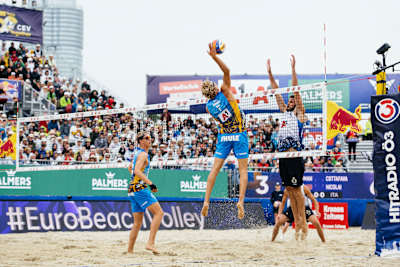
David Ahman and Jonatan Hellvig at the A1 CEV BeachVolley Nations Cup 2023
© Ulrich Aydt / Red Bull Content Pool
“In the beginning, we obviously didn’t manage to do it all the time, but maybe once a set or once per game,” Hellvig says. “And when we did make it work, we realized how cool and fun it was to play this way.”


Below are some volleyball tips for changing the game — and winning it — just as Hellvig and Åhman have done.
01
Mastering the basics
Serving
Learn the ins and outs of these common volleyball techniques to start a point the right way.
- Overhand serve. Place the foot opposite your serving hand just in front of your body. Reach your non-serving arm forward and keep your serving arm back, kind of like you’re holding a bow and arrow. Use your non-serving hand to toss the volleyball upward, about three to four feet over your head. Hit the ball with your open palm as you shift your weight from your back leg (your back foot will go almost perpendicular to the ground) to your front leg. And, as always with proper sports technique, follow through.
- Float serve. Take a step forward with the leg that’s on the same side as your serving hand. Then, take another step with your other foot as you toss the ball three to four feet overhead. Go for the bow-and-arrow stance as you line up your serve. Bring your serving-side foot forward again — try to get it nearly under the ball — as you hit the ball in mid-air with an open palm. Shift your weight and follow through like with a standard overhand serve. You might come up off the ground just a bit.
- Jump serve. With this serve, you’ll leap into the air as you hit the ball. Start a few feet behind the serving line, then follow the same steps as a float serve, but toss the ball way higher, jump to hit the ball while it’s in mid-air, and serve with the heel of your palm. Shift your weight and follow through as usual. (Pro tip: lower body strength training and jumping rope may be good training exercises to level up this serve.)
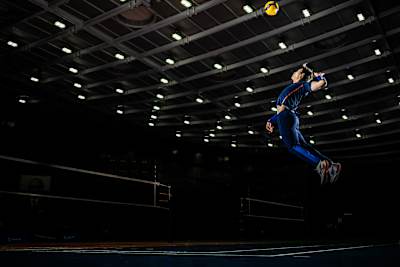
Yuji Nishida
© Jason Halayko / Red Bull Content Pool
Passing and receiving
Firmly planted feet are best for passing powerful hits, whereas moving feet toward the target spot is better when the ball is moving slowly. (The latter technique involves the same follow-through and weight-shifting as serving.) Let your upper body go low, and don’t swing your arms — use them as a “platform” for the ball instead.
Receiving (passing a serve) involves maintaining an angled body and focusing on the server’s leg motion, arm speed, and where they’re directing the ball. If you sense a powerful serve heading your way, plant your feet where the ball is headed. Keep your posture rigid, point your shoulders toward the setter box, and make contact with the ball.
To receive a slow serve, focus even more on the setter box to ensure the ball lands there. If you’re receiving a topspin serve, shoot your hands lower and move from a shorter height. Do your best to extend your body outward instead of just swinging your arms.
Of course, anyone on your team can receive or pass. Shouting “mine!” when you’ve got signals to the team that you have it under control. Not so sure you’ve got it? Shout out a teammate’s name so that they can take it.
Setting
Properly setting a volleyball is a two-hand affair. Your thumb and index fingers should be loosely in a triangle as you stagger your feet, bend your knees a bit, and position your shoulders over your toes. Always use both hands to set, and always set above your head.
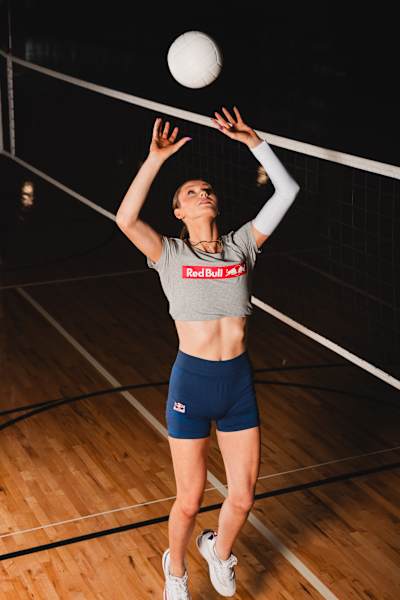
Bergen Reilly
© Charlotte Gottfried / Red Bull Content Pool
For a front set, bend your elbows, move your weight toward your front foot and exert pressure from your hips through your fingertips. This should create soft touch contact with the ball. From there, the ball will reach the hitter at a modest enough pace that they can expertly set up a spike.
For a back set, use your feet and hands in the same way, but let the ball come closer to your head while moving just under the ball. Push your hips forward, arch your back, and contact the ball as you move your hands slightly behind you but still above your head. Where you place your hands is key to accuracy: Hands behind your head send the ball backward, and hands in front move the ball forward.
Hitting and spiking
For some volleyball players, hitting and spiking are the same. For others, there’s a vague difference. In any case, spiking is the more effective way to score a point.
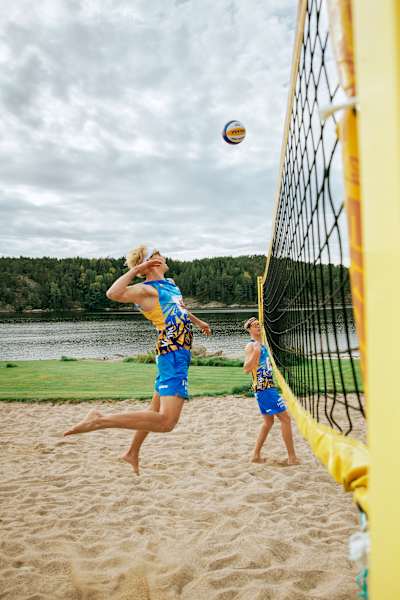
Take three or four steps for an effective spike. Aim to be on your third step by the time a setter is sending the ball your way. On your last step, jump high and contact the ball at a sharp downward angle. This angle should be sharp enough to rapidly go over the net but not so sharp it lands on your side of the court.
David Åhman and Jonatan Hellvig
© Adam Klingeteg / Red Bull Content Pool
Pull your spiking hand back, then move it forward and hit the ball with the center of your hand. Rotate at the shoulder, then make an aggressive forearm motion and snap your wrist downward. Spike the ball at the highest point off the ground, and bend your knees as you return to the ground.
02
Improving team communication
On-court communication
The best volleyball strategies involve mastering both form and communication. After passers shout “mine!” to claim a ball coming over the net, they should clearly state to whom they’re passing. The person getting this ball — the setter — must also say “mine!” and declare which hitter will be getting their set. From there, it’s on the hitter to claim the ball as the rest of the team gets back into position. If the spike doesn’t result in a point, the whole series of events begins again.
Reading the game
Practice makes perfect — the more you play, the more you’ll see what’s coming next on the court. Look at where everyone on both teams is positioned and how they’re moving, and follow the ball’s trajectory. Use these visual cues to figure out who might be revving up to do what, and position yourself accordingly. Your goal is to get yourself ready to pass, receive, set, or hit — whatever it takes to score the point.
Hand signals and cues
When serving, consider using a signal indicating what type of serve you’re going with and where you’re directing it. The team can also agree on signals related to spiking, setting, and defense. The key is for everyone to memorize these signals before the game — and to keep these cues a team secret.
03
Building strong defense
Blocking techniques
Participants during the Red Bull Back Line Mersin Qualifiers in Turkey
© Barış Acarlı / Red Bull Content Pool
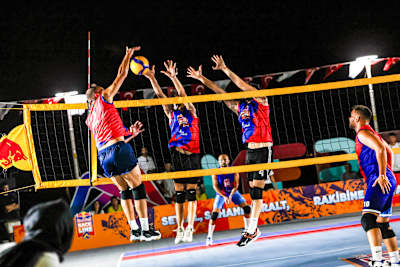
Blocking is the art of stopping a hit or spiked ball from crossing the net. A successful block is more likely the higher you reach above the net, with hands and fingers spread wide to cover as much area as possible. Hold your arms steady and angle your palms just a bit downward. Keeping your shoulders and hips square to the net, and your elbows in front, is important too.
Another huge factor in a successful block: timing. Do everything you can to make contact with the ball at its highest point so that the ball goes back over the net. The communication drills you’ve run with your team — and signals you’ve set — can help everyone be in prime position for a successful block.
Digging and diving
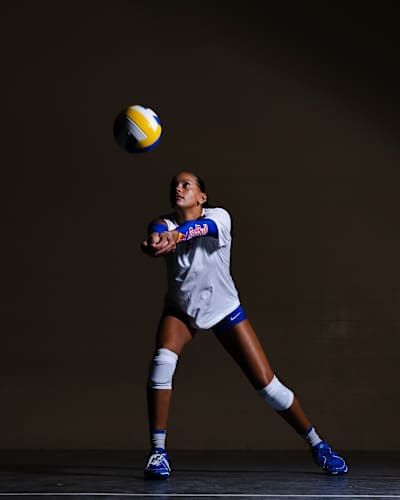
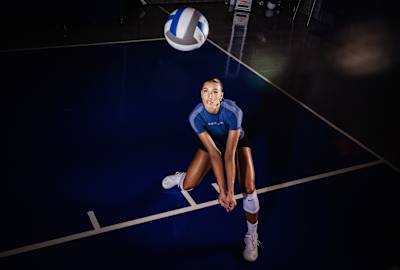
Think of digging position as a squat, but bent far more forward than usual. For a successful dig, extend your arms outward, make fists, then push your hands toward each other to create a platform out of your forearms. Move the foot opposite the direction of the ball slightly off the ground, but keep toes on the ground. Use your “platform” to direct the ball toward a teammate. Balance your weight on your toes so that you can quickly rush toward the ball wherever it goes.
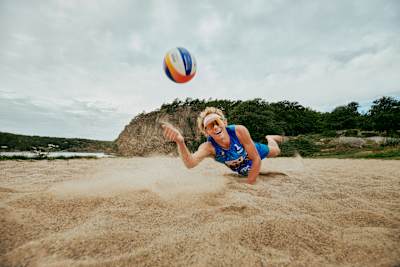
A dive is just a dig during which you fall to the ground (on purpose and with grace). For a successful dive, bend even more deeply into your knees than with a dig, and try to get your platform parallel to the ground as it contacts the ball. Roll into the ground with your chest or knees (or both).
David Åhman playing volleyball in Strömstad, Sweden
© Adam Klingeteg / Red Bull Content Pool
Court coverage
Depending on whom you ask, each side of a volleyball court has six to 36 zones. More important than defining zones is ensuring that each player covers a portion of the court. The six-zone model may make this easiest — each of the six players (a key volleyball rule is that a team must have at most six players on the court) is responsible for one zone. And if someone else has to occasionally step into your zone to make sure a point isn’t scored, that’s okay too.
04
Developing agility and stamina
Footwork drills
When improving footwork, the approach-and-spike and swing block drills are best. Here, someone will act as the coach and position themselves one foot from the net. From there, you can take at most three or four steps forward as the coach tosses the ball in the air to spike. The coach can increase their distance from the net by one more foot as you get more comfortable. Through this drill, you’ll learn your ideal step size and pacing for a great spike.
For the swing block drill, get two friends to act as attackers — you’ll block their spikes. Find a fourth person to toss the ball to an attacker, then get ready to block their attempt to get the ball over the net. Move from the middle of the court to the net to pull this off, practicing your timing along the way.
Endurance training
A great volleyball game does a number on the heart, legs, arms, and shoulders. Cardio conditioning helps you play better — think high-intensity interval training (HIIT) or long-distance runs. As for form and strength, everything from squats to planks are on the table, with burpees, push-ups, overhead presses, and planks to boot.
Flexibility and prevention
Regular stretching exercises make you more flexible, meaning you can reach farther to land an ambitious dig or spike. Stretching is also key before and after a match to warm up, prevent injury, and ease recovery.
For a simple pre-game routine, spend a few minutes doing jumping jacks, riding a stationary bike, or jogging in place. Follow this cardio warm-up with several 30-second stretches that target shoulders, legs, and arms. Do these stretches after every game or training session for a proper cooldown.
05
Mental focus and game strategy
Staying mentally sharp
Madisen Skinner
© Maria Jose Govea / Red Bull Content Pool
There are three keys to mental sharpness on the court:
- Visualization. Volleyball pros swear by it: Close your eyes and picture yourself landing moves with grace and ease. Now that you’ve “seen” this happen, you might be more likely to pull it off in real life.
- Positive self-talk. Repeating affirmations to yourself before and during the game can help you get back in the zone.
- Take deep breaths. Slowly inhaling and exhaling is known to recenter people in intense situations, including fast-paced volleyball games.
Adapting to opponents
No two opposing teams are exactly alike, so the strategy for two different games shouldn’t be either. If you notice that the other team is big into cross-court spiking, share this knowledge with the team. Figure out how to move everyone around while on defense for ample coverage where the ball usually goes. Similarly, if you realize the other team isn’t great at dives, direct your hits to the court’s margins.
06
Consistency through practice
Create a routine for running volleyball drills. Jot down the drills you run, take notes on how you perform, and set goals for your next session accordingly. Couple the regimen with continued learning via volleyball resources and communities.
Take volleyball to the next level
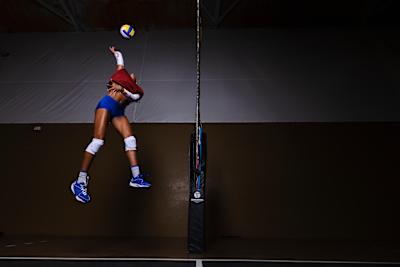
Olivia Babcock
© Harrison Barden / Red Bull Content Pool
With continuous practice, you can learn to hit a volleyball at the ideal height, block incoming spikes at just the right moment, and everything in between. Whether your goal is the level of volleyball dominance that Paolo Nicolai is known for or just smashing it on the indoor courts like Bergen Reilly, Olivia Babcock or Madisen Skinner, you can easily create your own platform — in every sense of the word — to victory.