
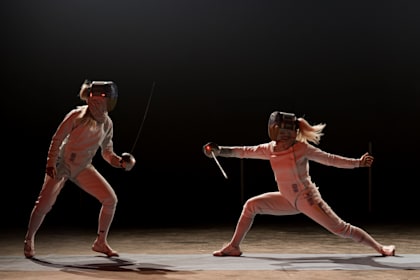
Fencing
What is fencing? A complete guide to an age-old sport
Fencing has been testing the swiftness, accuracy, and intelligence of sword fighters for hundreds of years.
When it’s time for a fencing match, all that matters is you, your sword, and the competition. The intense focus is one of the main reasons one-time Olympic medalist Miles Chamley-Watson loves the sport so much.
“What I love about fencing is it’s just you and your opponent, it’s so intimate,” he says. “It feels like nothing can stop you – that’s what drew me in.”
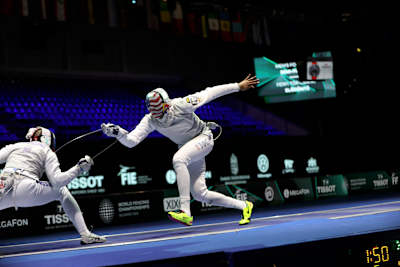
Miles Chamley-Watson at the 2019 World Fencing Championships in Budapest
© Spencer Gordon-Sand / Red Bull Content Pool

Fencing is a sport with quite a rich history, from its origins as a battlefield training drill to its inclusion in esteemed international athletic tournaments. If you’re curious about what fencing is and what it entails, read ahead for a comprehensive guide to this classic tradition.


01
What is fencing?
Fencing is a centuries-old sport celebrating the art of swordplay. Two opponents compete in a sword fight match, known as a bout, with slender weapons and protective gear. As competitors fight to score 15 points first, their reflexes, balance, and tactical abilities are put to the test.
Fencing traditions date back to 14th-century or 15th-century Europe. In this setting, fencing served as a military combat exercise. The transition from fencing for self-defense purposes to a recreational activity began when Italian fencer Domenico Angelo opened a fencing academy in the 1760s.

Miles Chamley-Watson
© Catherine Aeppel / Red Bull Content Pool
Eventually, formal competitions emerged, and fencing became a prestigious sport with globally recognized tournaments. Depictions of fencing in popular culture have been prevalent throughout media history, from Gomez Addams of the Addams Family to the TV show ‘Gilmore Girls.’
The development of fencing as a sport

Fencing’s history and evolution has taken this art from combat practice to world-renowned athletic discipline. The first fencing competition was held in 1880 as part of the first Grand Military Tournament and Assault at Arms pageant. Within less than two decades, fencing was featured in some of the most noteworthy international athletic events.
Today, the World Fencing Championships are presented by the International Fencing Federation (FIE), the top governing organization in fencing. National fencing federations affiliated with the FIE organize and preside over local competitions leading up to the World Fencing Championships. For instance, USA Fencing oversees events such as the North American Cup.
02
Three key types of fencing
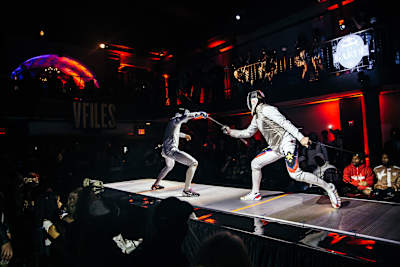
Red Bull En Garde 2022 event in New York City
© Anthony Geathers / Red Bull Content Pool
1. Competitive fencing
There are three disciplines in the realm of competitive fencing, sometimes also referred to as sport fencing. The core differences between each category revolve around the type of sword used and regulations for how points can be achieved. The three types of competitive fencing are:
- Foil. This is perhaps the most popular type of competitive fencing, in which a lightweight, pointed-tip sword is used. Competitors can only score points by landing a touch on their opponent’s torso after initiating an attack, usually with a forward lunge. The flick attack, in which fencers curve their blades to use their swords like whips, is sometimes seen in this fencing style.
- Épée. A heavier pointed sword is used in épée fencing, so flick attacks are uncommon. Within this type of competitive fencing, fencers may score points by landing a touch anywhere on their opponent’s body.
- Sabre. Unlike the above categories, sabre fencing competitors can use all sides of the sword — not just the tip — to score points. The target area for sabre fencing is anywhere from the waist up, excluding hands.
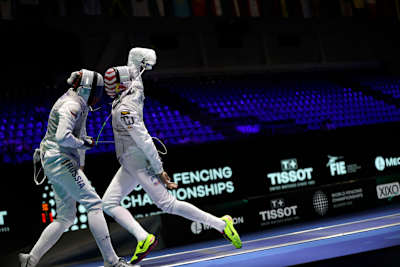
Men Foil Team event at the 2019 World Fencing Championships in Budapest
© Spencer Gordon-Sand / Red Bull Content Pool
2. Historical fencing
Some fencers have kept the original format of the sport alive with these ancient fencing styles.
- Classical fencing. This type of fencing harkens back to its 19th- and 20th-century format. Fencers may still use a foil, épée, or sabre blade, but the attack approach is more refined. Classical fencing almost looks more like a choreographed performance than an athletic contest.
- Historical European Martial Arts (HEMA). This discipline encompasses a variety of medieval and Renaissance styles of sword fighting. HEMA aficionados may be interested in learning how to handle weapons including long swords, bucklers, or British military sabres.
3. Recreational fencing
You don’t have to compete to enjoy fencing. This sport can be a great recreational activity if you’ve ever been curious about sword fighting. It’s also a great cardio exercise if you’re looking to incorporate something different in your fencing routine. Whether you’re looking to enjoy fencing as a hobby or to get in shape, there are plenty of fencing schools and clubs to teach you.
03
A guide to fencing equipment and scoring
Weapons
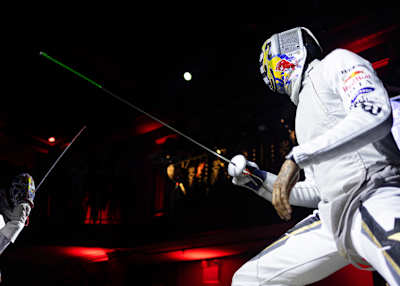
Miles Chamley-Watson & Alex Choupenitch during the Red Bull En Garde Event
© Rob Tringali / Red Bull Content Pool
All fencing swords are made from low-carbon steel to allow for flexibility, with a dull point to prevent injury. The core differences in the three main types of fencing weapons include:
- Foil sword. When you think of a fencing sword, a foil is likely what comes to mind. Weighing just over one pound, foils are the lightest fencing weapon, and they’re designed for thrusting. They also feature a small centered guard near the handle to protect the fencer from accidentally grabbing the blade.
- Épée sword. Similar to the foil, the épée is also a thrusting weapon, but it’s slightly heavier. The guard is also larger and more off-center to protect the fencer’s wrists, since points can be scored anywhere on the body with this style.
- Sabre sword. The sabre weighs about the same as a foil, but it’s designed for both cutting and thrusting in fencing competitions. These swords also feature knuckle guards to protect fencers’ hands.
Protective gear
Fencing safety equipment is an essential part of this sport’s uniform. All competitors are required to wear the below attire and fencing gear during a match.
- Masks. Made of either stainless steel or carbon steel mesh with a removable lining on the inside, fencing masks are subject to strict regulations. Any mask worn in an official competition designated by the FIE must pass a “punch test” of 12 kilograms.
- Neck bibs. You’ll find protective Kevlar or synthetic fiber in fencing neck bibs. These can withstand impacts of up to 1600 Newtons.
- Jackets. Fencers wear jackets made of a Kevlar and cotton or nylon blend, along with a protective plastron layer underneath to protect their arms.
- Gloves. Competitors wear a glove made of a similar Kevlar blend on the hand holding their sword.
Scoring systems
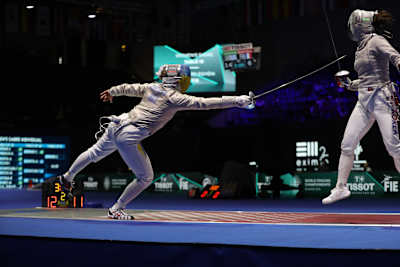
Olga Kharlan during the 2019 World Championships of Fencing in Budapest
© Spencer Gordon-Sand / Red Bull Content Pool
In fencing, one point is awarded each time a competitor scores a touch on their opponent. Fencers must wear an electrically conductive lamé, in addition to their protective fencing equipment, over the target area for their competing style. Fencers must also attach a body cord to their weapon so that, when the blade makes contact, the electronic scoring system records a point.
A brief overview of fencing rules
Fencing bouts consist of three total rounds that last three minutes each. The bout lasts until 15 points are scored. If all three rounds are completed and no competitor has reached 15 points yet, the fencer with the highest point total wins. In team fencing, this process is repeated with each pair of opposing team members across nine bouts, with the goal of reaching 45 points.
Fencers score points when they hit their designated target areas, and there are a number of ways they can lose points. This includes failing to salute their opponent and the referee at the start and finish of a bout. Improper footing or covering your target zone with your hand may also result in point deduction. There are also rules specific to each fencing type. For instance, all play must cease in foil fencing if someone strikes outside the target area.
04
Three key fencing techniques

2 min
The sport of Fencing is lightning fast
The sport of Fencing is lightning fast
If you’re working on getting the basics down, there are a few helpful fencing techniques for beginners to learn.
- Fencing footwork is foundational. Learning how to maneuver your sword is important, but finding your footing is just as essential. You’ll have to move forward and backward, not side to side, within your bout’s boundaries. You must also remain in a formal stance, with your front leg pointed forward and your back leg at a 90-degree angle. Practice moving back and forth in this stance in your day-to-day life so you get used to moving in this position.
- Aim your weapon. When trying to hit a target area, focus on where you want to land the touch before you move your weapon. Concentrate on where you want to strike before thrusting your sword forward. The more you practice this subtle but important step, the more natural it becomes.
- Lead from the wrist. Your wrist plays a huge role in precision. If you lead from the shoulder or upper arms, your movements may be too large to land a hit. Practice keeping your arm still when hitting your target if you want to improve your accuracy.
Fencing is a time-honored tradition
Fencing has been testing the swiftness, accuracy, and intelligence of sword fighters for hundreds of years. The many disciplines of this sport have evolved through history into the modern competitive formats we know today. If you take part in this long-established custom, you’ll strengthen a number of physical and mental skills. As Chamley-Watson puts it, there’s nothing like drawing your sword and the world melting away as you focus on that first hit.