
Urban Climbing
Engineering the Impossible
Nothing bolted. Nothing drilled. No trace left behind. The Bloukrans Bridge set the rules. Here's how Richard Lievaart's team hung around 600 monkey bars beneath its arch anyway.


Most monkey bars start with a hole in the ground. You dig, pour some concrete, bolt the frame down and you're done. The Bloukrans Bridge didn't offer Richard Lievaart, and his team any of that. And it made sure he knew it.
When Thomas van Tonder reaches for the first bar on 26 October, he'll be hanging from a structure that weighs around five tonnes and runs for roughly 280 metres along the underside of the arch, 216 metres above the gorge.
How much of it is bolted to the bridge? None of it.

"Nothing is bolted or drilled to the bridge," says Richard.
01
The Bridge Sets the Rules
That was the deal from day one. No bolts. No drilling. No marks. If you want to hang hundreds of monkey bars off this bridge, you'll do it without laying a finger on its concrete.
Richard spells out what that means. "Everything has to be able to be packed away and taken with us, leaving no trace that we were there."
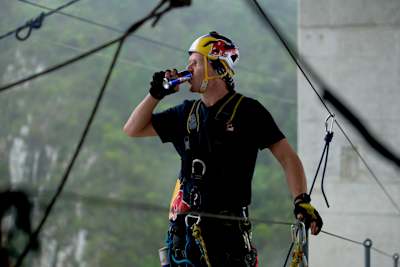
Thomas Van Tonder prepares for Red Bull Bridge Bars
© Craig Kolesky / Red Bull Content Pool
It's a big ask on any structure. On one that has to hold a grown man swinging, hanging and braking his way across it, it's the whole puzzle.
Richard, Head of Rigging and Safety Director at Vertical Safety Systems (VSS), is the man solving it. He's also an old mate. He and Thomas met at a climbing gym, where they trained together early in the mornings before it opened.
Now he's up against Africa's most stubborn piece of concrete.
The Bridge Doesn't Do Straight
The first problem is shape. The Bloukrans arch spans 272 metres and rises about 62 metres from its base to its crown. Truss, the steel framework the bars hang from, comes in straight lines. The bridge doesn't do straight.
So the team fights the curve with short straight pieces. Each section of truss is three metres long, and each one gets its own strap.
"Each piece of truss is touching, but it's slightly apart at the top, which gives us the space for the curve," Richard says.
There are around a hundred of those sections, and they're joined to each other along the bottom chord as well. "So they all connect to each other," he says, "but that still gives us that slight bit of curve."
A hundred straight lines, bent into an arch they were never meant to follow.
One Metre of Steel
Want to understand the whole build? Look at a single rung.
Each one is a steel pole, one metre long. Twenty centimetres sits underneath the bridge. Thirty centimetres is strapped underneath the truss. The last 50 centimetres sticks out into the air.
That's the half metre Thomas hangs from.
It's a cantilever, and it works like a seesaw. "When Thomas pulls on one side, the lever pulls up into the bridge on the other," Richard says. "We're using that counterforce to make the half metre Thomas is hanging on as secure and tight as we can."
Here's the clever bit. The Bloukrans Bridge was built as a cantilever, two halves of the arch advancing from either side of the gorge until they met. Richard has turned the bridge's own trick against it. Every time Thomas pulls down, the bridge itself holds the bar tight.
The bars are spaced half a metre apart, and they aren't all the same. On the climb they're 38 mm thick, which is better for hanging. Across the middle they go up to 48 mm, for the big swings. On the way down they're 42 mm, a mix of the two.
9.6 Kilometres of Strap
If you can't bolt into a bridge, you wrap it.
Holding everything in place are 240 straps, each about 40 metres long, looped all the way around the arch and ratcheted tight. Every corner gets rope and edge protectors, so the concrete can't chew through them.
Laid end to end, those straps would stretch 9.6 kilometres. That's more than the height of Everest, wrapped around one bridge.
"The straps are essentially trying to pull the truss up into the bridge the whole time," Richard says. And because every piece of truss is connected to the next, the straps end up tying the whole structure together.
The result is a five-tonne frame that barely moves. "The only real movement or flex in the system is in the rungs themselves," he says. "The half metre sticking out does have a little bit of flex, but other than that the truss is held securely in position."
The bridge gave him nothing to hold on to. He built something it can't shake off.
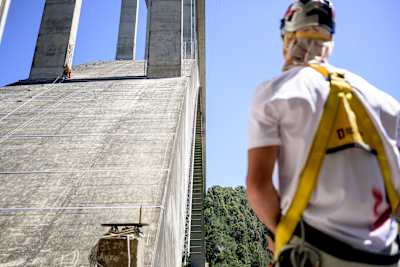
Thomas Van Tonder prepares for Red Bull Bridge Bars
© Craig Kolesky / Red Bull Content Pool
Two Ways Home
Then there's the bit nobody wants to need.
Thomas will be wearing a harness clipped to two separate safety systems on two separate ropes. One runs to a safety rail. The other is attached to the bridge. At 216 metres, the bridge doesn't do second chances. Richard has given Thomas two. For Thomas, knowing who rigged them matters as much as the ropes themselves.
"Having people I trust enough to build this, and knowing I'll get home safely, is a big part of why this is possible at all," he says.
The Bridge Gets the Last Word
Rigging and de-rigging adds up to about 32 days of work. Once the attempt is over, every strap, every section of truss and every one of the roughly 600 bars comes off again. Then the bridge gets its way after all.
No bolts. No holes. No marks. If Richard and his team get it right, the next person to bungee off Bloukrans won't know they were ever there.