
Obstacle Course Racing
Three Challenges, One Set of Bars
On flat bars you find a rhythm and keep it. On the Bloukrans arch it changes three times. Here is how Thomas van Tonder is building a body to answer all of them during his Red Bull Bridge Bars attempt


On a flat run of monkey bars, you find a rhythm and you keep it. One swing, repeated until the bars run out. It is hard. But it is one problem. Thomas van Tonder's attempt is not that.
The Bloukrans arch rises, flattens and falls away, and the bars follow it. As the angle changes, so does the job his body has to do. He will need a different technique for each stretch, in one continuous attempt, beneath Africa's highest bridge, 216 metres above the river.
Three very different challenges. One set of bars. No chance to let go.

Thomas has split the bridge up the same way, based on the technique that works best for each part.
01
Challenge one: The climb
The arch starts steep. The first incline is 45 degrees, and it eases off towards the middle. At the bottom it is so steep that he cannot face forward.
"I literally have to turn my body around facing backwards, pull myself up and then reach for the next bar," he says.
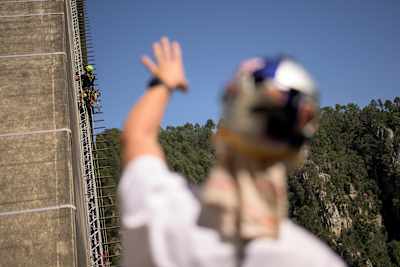
Thomas Van Tonder sizes up the climb
© Craig Kolesky / Red Bull Content Pool
Every reach comes with a cost. The hand that is not reaching has to lock off in a stationary hold at 90 degrees while the other one finds the next bar. One of those is easy. Hundreds is the problem.
"This movement is usually fine in small amounts, but the hard part is the sheer number of them I have to do consecutively," Thomas says. The real damage is the fatigue, "building up in the same muscle groups, which have to do the same pulling movement over and over to reach the next bar."
He admits he underestimated it too. "People underestimate it; even I underestimated it."
Learn More About Red Bull Bridge Bars


02
Challenge two: The swing across the crown
As the arch flattens, the climb becomes more of a traditional 'monkey bars swing'. One hand down and up, the other hand down and up, forward like a classic monkey swing. It is Thomas's most comfortable way to cover distance on bars. Normally, that is.
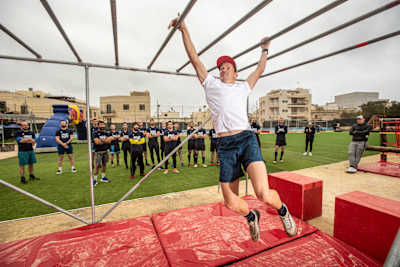
Thomas van Tonder
© Andrew Large / Red Bull Content Pool
"The muscle groups I use for this technique have already been obliterated by the climb just to get to that point," he says. "So what would usually be easier is now already harder."
The bars here are thicker. That is deliberate. A thicker bar is a bit harder to hold, but a bit kinder to the hands once he starts swinging. The aim is to get his hands to survive the whole crossing. "It's not much, but a little bit counts."
The crown is also where the body stops being the main problem. Thomas is at his highest, mostly hanging from a single hand, with the whole arch laid out ahead of him.
"Mentally, the middle segment is the hardest part," he says. "Looking ahead, seeing the arch and how far you still have to go to the finish is super intimidating. You almost can't fathom it: all those bars in front of you, and you still have to do every one of them."
03
Challenge three: The brake
Then the arch tips over and the job changes again. On flat bars, nothing pulls him forward faster than he wants to go. On the way down, something does.
On the descent, Thomas stops pulling and starts catching. It is called an eccentric movement, and he has a simple way to picture it. "Imagine jumping up onto a bar and lowering yourself slowly."
Go too fast and the consequences are immediate. "If you don't brake enough, you land too hard on your next hand and the bar rips out of it because your hands can barely close," he says.
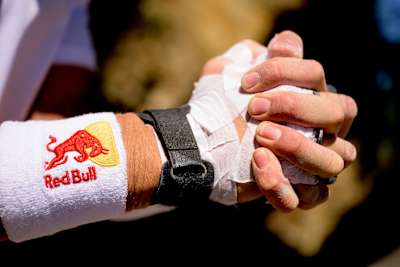
Hands on
© Craig Kolesky / Red Bull Content Pool
According to Thomas, controlling the way down is almost the hardest part of all, and the reason is the same as everywhere else on the arch. "We've almost maxed out on the climb and pushed beyond that in the middle. Now we're using those muscles eccentrically, slow and controlled, which is even harder in its own right on fatigued muscles."
The bars on the way down sit somewhere between the other two sizes. Thomas found the medium bar suits the technique best.
04
The biggest difference from a flat course
On level bars, an athlete can train one movement and repeat it. The arch does not allow that. The angle shifts gradually, so there is no clean line where one technique ends and the next begins.
"I can't just hyper-focus on a single technique," Thomas says. "I have to be able to do all of the different techniques, and at a magnitude never seen before."
He thinks there will be a stretch of 20 to 30 metres below the top of the arch where he is neither climbing nor braking, just swinging. Everything before that is climbing. Everything after is managing momentum. But the exact switch points are unknown, and he will have to find them by feel.
"I might try going forward for a bit, find it doesn't work, and have to go back to the other technique," he says. "That puts a lot of extra mental strain on me." Always, in the background, is the fear that a muscle group will simply stop working.
05
Some aspects cannot be trained for
At home, Thomas built a rig on the side of the mountain to train on. It came in at about 48 metres. He climbs it, then comes back down. It is a serious piece of kit. It is also a fraction of the real thing.
"On the bridge it's three times that in a single movement," he says. "So I can't replicate how continuously the same muscle groups get hammered."
Thomas knows he can manage roughly 40 to 50 metres of steep incline in one go. Beyond that is guesswork. The incline and decline on the arch are longer than anything his simulation rig can give him.
"It's really a mentally overwhelming thing, again, to look at that bridge with what seems like a million monkey bars ahead of you, not knowing at what point you can actually start moving differently," he says.
So the body has been built, as well as it can be built without the bridge itself. What is left is the part only the bridge can teach him.
"We'll only know how far I can go on the bridge itself."