




Surfing
Surfing
How Cape Courage Is Reigniting the Dungeons Legacy
Eighteen years after the last Red Bull Big Wave Africa, Dungeons has a stage again. Cape Courage brings a multi-generational mix of South African chargers back to the most feared reef on the continent
There is a particular kind of cold that lives at the bottom of Africa. It comes up off the Southern Ocean, riding four-thousand-mile groundswells that have forgotten what warmth ever felt like, and it settles into the kelp-thick water below a jagged outcrop of mountain called the Sentinel — where the reef reveals itself only a few times a season, and only to those willing to find out the hard way why surfers ever agreed to call it Dungeons.
For nine years, between 1999 and 2008, that cold water played host to one of the great fever dreams of big-wave surfing — Red Bull Big Wave Africa, a paddle-in invitational that took the wildest reef on the Cape Peninsula and turned it, however briefly, into a stage. Then, for reasons that had less to do with the ocean than with the humans standing at its edge, the stage went dark. Eighteen years dark.
This winter, it flickers back on.
A Wave That Doesn't Care About Your Plans
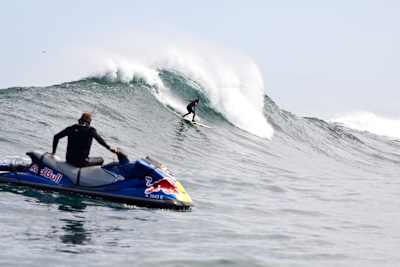
2009_Frank Soloman @ Dungeons2
© Craig Kolesky / Red Bull Content Pool
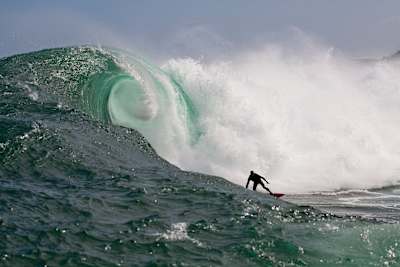
To understand why Cape Courage matters, you first have to understand Dungeons — and understand that Dungeons does not care, has never cared, and will never care about your event permit, your broadcast schedule, or your sponsors' activation timeline. It is, in the words of organizer Tim Coles, "the white whale of big waves" — a break that might deliver a mere handful of truly world-class days across an entire winter, and that demands a wildly specific alchemy of deep-water storm energy, glassy wind, and cooperative tide before it will show you what it's capable of. Get it wrong and you've got nothing. Get it right and you've got twenty-foot faces detonating across a reef the size of three rugby fields, close enough to the seal colony on Duiker Island that the sharks have learned the schedule too.
Dungeons was first paddled — not towed, paddled — in the winter of 1984, when Pierre de Villiers and Peter Button hiked over the mountain from Hout Bay, dropped down through what was then a rubbish tip at the base of the ridge, and swam a channel that nobody had swum before them, on boards that, by their own later admission, were entirely the wrong shape for the job. There is no glamorous prologue to that story. There is only two young men deciding a wave looked possible, and finding out.
It stayed that way — a rumor, a whisper passed around bonfires, a shape glimpsed from Chapman's Peak on a screaming south-easter — until 1999, when Red Bull, having watched South Africans Cass Collier, Ian Armstrong and Mickey Duffus bring home ISA Big Wave World Cup gold from Todos Santos, decided the country that produced surfers like that had to have a wave like that. Big Wave Africa was born, and for the better part of a decade Dungeons took its place beside Mavericks and Waimea and the newly discovered Nazaré in the sport's mental atlas. Sean Holmes won the inaugural event. Greg Long, the Californian who would go on to be recognized as one of the finest big-wave riders alive, took it in 2003. And in 2008, in its final edition, Durban's Grant "Twiggy" Baker put his name on the trophy — a result that, in hindsight, reads less like an ending than a hinge point, the moment before the door swung shut.
Why the Lights Went Out
Ask Coles why an event with that much momentum simply stopped, and he doesn't reach for the tidy answer — sponsorship dried up, the swells didn't cooperate, take your pick. He goes somewhere more honest.
"It's worth looking at why it stopped in the first place, which came down to the attitude of the community at the time," Coles says. "There was a feeling that what was taking place wasn't necessarily in the best interest of the entire community — that the spotlight on our waves wasn't being matched by the same spotlight on our surfers. There was a strong pull back toward the core community and the core ideals of just surfing, without corporate money involved."
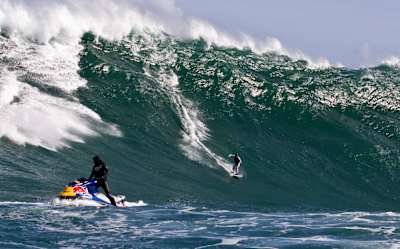
DUNCAN SCOTT
© Craig Kolesky / Red Bull Content Pool
That's one half of the story — a very surfing kind of half, the same instinct that's shut down secret spots and burned bridges from Malibu to Tavarua since the sport began. The other half is bureaucratic, and somehow just as ruthless.
"The big blocker has really been the technicality of putting an event like this together," Coles explains. "Back in the day there was institutional muscle memory — people knew what legislation applied, what it fell under, even as an event. I fill out forms and one says I'm doing a film shoot, another says I'm running a race, and this is neither of those. The legislation isn't designed to accommodate specialty events like this. It's a technically brutal event to run given the location, the accessibility, and the overlapping jurisdictions of different public sector players — SANParks, the City of Cape Town, the harbour. It's an administrative nightmare, and an underwriter's biggest nightmare too."
So the wave kept breaking, in private, for whoever happened to be watching the charts. Twiggy Baker kept showing up. So did Frank Solomon, Matt Bromley, and a scattering of others willing to make the walk over the mountain on the strength of a good forecast and nothing else. But the platform — the thing that turns a secret into a career — was gone.
The Lost Generation
This is the part of the story that stings, and it's the part Coles keeps circling back to. Because a wave without a platform doesn't just mean less footage. It means fewer surfers.
It is time, again
© Craig Kolesky / Red Bull Content Pool
"We realised that by pushing exposure away from the waves, we also pushed exposure away from our up-and-coming surfers, and we've had a bit of a lost generation of very talented big wave chargers," Coles says. "Matt Bromley is a great example — guys who've come of age and never seen a premier event run in this country. That has massive knock-on effects for their ability to access support, get sponsored, and pursue this dream. We have world-class waves and world-class surfers here, but we've struggled with exposure."
There's a wave that haunts this conversation, and it's not one that made the highlight reels. In 2018, at Dungeons, a rider named Pieter de Wet — known to everyone simply as "Free Piet" — caught something big enough to earn a shortlist nod for the Biggest Paddle award on the global stage. And almost nobody noticed.
"No one really batted an eyelid," Coles says. "He didn't take the final prize, but those are the kind of moments out here that I think carry real international significance for big wave surfing as a sport — and we've never had the platform or the exposure to generate interest around this crazy little hobby of ours."
That, in essence, is the case for Cape Courage. Not nostalgia for a trophy that hasn't been contested since the Beijing Olympics were still a warm-up act. A genuine reckoning with what gets lost when a country's best watermen have nowhere to be seen.
Paddling, Not Towing — On Purpose
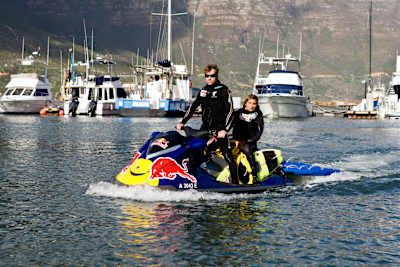
If there's one decision that defines Cape Courage's character, it's the one that was never really up for debate: this is a paddle-in event, full stop. No tow-ropes, no jet-ski whips into the pit. The skis on hand are there strictly for water safety.
James Taylor
© Craig Kolesky / Red Bull Content Pool
Some of that is simply the law of the land — or rather, the sea. Dungeons sits inside a SANParks Marine Protected Area, where personal watercraft use is tightly restricted to genuine rescue scenarios. But listen to Coles for more than a minute and you realize the legislation is only doing him a favor, formalizing a choice he'd have made anyway.
"Tow-in was never really on the table," he says. "The other big reason is keeping the spirit of the event in honour of those who pioneered these waves with far, far less than we have available today. Guys were paddling out there in the shonkiest old wetsuits on five-six fish boards — not that I'd recommend that — but we're trying to honour the legacy of the surfers who came before us, and run a proper, core event where we can."
It's a small mercy, in a way, that the ocean and the rulebook agree on this one. Because paddling into Dungeons — putting your own two arms between yourself and a wave that can run twenty feet on its face — is precisely the thing that separates a competitor from a passenger. It's also, not coincidentally, exactly what de Villiers and Button did back in 1984, on the day nobody was watching.
Building the Field, One Hard Conversation at a Time
Assembling eighteen surfers for a comeback event at the most feared wave on the continent turned out to be less about star power than about restraint. Coles and his team ran what amounts to a small, informal referendum through the South African big-wave community, gathering nominations, cross-referencing them, and whittling the list down to something that felt honest rather than merely impressive.
"We decided this year to keep it as local as possible, and even that was hard, because there's a lot of talented local chargers," Coles says. "We went with the idea that it's for the locals, by the locals. Part of that is because this year is really a proof of concept — showing we can host a safe, good event with world-class waves — and I didn't feel we could tick every nice-to-have box at once: international invites, bigger sponsors, all of it."
Notably absent, at least for this edition, are two of the Cape's fiercest female chargers. A young goofy-footer named Casey had to withdraw for personal reasons; Caitlin Moore, who has torn it up at Sunset Reef, took a session at Dungeons to gauge her own readiness and, after weighing it honestly, chose to sit this one out.
"Both are surfers I'd genuinely love to see in the comp down the line," Coles says.
What remains is a field built to bridge two eras rather than crown one — Twiggy Baker sharing a waiting period with the likes of Sam Warren and Jake Elkington, a generation that grew up idolizing him without ever getting the chance to line up alongside him in something that counted.
"No South African big wave event would be complete without Twiggy," says Coles. "It matters for the next generation to watch surfers like that — often their heroes — in the lineup, to learn positioning from them and to get the chance to compete against them. Honestly, the balance came pretty naturally. It's a fairly small crew that's out there a lot, and if you took a random cross-section of everyone who's surfed Dungeons in the last three years, it's already pretty diverse across skill level, profession, age — a whole bunch of metrics. It was always going to be a balanced field."
Betting on the Ocean
Cape Courage's waiting period runs from the first of July to the last of August — sixty-odd days for the Atlantic to make good on its reputation. As of now, the status board reads simply: on hold. Red light, waiting for amber, waiting for green.
Ask Coles what happens if the swell never quite arrives, if the whole two-month window closes on nothing but chop and onshore wind, and he doesn't flinch.
"That's not something I've spent a lot of time thinking about, honestly — I really believe we're going to get a swell," he says. "There could be an option to extend the waiting period, which could be fruitful. What we can't do is move location — it's not a mobile event. We wouldn't run it anywhere else. I firmly believe we're going to run."
It's the kind of certainty that only makes sense at Dungeons, where uncertainty is the entire point.
More Than One Winter
For all the talk of proof of concept, Coles is unambiguous about where this is meant to go.
"Definitely the goal is to build toward an annual event," he says. "This is our MVP — we'll see what works and what doesn't, and build off the successes while cutting out the failures. But the intention is absolutely for this to be ongoing, and hopefully a cornerstone of South African surfing. We've lost J-Bay as our premier winter event. We've got the Ballito Pro, which is amazing — but in terms of winter events in South Africa, I think this steps into a real vacuum."
And underneath the logistics and the permitting nightmares and the swell charts, that's the real stake on the table. Not a trophy. Not a highlight reel. A pathway — the thing an eighteen-year silence took away from an entire generation of South African chargers, and the thing Coles is betting an entire winter's worth of storm-watching on getting back.
"What we lost was the scene," he says. "That's what we're hoping to rebuild with this: the platform, a pathway for the next generation, and a bit of life back into South African big wave surfing. Reignite the fire, honour the people who came before us, and get the next generation schooled up, tooled up, and ready to charge."
Somewhere off Hout Bay, right now, a deep-water storm is spinning itself into being thousands of miles south of anywhere. Whether it turns toward the Cape in time is, as it always has been at Dungeons, entirely out of anyone's hands. All Tim Coles can do — all anyone connected to this wave has ever been able to do — is watch the charts, make the calls, and wait for the light to turn green.
