
Rowing
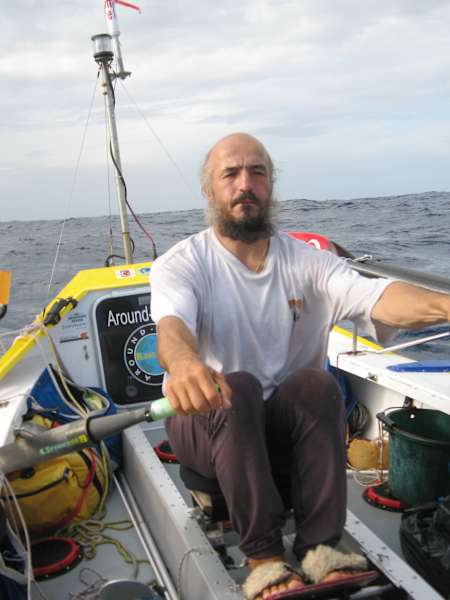
Meet Erden Eruç – The Human Rowing Machine
After a childhood spent climbing in Turkey, Erden Eruç spent five years circumnavigating the globe, using only man power. In season two of How to be Superhuman, he reflects on his epic quest.
In 1997, Erden Eruç traced his fingers along a map of the world, and plotted a path from his new home of America, across the Pacific Ocean, eventually back to his former home, Turkey. He wondered if it would ever be possible to make this journey, using human power alone.
Fifteen years later, Erden stood on California’s Bodega Bay, and dipped his toes into the water to signify the completion of a simply mind-blowing feat.


After five years and 11 days, including 876 days rowing at sea, the shattering of all manner of world records, and plenty of unthinkable hardship, he had just become the first person to circumnavigate the globe solo by human power.
Back in 2007, when Erden had stood on the same coastal spot to start his epic journey, he was a 46-year-old former IT consultant about to realise a dream that had been 10 years in the making.
Although he’d always had an adventurous streak and grew up climbing with his father – which had seen him scale a 13,000ft peak aged 11 – Erden had no experience of rowing.
Tragedy strikes
Unfortunately, it was a tragic accident in 2002 that had given him the impetus to pursue his passion. Erden’s hero was Swedish adventurer Göran Kropp, who had cycled from Scandinavia to the foot of Mount Everest before scaling the peak, unsupported by Sherpas or oxygen.
Erden befriended Kropp and the pair were part of a group climbing the Columbia River Gorge in Eastern Washington, when an accident saw the Swede fall to his death.
“When I returned to the site of the accident, there was one rock soaked in his blood and I kept it, as morbid as that might be,” Erden tells Rob Pope in the latest episode of How to be Superhuman podcast. “Life is short, so it turned out to be the swift kick in the rear I needed to get going myself.”



After taking out a loan, Erden bought a two-man rowing boat, joined his local club, and started to spend so much time on the water, that by the time of his 2007 departure from California, he felt ready. “By the time you get to that point, 80% of the work is done,” he says.
Rowing Down Under
Armed with a satellite phone, freeze-dried eggs, pineapple slices, and an iPod, Erden began rowing towards Australia, and quickly found a routine where he would reward himself for his efforts.
“I would row for two hours, so if I wanted music, I had to earn it,” he explains, adding that he listened to Pink Floyd, Beethoven and Turkish folk to keep him going.
He also learned how to identify the marine wildlife that accompanied him on his journey, recognising the thud of the sea turtles against the bottom of the boat, compared to the whizzing torpedo sound of the tuna, or the silence of the small sharks that used his boat for shade.
I would row for two hours, so if I wanted music, I had to earn it
But, the Pacific was never going to let him have an easy ride. After 147 days of rowing, and with salt blisters plastered all over his body, Erden became stuck in a counter-current where winds blowing in from opposite directions made it virtually impossible for him to move forwards.
All he could do was to keep rowing, which he did valiantly. Yet, 13 days later – to his horror – he discovered he was in the same spot where he’d been two weeks previously, having rowed in a massive circle.
“The ocean is so much bigger, so much stronger than me, there is really no controlling the outcome,” he says. “You end up with this sense of submission. There's no use in cussing at the sea and swinging your fist at the skies.”
Instead, Erden tried his best to suppress the negative thoughts by giving himself tasks to perform, like reciting multiplication tables, which kept him calm. These techniques came to the fore when his plan of crossing the equator was thwarted by the ocean. Instead, he ended up moving too far west after getting caught up in the middle of typhoon season, just north of Papua New Guinea.
The ocean is so much bigger, so much stronger than me, there is really no controlling the outcome
“I was in the wrong hemisphere at the wrong time of the year, and just could not bring the boat to land,” explains Erden, who was fast running out of supplies and needed to find land urgently. Eventually, he was rescued by a fishing boat after putting out a distress call, and he landed after a record 312 days alone at sea in a rowing boat.
Carrying on regardless
The rules of circumnavigation state that you can return to the exact spot and continue your journey so, after eight months during which he was reunited with his wife Nancy and had to overcome a severe case of Edema, which left his feet and ankles extremely swollen, Erden’s quest went on.
I thought ‘am I going to have to get air-lifted out of here?'
He made it to Australia and continued to Africa, all the time still only using human power. But he got stuck, almost literally, while cycling through Mozambique in monsoon season, along a 60km unpaved road that was covered in a thick silt.
“My bicycle and I just got buried into what looked like knee-deep, chocolate milk. It was horrendous, slow-moving, and there was really no way to get off it. I thought ‘am I going to have to get air-lifted out of here?’”
Writing about that day in his daily dispatches, he noted that it was the first time he thought he would actually fail. Yet, as he pushed his bike and waded through the silt, he found a path to a newly built highway. “I had the entire highway to myself!” he recalls, even using rain puddles to help clean himself and his bike up as much as possible before setting off on the road.
As he continued through Tanzania and on to Namibia, conditions were tough: “You’re dealing with flies, sand flies, mosquitoes, the threat of malaria, and the heat. It becomes like a huge pressure cooker, real Indiana Jones stuff!”
Erden against the world
At this stage, Erden entered what he describes as a deeper place, where a steely determination took over: “It was a feeling that it was me against the world. I was going to finish this despite everything.”
And that ‘everything’ included desperate financial problems as he was $240,000 in debt, having failed to attract significant sponsorship, as well as an increasingly concerned wife back home.
With all this on his mind, he rowed the Atlantic from Namibia to Venezuela, before taking on his final challenge across the Gulf of Mexico to Louisiana where floating oil rig platforms threatened to ruin his efforts, and required him to stay awake and alert for days at a time – which he managed, supported by audiobooks.
After 69 days of this final rowing boat crossing, he reached dry land in Louisiana, before cycling all the way back to California to complete his astonishing circling of the planet.
He had rowed for a total of 876 days, covering 33,000 miles – both records. He had also become the first person to row the Atlantic, Pacific and Indian Oceans.
That journey ended in 2012, and you would’ve thought that he might never be allowed to trace his finger across a map again, in case it gave rise to another idea.
But, clearly, that rule was not enforced. In June 2021, he’s set to leave Crescent City in northern California for a nine-month rowing jaunt to Hong Kong. And that’s only part of the journey. From there, he’ll be following in the footsteps of his mentor Göran Kropp, cycling to the foothills of Everest, where he’ll attempt a summit.
Superhumans have got nothing on Erden Eruç.
