




Gaming
Games
Chasing dreams in Lonely Mountains: Downhill
We talk with the two-man indie team crafting a stylish downhill mountain bike game that ditches tricks and stunts to focus purely on the riding.
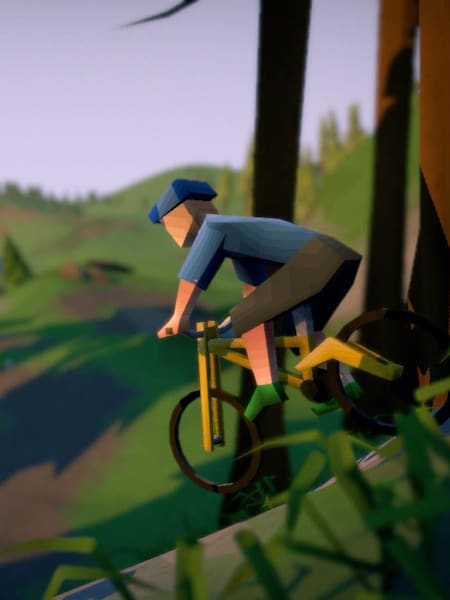
“Lonely Mountains: Downhill is a game about you and your bike and finding the best way down the mountain – all the way from the peak to the valley,” Daniel Helbig tells us, when we ask him to sum up his game in a sentence. “Each of our Lonely Mountains is carefully handcrafted to offer a high replayability as well as lots of shortcuts to find and secrets to explore.”
“Our core gameplay is about best times and being fast. However it’s not all about speed, but also about exploring the mountain, finding the best paths, taking some risky jumps and making it to the finish line in one piece,” he continues.
No tricks allowed
Surprisingly, given the faithful recreation of downhill mountain biking we’ve seen so far, the team aren’t actually avid downhill riders, nor are they huge fans of sports video games – but Bubenik drew inspiration from his much-loved way to commute, and they say that not paying attention to other sports gives them a different edge for when it comes to crafting the game.
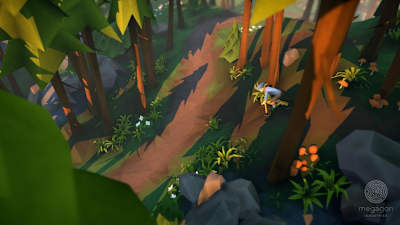
Zip through the forests
© Megagon Industries
“[We’re] both not the most passionate players of regular sports games,” Bubenik tells us. “That’s also probably one of the reasons Lonely Mountains is a different kind of experience than most other sport games. But one day, a couple of years ago Daniel had this rough idea for a racing game set on some stylised mountains and both things started to connect. More or less over night I made a prototype for a mountain bike game which just felt so right that we’ve been working on it ever since,” he says.
That’s not to say the duo haven’t looked at other sports games for inspiration. “Actually it was not a bike game, but a mobile skiing game called Skiing Yeti Mountain from Featherweight Games which influenced the very early prototype,” Helbig tells us. “Although it has super simple controls, it really feels great and we wanted to have that kind of feeling for our game. Because when you sit on your bike in real life, you don’t think about which button to press, you just ride. That’s the feeling we wanted to have.”
And that streamlined feeling is what the team is looking for going forward, and so much so that you won’t find any kind of trick system in the game at all – instead, the focus is on getting down to the bottom of the mountain as fast as possible, setting fast times and runs to beat on a leaderboard.
Crashes are definitely an essential part of LMD, so we tried to make them as fun as possible.
“Of course a trick system is something that comes to mind when you think of a biking game,” Bubenik tells us, “But we’re convinced that it would not make the game much better. One common feedback from playtesters is that they expected tricks before they played the game, but they didn't miss them at all while playing. And you will still have a lot of ways to show off your skills. Racing through a thick forest with full speed or making nearly impossible jumps over large canyons can be quite impressive.”
Big jumps mean that there’ll be big wipeouts too, some of which look pretty gnarly for the blocky-headed rider. “That’s the good thing about video games – you can make things fun which would really badly hurt in reality. And as crashes are definitely an essential part of LMD – and happen a lot – we tried to make them as fun as possible, not only for the player but also for everyone who’s watching,” Bubenik tells us.
Just as the game has a streamlined focus on its core downhill gameplay, it sports a clean visual style to match – uniquely low in polygons, but still rich in colour and detail. “One of the main inspirations for the game’s style is the art of Timothy J. Reynolds (@turnislefthome on Twitter), who really does amazing low poly artworks,” says Bubenik. “In terms of games Lara Croft GO was a huge influence too.”
It’s easy to see the inspiration from Reynolds, who has crafted stylish, low-poly work for the likes of Twitch and magazines like Wired, Kill Screen and Fast Company, while Square Enix’s mobile Lara Croft title is a similar inspiration, but to see that art-style transferred to a fast-paced, action-oriented game is a breath of fresh air, and a welcome departure from other titles that aim to capture the realism of action sports – but often wipe out at the bottom of the uncanny valley instead.
Crowdfunded cycle sim
While some of those other sports titles might be loaded with big budgets, Megagon’s a two-man indie studio, meaning that LMD is a low-cost affair – and in the indie spirit, Helbig and Bubenik, are looking to fans on Kickstarter to help fund the development for the game.
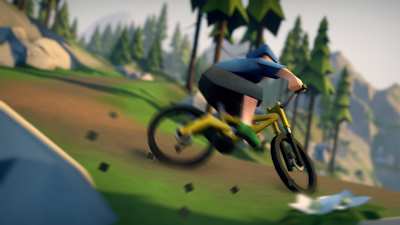
Pedal power
© Megagon Industries
“Our initial goal [for the campaign] is €35,000. With this and the Medienboard Berlin-Brandenburg funding we can focus on the development and finish the base version of the game with the most important features. However, there are a few things we would love to add to the game. We have lots of ideas for more mountains we would love to build but also more game modes, features or maybe even a local multiplayer mode if the campaign is really successful,” Helbig tells us.
That’s not to say they’re not sceptical of the system in today’s world, though.
“We believe the golden age of Kickstarter is definitely behind us. What we see is that even indie games which are really good and have an awesome presentation sometimes have a really hard time making it to 100 percent,” he continues.
“We think there are several reasons for that – not only the bad experience some people have had with Kickstarter projects. First there are a ton of games coming out each month on all kinds of platforms. Secondly a lot of good games that are barely a few months old are already on really high discounts or part of cheap bundles. Finally a lot of people are very happy just playing their one favourite game for months or even years. All these things combined make up for a very tough games market and that also affects Kickstarter.”
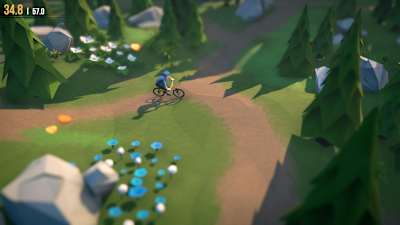
Explore to your heart’s content
© Megagon Industries
Still, the team are optimistic about their Kickstarter ambitions: “The release will definitely be more mid-2018 than early. But the actual timeline really depends on the success of the Kickstarter,” says Bubenik.
With a gorgeous art style and a clean focus on solid downhill riding, the game looks like a natural fit for consoles, especially the Nintendo Switch, and even on mobile – so will it make it outside of the PC and Mac release in the future?
“We definitely want to and we believe (and a lot of people seem to agree with us) that the game would be a natural fit for any of the bigger consoles,” Bubenik tells us. “But, seeing that we are only two people at the moment – we decided that we will first focus on the PC version and make that as good as we can. As for mobile, we did a prototype for it which was very promising but we’ve decided to put it on ice for the moment.”
For the moment, the team are putting all of their energy into making Lonely Mountains: Downhill as polished and as fun as it can be on PC and Mac, and focusing on getting that version complete is the main goal here – all we know for sure is that we can’t wait to get our hands on it and to start setting some fast times.
Lonely Mountains: Downhill is currently seeking funds on Kickstarter – its campaign concludes on November 16.
