
Fitness Training
How to get a flat stomach with Plank exercises?
Do you dream of a flat stomach but are overwhelmed by the abundance of fitness exercises? Then planking is the solution! Here you can find out everything you need to know to train properly.
From the gym to your own living room - plank exercises are everywhere and are considered one of the most effective ways to strengthen your core and get a flat stomach. But why are they so effective? Which variations produce the best results? And how do you get a six-pack like Gee Atherton? Don't worry - we'll tell you all about the famous plank.
01
What is the principle of the plank?
Plank: an ally for a flat stomach
The plank is primarily based on static muscle work. You don't move, but your muscles don't rest. While you hold the plank, your abdominal muscles work intensively to strengthen the centre of your body. By training the core muscles, it not only strengthens the abdomen, but also the back and glutes. The result? A toned stomach and strong deep muscles. And a flat stomach is nice, but if you also get a strong, balanced body, all the better. So if you want to get rid of those little rolls of flab and have a flat stomach, you've come to the right place.
02
The most effective plank exercises to strengthen your abdominal muscles
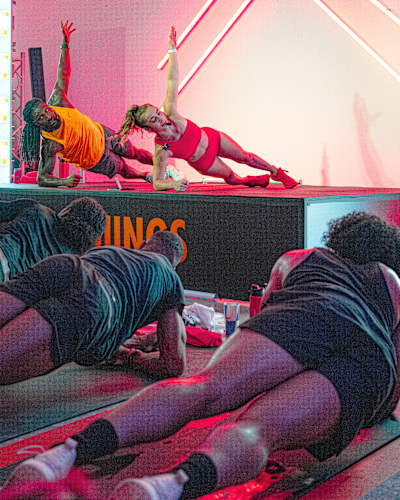
Group training in Miami
© Daniel Zuliani/Red Bull Content Pool
The classic plank: the basis of abdominal training
Ah, the famous plank! The supreme exercise for abdominal muscle training. In the push-up position (on your arms or elbows, depending on your preference), you hold the position without rocking. Simple on paper, but the seconds drag on like chewing gum. However, this position is extremely effective for shaping the abdominal muscles and strengthening the arms, back and even legs at the same time. In short: a multifunctional exercise for a flat stomach.

The side plank: focus on the oblique abdominal muscles
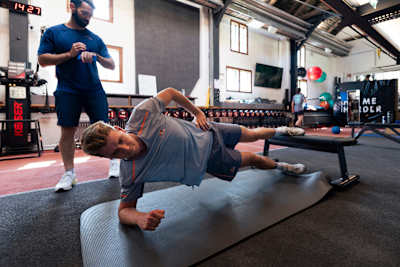
Cam Green during his visit to the Red Bull Athlete Performance Centre
© Leo Rosas/Red Bull Content Pool
If you want a slim waist, the side plank is the perfect exercise for you. This involves leaning on your side and primarily engaging the oblique abdominal muscles (obliques), which shape the waist. Once in position, tighten the abdominal muscles firmly and remain stable. This exercise can be combined with the classic plank:
After about a minute, switch to the side plank, then back to the classic plank and then to the other side. The change of position helps you to hold the plank for longer.
Dynamic plank: movement for greater effectiveness
Why keep it simple when you can make it complicated? The dynamic plank adds variations to the classic plank exercise, for example raising an arm or leg or changing from a low to a high plank position. This makes the abdominal muscles even stronger and prevents boredom. With imagination, there are many variations.
The back plank
The back plank strengthens the lower back muscles and trains the buttocks and abdomen at the same time. Lying on your back, you lift your hips with the support of your arms or elbows, tense up and hold the position. A simple exercise that does a lot for the lower body.
The scissor movement
This plank exercise combines dynamic movements with a static basic posture. You lie on your back, lift your legs and hit your feet like scissors. The abdominal and thigh muscles are worked intensively.
Plank on your knees
Not ready for the classic plank? No problem, the knee variation is gentler and ideal for beginners or those who want to approach the exercise slowly. The important thing is to learn the correct posture and build up the muscles slowly - without buckling!
Plank with exercise ball
Fitness equipment can also help with the plank. Do you have an exercise ball at home? Then the plank will be more challenging - and a bit more fun. Your feet rest on the ball while you hold the position. The instability means that your stomach has to work even harder to stabilise your body. As a bonus, this also trains your balance and patience!
03
FAQ
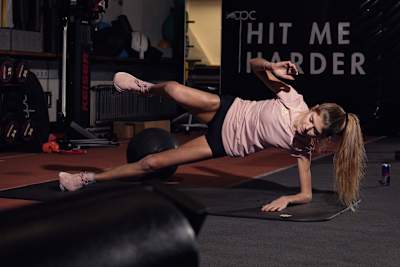
Konstanze Klosterhalfen trains intensively at the APC
© Markus Berger/Red Bull Content Pool
Is it recommended to do planks every day?
That depends on your level and your goals. If you train regularly and listen to your body, 3 to 4 sessions per week are usually enough. If you want to do more, just make sure to vary the exercises and give your muscles enough time to recover. Recovery is essential for plank training. So don't forget your can of Red Bull as well as rest.
When do you see the effects of the plank?
The first results usually show after 3 to 4 weeks. But remember:
Plank, like exercise in general, needs regularity. Keep at it and your flat stomach will appear sooner than expected.
How long should you hold a plank?
For beginners, 20 to 30 seconds per round is a good start. Over time, you can gradually increase the duration. The important thing is that you progress at your own pace.
So, now you've completely understood the plank workout! So having a flat stomach isn't that complicated, is it? Ready to make your abs shake?