
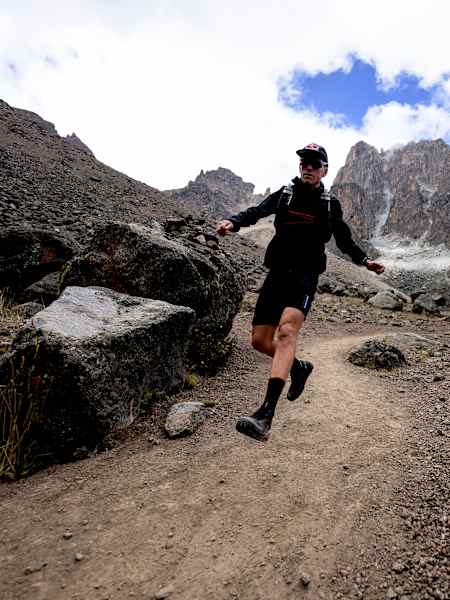
Mountain Running
Adventure Lessons: What Mount Kenya Taught Ryan Sandes About Racing Smarter
From tagging 13 Peaks, grueling multi-day traverses, and now a fresh expedition up Mount Kenya, Ryan Sandes keeps stacking up the lessons that make him a sharper racer.
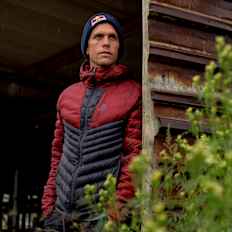

"I'd rather be 30% under-trained than 2% over-trained," says ultra trail ace Ryan Sandes, talking about the fitness level he'd want going into a multi-day adventure project. It's not a throwaway line — it's a distillation of a 19-year career built on balancing personal projects with race goals. His latest, an expedition up Mount Kenya, added a fresh set of lessons to the pile.

Ryan Sandes prepares for Red Bull Mount Kenya Expedition
© Craig Kolesky / Red Bull Content Pool

Ryan Sandes fuels his Mount Kenya Expedition with Red Bull
© Craig Kolesky / Red Bull Content Pool
"There are athletes who just kind of race, race, race. And that's fine, but I need to do those projects because adventure fuels me," he says. "Perhaps more importantly, though, on those projects a lot can (and usually does) go wrong. You learn a lot about yourself through those setbacks, and I've taken all those lessons and applied them in race situations over the years."
I can’t just say to you: 'Here are five key things you need to knock out the park in training and you're guaranteed race success,' trail running doesn’t work like that and that is why I love it.



You might not be about to attempt a 100-mile race or personal project, but you can apply these lessons to your own adventure activities. These are Ryan's tips:


01
Stay Mentally Hungry by Keeping Things Fresh
For Ryan, adventure projects aren't a distraction from racing — they're what keeps him wanting to race at all. Mount Kenya is the latest example: a new mountain, a new set of unknowns, and — whether the expedition goes exactly to plan or not — a return home mentally recharged and hungry to get back into structured training.
He points to this mental sharpness as the real differentiator among elite athletes today — not just fitness, but focus, hunger and being switched on, in training and on race day alike.
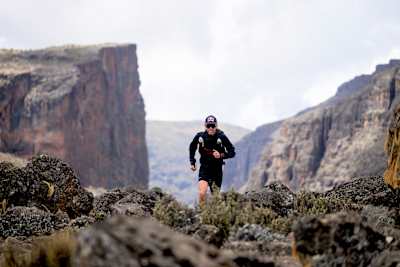
Ryan Sandes tackles Red Bull Mt Kenya Expedition
© Craig Kolesky / Red Bull Content Pool
02
Break the Bigger Goal Into Manageable Goals
Any runner — novice, intermediate or elite — needs a goal and a plan to stay motivated. Break the big target into a series of mini-goals in the build-up: a couple of long runs, a smaller race, anything that tells you what to expect on the day. Those same mini-goals carry into race day itself, helping you set realistic pacing targets instead of chasing numbers your training hasn't earned.
03
Plan, Prepare — But Respect the Mountain
Planning and preparation remain non-negotiable for Ryan — a discipline he traces back to his background in Quantity Surveying and Construction, and the project-management habits it taught him. But Mount Kenya reinforced a lesson learned the hard way on the Great Himalaya Trail: you can't force a natural environment to cooperate with your calendar.
Setting a fixed start date for the Himalaya crossing, regardless of late-winter conditions, was — in hindsight — a mistake. The mountain doesn't care about your schedule.
"Have a healthy respect for the ocean," his grandfather used to tell him at the beach growing up. Ryan's carried that same principle into the mountains ever since.
If conditions aren't right, delay or stop. The goal will still be there. Plan and prepare thoroughly, then hold that plan loosely enough to adapt when the mountain says no.
04
Be Comfortable With More Than One Attempt
Not every project comes together on the first try — and that's fine. Sometimes it takes multiple attempts, more homework, another season. Ryan's advice: be willing to try, fail, recognise the moment to turn back, and return to the drawing board without treating it as a setback. Mount Kenya delivered its own list of takeaways he's already applying to future big-mountain plans.
05
Accept an Imperfect Build-Up
Nobody lines up 100% ready. Ryan cites Kilian Jornet — arguably trail running's most-raced athlete — making the same point on a podcast: even he rarely, if ever, gets to a start line with everything having gone perfectly to plan.
Social media can make it look otherwise — the dream project, the ideal budget, everything running like clockwork. In reality, life happens. The lesson is to accept your build-up for what it is, show up at 80% if that's what you've got, and treat working through it as part of the challenge rather than a failure before you've started.
06
When Things Go Wrong, Don't Panic
That same comfort with imperfection carries into the race itself. When something goes sideways — and it will — Ryan's approach is to recognise the moment rather than spiral: I've been here before, I know this movie, don't panic. Runners who manage their low points best are consistently the ones who perform best.
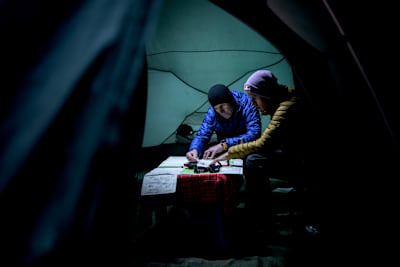
Ryan Sandes and Ryno Griesel Plan Mount Kenya Expedition
© Craig Kolesky / Red Bull Content Pool
07
Train Smart, Not Just Hard
Training should be race- or project-specific and get more focused the closer you get to the goal — sand training for a desert crossing, hill repeats for a mountain race, night sessions dialled in for something like UTMB. Multi-day projects are about conditioning your legs to back up day after day without peaking too early; single efforts need a different kind of readiness. Staying flexible and willing to try new approaches matters more the longer you do this.
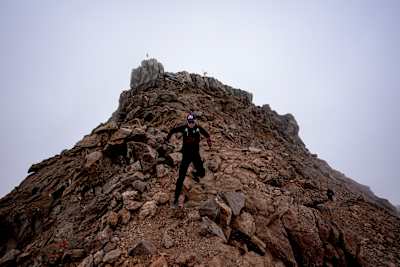
Red Bull’s Ryan Sandes tackles Mount Kenya
© Craig Kolesky / Red Bull Content Pool
Keep It Simple: Focus on What Moves the Needle
Thorough planning is essential, but Ryan's wary of over-complicating it. In the chaos of an adventure project, rigid over-preparation can work against you — you need to think on your feet. His fix: run through scenarios in advance so nothing catches you off guard, but keep the plan simple enough to hold in your head under pressure.
The same goes for training. Focus on the handful of things that actually move the needle — consistency, terrain-specific work — rather than chasing marginal one-percent gains that eat time and mental bandwidth without changing the outcome.
There is something really magical about vast, open landscapes. You know, complete wilderness free of all clutter. It's the only place I can really switch off. And, ask myself some pretty tough questions.
08
Crew Is Crucial
Ryno Griesel has been alongside Ryan on most of his biggest projects and races. That stability and trust is fundamental to both confidence and motivation, in adventure and in competition. Get your crew together, and get out there.


