
Spinning
Sam Sam Explains The Price of Admission
Getting 'in' was its own apprenticeship, and it started years before anyone was watching.
Before Sam Sam Thubane was ever behind the wheel for money, before Shay'iMoto, before Red Bull put his name on a car, he had to find a way through the gate. Not the wheel, the gate.
He was eleven, maybe twelve, when he first met the culture that would define him, not in an arena, but on the traffic circles around Mahushu and Mphatseni, on the edges of Hazyview. "When I started putting traffic circles," is how he remembers it, a phrase that sounds almost administrative until you understand what it means on the ground: a public roundabout, repurposed as a stage, a kid watching older men treat an intersection like it belonged to them.
In Episode 1 of What We Know, which looks at creativity as a way through fear, SamSam's segment isn't really about the spin itself. It's about everything that had to happen before he was allowed to attempt one in front of people who mattered.
Because spinning, in its early years especially, wasn't an open sport. It had gatekeepers, in the loosest and most literal sense. To get into an event, you needed to be known, or vouched for, or both. Sometimes that meant an actual exchange changing hands just to be let through. "Sometimes they can pay something to someone so that we can come today," SamSam says of it, the sentence doing double duty, describing a transaction and admitting, almost in passing, how precarious that access always was. You could have the skill and still not get the invite. You could have the invite and still need to find cover for it. The car was the easy part. The door was the negotiation.

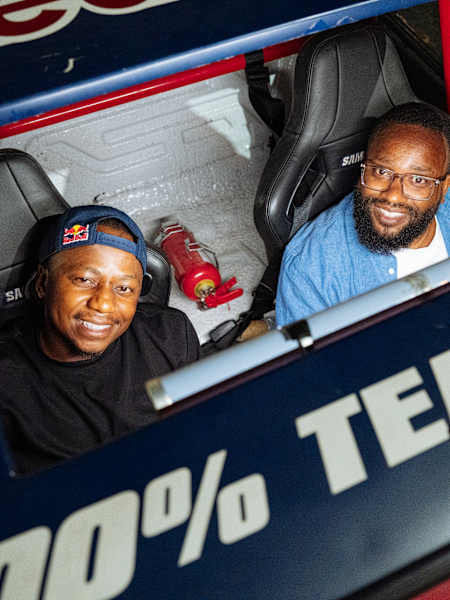
Sam Sam
© Tyrone Bradley / Red Bull Content Pool
It's worth sitting with that for a moment, because the version of fear most people assume drives a story like this is the obvious one: the physical risk of a driver holding a car in a tight, controlled spin while someone rides the door sill or clings to the roof, trusting a stranger's hands on the wheel. That fear is real, and it's part of what makes spinning what it is. But for SamSam, the deeper and less visible fear came earlier. It was the fear of being permanently on the outside of something he already knew, at eleven years old, that he wanted in on. Talent doesn't count for much if nobody lets you prove it.
What's easy to miss, looking at where he's ended up, is how much of his early career was spent solving that problem before he ever solved the harder technical ones. Long before the BMW E30 his father helped him get, long before national television introduced him to a country that didn't know spinning existed outside its own neighbourhoods, SamSam was already fluent in a different skill: working out how to be let in. Who to know. What to offer. When to wait and when to push. That's not a footnote to his story. It's the first chapter of it, and arguably the one that shaped everything after.
There's a version of this profile that starts with his numbers, his titles, the countries he's since spun in that have nothing to do with Hazyview. That version exists elsewhere, and it's a good one. This isn't that version. This one starts at the traffic circle, because that's where the real audition happened, long before anyone official was watching, when the only thing standing between SamSam and the sport he loved was whether someone would let him through the gate that day.
He got through. Enough times that eventually nobody needed to be paid, or asked, or convinced. The invitations started coming to him. But it's worth remembering that the boy on the traffic circle didn't know that was coming. He just knew he wasn't leaving.
Watch SamSam's full segment in Episode 1 of What We Know to see how that early hustle for access became something else entirely, once he stopped needing anyone's permission at all.