





Fitness
Fitness
Back stretches: The exercises you need for better mobility
Does your back feel stiff when you wake up, or is it aching after an 8-hour day at the office? Forget the pain; here’s the ultimate stretching routine to relieve the tension in just a few minutes.
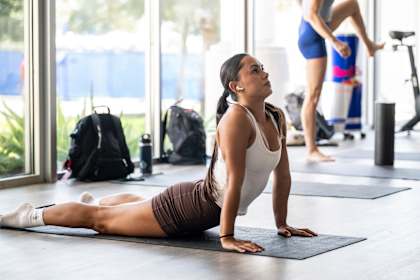
A stiff back when you wake up, tension after a long day at your desk or the sudden twinge of sciatica – back pain can affect almost anyone. The good news is that easing the strain doesn’t have to mean hours of exercise or specialist equipment.
A few minutes of targeted stretching, done regularly, can help improve mobility and keep your back feeling more comfortable, whether you’re new to stretching or looking to move like functional fitness athlete Laura Horváth.
Here’s your complete guide to back stretching, with exercises and techniques to help ease tension from your lower back up to your neck. Whether you’re starting the day, taking a break from your desk or winding down in the evening, you’ll find stretches to suit every situation.
Best place to start:
- The most effective back stretches are child’s pose, knees-to-chest, cat-cow and supine twist.
- Hold each stretch for 30 to 60 seconds, without straining, breathing in through your nose and breathing out slowly through your mouth.
- Do five to 10 minutes a day rather than one long session a week.
- If you have acute pain, sciatica or a known slipped disc, consult a professional before starting.
01
The key benefits of back stretches

Functional fitness athletes like Laura Horváth stretch regularly
© Ádám Bertalan/Red Bull Content Pool
Preventing and relieving back pain
A sedentary lifestyle and poor posture gradually shorten the lower back muscles, hamstrings and hip flexors, which puts strain on the spine and causes tension. Stretching these muscle groups relieves this pressure, which means less stiffness, less diffuse pain, and faster recovery in the event of an acute episode.
Improving mobility and flexibility
A supple back does not rely on other parts of the body to function properly. When the paravertebral muscles remain stiff, it is often the shoulders or hips that end up bearing the brunt instead – and that’s no fun at all. Regularly stretching the entire spine, including the neck, improves your range of motion. Bending over, turning round in the car or sleeping comfortably all become easier.

Squash star Nouran Gohar stretches her back during a session in Cairo
© Omar Mohamed Hany Zain/Red Bull Content Pool
Improving your posture in everyday life
Good posture distributes body weight evenly and reduces wear and tear on the intervertebral discs. Stretching the latissimus dorsi (better known as your lats) and pectoral muscles counteracts the forward rounding of the shoulders, which has become almost universal in the age of screens (and you’re no doubt reading this in that very position). Combined with some back-strengthening exercises, they remain one of the most accessible ways to restore proper alignment.
02
How can you stretch your lower back effectively?
The lower back alone accounts for the majority of back pain. Here are the most effective exercises to prevent you from getting a stiff back.
Child’s pose for the lower back
Muscles targeted: Paraspinal muscles, latissimus dorsi, sacro-lumbar muscles.
Kneel with your buttocks resting on your heels, lean your upper body forward with your arms outstretched and your forehead on the floor. Hold for 30 to 60 seconds whilst breathing deeply. This pose relieves pressure on the lumbar vertebrae (L1 to L5) and calms the nervous system through slow breathing. Do two to three repetitions.
Modification: If your buttocks do not touch your heels, slide a cushion between them to make the pose more accessible.
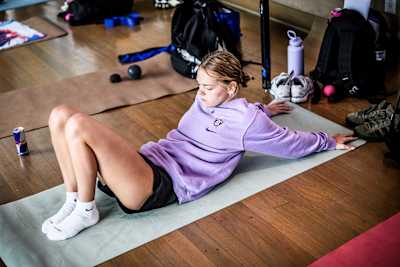
American diver Maya Kelly stretches before competing in Boston
© Romina Amato/Red Bull Content Pool
Twisting exercises on the floor
Target muscles: Obliques, quadratus lumborum, deep paravertebral muscles.
Lying on your back with your legs straight, bring one knee towards your chest, then let it roll over to the other side, keeping your shoulders flat on the floor. Hold for 20 to 40 seconds on each side. This gentle twist stretches the obliques and the small deep muscles that stabilise the spine. Turn your head slightly towards the side opposite to your knee to enhance the stretch.
Please note: If you have a known slipped disc, avoid this exercise or perform it with a reduced range of motion.
Stretches specifically for sciatica
Sciatica radiates from the lower back down into the leg and is often linked to compression of the piriformis muscle or a lumbar disc. Lying on your back, with one ankle resting on the opposite knee, bring the free knee towards your chest. This stretch of the piriformis, and more broadly the deep gluteal muscles (gluteus maximus, gluteus medius), helps to relieve nerve compression. If you experience severe pain, radiating pain or pain associated with a loss of sensation, consult a professional before continuing on your own.
Stretching the psoas: the forgotten muscle in lower back pain
The psoas is often overlooked in back stretching routines, yet this deep muscle, which connects the lumbar spine to the hip, is involved in the majority of lower back strains. In people who lead a sedentary lifestyle (sitting for long periods), it tends to be too tight, pulling the spine forward and accentuating lumbar lordosis.
To stretch it, kneel in a forward lunge with your back knee on the floor. Slowly move your pelvis forward until you feel a stretch in your groin and the front of your hip and thigh. Hold for 30 to 45 seconds on each side, keeping your back straight and shoulders relaxed. Repeat two to three times on each side.
Looking for more articles like this? Then check out the stories below
03
Upper back stretching routine
Neck and upper back stretches
Gently tilt your head to the side, bringing your ear towards your shoulder without lifting it, for 20 seconds on each side. Follow this with a slow rotation towards each shoulder, then a forward bend. These movements relax the upper trapezius muscles, which are often overworked by ‘text neck’ – that forward-leaning head position when looking at a screen. Yes, it’s not just Formula One drivers who need to exercise their necks.
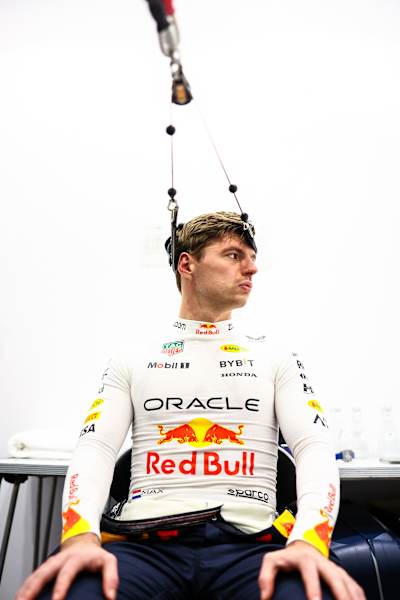
Max Verstappen knows the importance of stretching the back and upper neck
© Getty Images/Red Bull Content Pool
Shoulder blade mobilisation
Clasp your hands behind your back, bringing your shoulder blades together whilst keeping your chest open, or perform wide shoulder circles. Conversely, cross your arms in front of you at shoulder height and push your shoulder blades outwards; the two movements complement each other for this often-neglected area.
Exercises for the latissimus dorsi
Standing up, raise one arm vertically, then lean your torso to the opposite side, tracing a wide lateral curve. You can also hold onto a door frame at head height and let your body weight shift slightly backwards for a deeper stretch. Be careful not to fall over, though.
04
Techniques for straightening a hunched back
Spinal stretching
The ‘cat-cow’ exercise, performed on all fours, involves alternating between rounding your back as you breathe out and arching your back as you breathe in. This mobilises the entire spine, vertebra by vertebra, and remains one of the most recommended exercises in physiotherapy. The cobra pose, lying face down with your upper body raised on your hands, restores the spine’s natural curve (adjust if your lower back is sensitive).
Corrective yoga poses
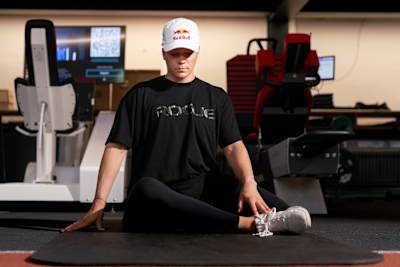
Horváth uses back stretches to improve strength and mobility
© Leo Rosas/Red Bull Content Pool
Borrowed from yoga, the camel pose – performed on your knees with your hands on your heels and your chest open – intensely stretches the anterior chain, which pulls the shoulders forwards. The bridge pose, with the pelvis lifted from a lying position, strengthens the back extensors whilst opening up the ribcage. This should be practised alongside a minimum of back-strengthening exercises at home to maintain the long-term gains in mobility.
05
Stretching programs tailored to the time of day
Recommended frequency: Practise at least three times a week, ideally every day. Short daily sessions of five to 10 minutes are more effective than one long session a week. The back muscles respond better to regularity than to occasional intensity.
Morning routine to relax the back
When you wake up, your spine is naturally stiffer. Start in bed by bringing your knees up towards your chest, gently twisting one leg at a time. Once you’re up, do a few cat-cow stretches followed by the child’s pose. Five minutes is enough to ease morning stiffness.
Exercises to do at the office
To stay fit at the office, a simple torso twist – with your hands on the armrests – mobilises the spine without having to stand up. Whilst standing, a few side bends and shoulder circles break up the static posture. It’s better to take five short two-minute breaks spread throughout the day than a single long session at the end of the day.
Post-workout stretches
Warm muscles mean greater flexibility; this is the ideal time to work on deep flexibility, with stretches held for 30 to 45 seconds on the areas that have been worked (lower back after a run, back muscles after weight training). However, avoid overly intense stretching immediately after a very intense workout.
06
Adaptations for specific situations
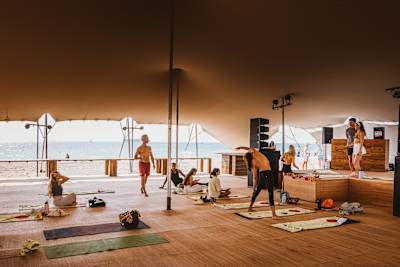
Yoga postures are great for strengthening the back
© Daniel Zuliani/Red Bull Content Pool
Exercises suitable for lower back pain
The golden rule is to keep it gentle until you feel a comfortable stretch, but never sharp pain. The child’s pose, knees drawn up to the chest, and the cat-cow stretch remain the safest movements. Avoid standing forward bends, as these increase pressure on discs that are already weakened. If the pain persists, worsens or is accompanied by numbness, consult a healthcare professional.
Exercises for pregnant women
Pregnancy naturally increases the lumbar curve, which explains the frequency of back pain. Gentle cat-cow stretches, shoulder rotations and neck stretches are generally recommended. From the second trimester onwards, avoid lying flat on your back for prolonged periods and deep twists. Always check with a midwife or doctor, as every pregnancy is different.
Solutions for a stiff back
Acute lumbago severely restricts movement following a seemingly harmless action. In the first 24 to 48 hours, opt for relative rest rather than active stretching. Once the acute phase has passed, very gentle movements such as bringing your knees towards your chest can help to gradually relieve the stiffness. If the stiffness persists, a medical consultation can rule out any more serious causes.
A healthy back is built up over time, not in a single ‘miracle’ session. Five to ten minutes a day are better than an occasional long session. Listen to your body, and if pain persists despite regular exercise, consult a professional: stretching helps prevent and relieve pain, but is never a substitute for a medical diagnosis.
07
Common mistakes to avoid
Even with the right exercises, certain habits can undermine the effectiveness of stretching, or even worsen tension:
- Pushing beyond the point of pain: Stretching when you feel sharp pain causes a reflex muscle contraction, which is the opposite of the desired effect.
- Bouncing and jerky movements: These can cause micro-tears in the muscles and trigger muscle spasms.
- Holding your breath: Holding your breath increases muscle tension. Breathe out slowly each time you deepen the stretch.
- Standing forward bends if you have lower back pain: This position significantly increases pressure on the intervertebral discs, which are already weakened.
- A single, intensive session: A single long session per week does not have the same effect as short daily sessions. Consistency is key.
- Skipping the warm-up: Stretching ‘cold’ muscles (especially in the morning) without a few minutes of mobilisation increases the risk of injury.
08
FAQs

Strengthening the back helps Horváth perform lifts like these
© Christian Pondella/Red Bull Content Pool
What is the best stretch for the back?
There is no single universal stretch, but the child’s pose is unanimously recognised as one of the most effective, as it decompresses the entire spine, stretches the lower back muscles and promotes deep relaxation. The cat-cow stretch comes in second place for its ability to mobilise the entire spine, vertebra by vertebra. For best results, combine several exercises targeting the lower back, mid-back and hips.
Which stretches should you do if you have back pain?
If you have moderate lower back pain, start with the gentlest movements, such as bringing your knees towards your chest whilst lying down and the child’s pose. These two exercises do not put pressure on the intervertebral discs and help to gradually relax tense muscles. Avoid standing forward bends (such as touching your toes) during the acute phase, as these increase pressure on the discs. If the pain is severe, radiates down the leg or is accompanied by numbness, consult a doctor or physiotherapist before exercising.
How do you stretch the lower back?
To stretch the lower back effectively, target the muscles responsible for the tension. These are the paraspinal muscles, the psoas and the quadratus lumborum. The most effective movements are: the child’s pose (direct decompression of the L1 to L5 vertebrae), the supine twist (stretching the deep and oblique muscles) and the standing side stretch (quadratus lumborum). Hold each position for at least 30 to 60 seconds, breathing deeply and smoothly. Ideally, practise these exercises every day or at least three times a week.
How can you relax your back muscles?
Relaxing the back muscles involves a combination of two approaches: static stretches (held for 30 to 60 seconds, which lengthen the muscle fibres) and deep breathing (which activates the parasympathetic nervous system and promotes relaxation). The cat-cow pose is particularly effective for ‘unlocking’ tension vertebra by vertebra. A hot shower or a hot water bottle before your session can also increase your muscles’ responsiveness to stretching.
How do you stretch your upper back?
For the upper back, focus on the trapezius, rhomboids and latissimus dorsi. The most suitable exercises are the neck stretch (ear towards the shoulder, 20 seconds on each side), seated torso rotations, and the latissimus dorsi stretch with raised arm and lateral bend. Mobilising the shoulder blades (shoulder circles, spreading the shoulder blades with arms crossed) effectively completes the routine. You can also do this standing against a wall: place your hands at shoulder height, step your feet back slightly and let your chest drop.
How should you stretch your back in the morning?
In the morning, the spine is stiffer because the intervertebral discs are hydrated and slightly swollen after a night’s sleep. Start before you even get out of bed: bring your knees towards your chest, then gently twist, one leg at a time. Once you’re standing, do eight to 10 repetitions of the cat-cow stretch on all fours, then finish with the child’s pose held for 30 seconds. Five to ten minutes is enough. Avoid intense forward bends in the first few minutes; opt for gentle mobilisation movements before moving on to deeper stretches.
