



Surfing
Surfing
Gear guide: Everything you need to know about buying a surfboard
Episode three of Surfing with Wings, Red Bull's comprehensive guide for everything surf.
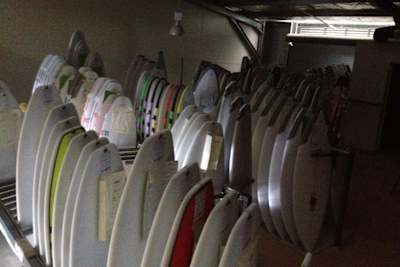
The choices!
© [unknown]
When you strip it down to the basics, you don’t need much to surf. Three things will get you there: waves, yourself, and something to ride on. You cover the first two purely through existing, and finding a route to the beach, but the third – digging up a decent board (and knowing the type that’ll work best for you) – can take a little extra knowhow.
Where would surfing be without the humble surfboard? From the heady early days of 15kg redwood planks, to the fibreglass hot rods we see today, board design has undergone an epic evolution over the past century. And while the choices and trimmings are vaster today than ever before, there are a few tried and true pointers you need to think about before forking out for the right model.
Today, we’re taking a good hard look at the ins and outs of surfboards: the art of choosing the right one, and what to consider before you choose one.
01
A Little Retrospective
Back in the day – the 1950s and earlier – board choice was pretty limited. Shortboards hadn’t yet been dreamed up yet, and the Malibu-style longboard (typically 10.5 feet long and made of hard or balsa wood), reigned supreme.
Then, in the 60s and 70s, innovative surf nuts Australians Nat Young and Bob McTavish, along with American filmmaker George Greenough, created the first shortboard prototype: “Magic Sam”, which took the world by storm. Harnessing new polyurethane foam and fiberglass technology, McTavish began to create his deep-V “Fantastic Plastic Machines”, lighter, shorter units that gave rise to the shortboard revolution: a new evolutionary path of manoeuvrability, airtime, and surfing possibilities.
With further refinements in materials, shaping, and fin design over the decades, we’ve been on that evolutionary ride ever since.
So where’s board style at these days? Who’s riding what?
02
The modern ride
“You could divide it into: oldies, longboards, young hot shots, shortboards,” says Craig Regan, lifelong Mornington Peninsula amateur surf legend (and our go-to Surfing Sage).
“Mals (malibus) generally for the over-50s, short for the young hot shots, though there are a lot of old guys out there on short boards too.”
Given the influence of a pro circuit that thrives on speed and manoeuvrability, it makes sense that lighter and shorter is generally considered the way forward.
“If you’re talking Kelly Slater and co, you’re really talking very small, lightweight, easy to throw in the air boards,” says Regan. “They’re after those airborne manoeuvres, and you’re not going to get that with a chunky slab of fiberglass. When they hit the lip of the wave they want to gain the height, using the velocity of the lip of the wave to propel them in the air; it’s very timed. And those lightweight boards in an offshore breeze, even the breeze alone will blow the board up.”
However – and this is an important distinction – the pros are pros for a reason: they know how to use them.
“The shorter the board, the harder the paddle,” says Regan. A lot of the young kids run out and they want their short, light competitive shortboard, and they’ve never surfed before, and it ends up being a waste of time and money. Young kids will always look at the superstars and want to emulate them and they’ll usually go out and buy a shortboard, and they’ll wonder why they can’t ride them. They’re very light and manoeuvrable, but they’re difficult to ride unless you know what you’re doing.”
03
Volume is key
There’s a lot more to choosing the right board than merely its dimensions. The critical factor to consider is volume.
Volume determines how buoyant a board is, while buoyancy determines how the board will ride. As Dashel Pierson adds over at Surfline, it’s the difference between a board that sits on top of the water and paddles fast, and one that sits below and paddles sluggishly.
“If I got a really fine fiberglass board now, I’d just sink,” says Regan. “If you’re 95 kilos you’ll need a different board to if you’re 68kg.”
Still, weight alone isn’t the only consideration: the volume equation is calculated using different variables, including age, your fitness level, and your overall ability. Thankfully, pretty much every surfboard manufacturer’s website has a free volume calculator these days: you plug in all your info and it spits out the perfect volume for you, alleviating any guesswork.
04
Materials
What, then, about materials: the stuff your board’s made out of? Is there much choice? For sure, we know no one’s making any hardwood planks any more, but there’s more to today’s market than just fibreglass and foam.
As has been the case since the shortboard revolution, fibreglass boards with a polyurethane core still remain the primary choice. However, the surfing world has seen the rise of a new material in recent decades: the epoxy board, which uses a light polystyrene core, and arose due to a significant polyurethane shortage.
The biggest difference between the two is how the boards are made: fiberglass boards rely on a lot of hand shaping in the manufacturing process, while epoxy boards are compression-molded, and rolled out without much customisation (not to say that it’s not possible, just expensive).
In terms of pros and cons, epoxy manufacturers market their boards as being more buoyant and resilient than fiberglass, an appealing choice for the beginner or returning surfer. Does the claim hold up? As Denis Gallagher revealed from a series of “road tests” over at CHOICE Mag, both are pretty resilient: the epoxy tends to float and manoeuvre a little better (though only marginally), while the fibreglass lends itself to a little more control for the seasoned rider.
05
The bottom line and beyond
Ultimately, assuming you’re heading out for the first time, or returning to the waves after a long stint, you need a reliable and durable board with the right volume for your age, weight, fitness and skill level. Epoxy or fiberglass? Both will work fine. And hey, if you’re learning or you’re looking for a board that will be fun in junky conditions, why not look in to a softboard?
As for the brand? “I think there’s a lot of marketing behind it,” says Regan. “It’s very driven by the vogue, or who’s in or what’s cool. It’s like skateboards – ‘you gotta get the same brand’, but they all look the same. What difference does it make? There’s no real best … just the high profile ones that get in the media.”
As for the future, who knows where board design will go? We see the latest trend in the hydrofoil wing keel: a board where you’re actually elevated off the water.
What lofty heights might technology fling the common board to from here on out?
“I remember being in Noosa, and I was sitting out in the back waiting for a set to come in,” says Regan, “and I hear this brrbrrrbbrrbbbrr brrrrbbrrr – it was these two old blokes who’d invented this impeller, this type of jet, and they’ve got this thing on their wrist that controls it; they’re out there with this little motor thing that puts them into the wave without ever doing anything. And they’re catching every wave!
