




Bike
MTB Enduro
Why you should make the switch to 29" MTB tyres
What are the best 29er mountain bike tyres? From downhill grip to trail speed, we have selected some of the top tyres by riding category.
Big wheels are here to stay. If ever any proof were needed, just take a look at the results sheets of pretty much any high-level mountain bike race: The likes of Kate Courtney and more-or-less every cross-country (XC) pro ride 29ers exclusively. The top tiers of Enduro World Series racing are dominated by them, though some riders still prefer 27.5-inch wheels in the technical and demanding terrain.
29ers and Downhill racing
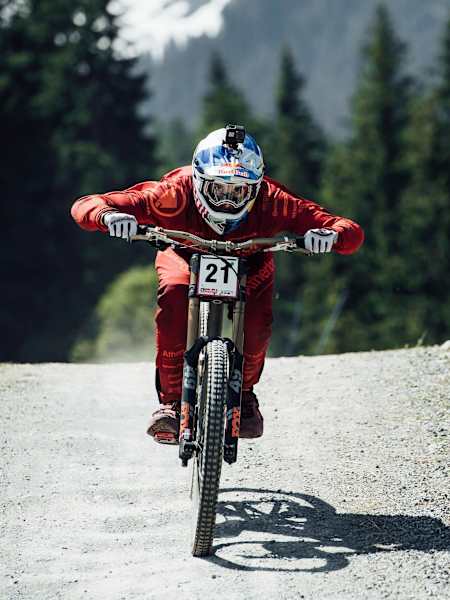
They have taken a long time for downhill (DH) racers to come to terms with, but in the Mercedes-Benz UCI Downhill World Cup they are now commonplace atop podiums. There are various reasons riders have been slow on the uptake. For one, the extra demands put on a bike with a top DH racer on-board mean parts break more easily; getting the wheels and tyres light and still strong enough has taken some time, but now technology has improved and there are few failures attributed to the wheel size itself.
Combining 27.5" and 29"
Watch enduro racer Martin Maes take a surprising win in La Bresse during the UCI Downhill World Cup last year in the player below

2 min
UCI DH World Cup Rd 7 La Bresse – Martin Maes winning race run
Watch Martin Maes's winning race run at Rd 7 of the UCI DH World Cup in La Bresse on August 25, 2018.
What are the benefits?
Whatever the setup, we’ve established that 29ers are fast. But even if you aren’t looking to eek every millisecond out of a trail, big hoops can have their appeal. They are said to roll efficiently over rough terrain, hold rotational speed and help create a progressive bike geometry with the bottom-bracket low between the wheel axles.
No matter how fast or stable your wheels, they aren’t going to be much good without a pair of top-notch tyres. Most tyre companies now make all their tyres in 27.5 and 29-inch options (and most continue to manufacture 26-inch tyres), so the choice is broad.
Here is a top pick for each mountain biking discipline.
Downhill – Schwalbe Magic Mary
If you are going to go big, you might as well go for ultimate grip. Schwalbe’s Magic Mary 29er tyres are something else. Big, widely-spaced knobs cut into fresh dirt, deform around roots and shed dirt efficiently, meaning they’re always ready to hit the next turn flat-out. The Addix Ultra-Soft compound is recommended for downhill use.
Cross-country – Maxxis Aspen
Rolling speed and bike weight are vital considerations in XC racing, but with today’s courses featuring brutally technical climbs and descents, not just any old low-profile tyre is going to cut the mustard. Maxxis’s Aspen tyre ticks all the boxes, keeping weight and resistance to a minimum while providing enough tread to hammer up and down hill and smash turns.
Enduro – Bontrager SE5
Bontrager, which is a sub-brand of Trek Bicycles, is often overlooked. But while the brand’s tyres aren’t as prevalent as, say, those of Maxxis or Schwalbe, there are some seriously good options in the range. The SE5 tyre is an enduro beast built to cope with the massive variety of terrain the discipline throws at riders. It’ll eat up rocks, roots, steep and technical tracks, plus it rolls well for those long connecting stages and doesn’t weigh a tonne.
Singletrack – Maxxis Ardent
If you are riding fast trails with sweeping turns and variable surfaces, there are few tyres that can contend with the Ardent. Its centre tread pattern minimises rolling resistance, while its side-knobs offer decent support in the turns. The Ardent is perfect for trail centres, singletrack and mellower mountain terrain.
Watch Myriam Nicole explain why she made the switch to 29ers for downhill racing in the player below


