
Cycling
How pro cyclists handle riding in sweltering heat
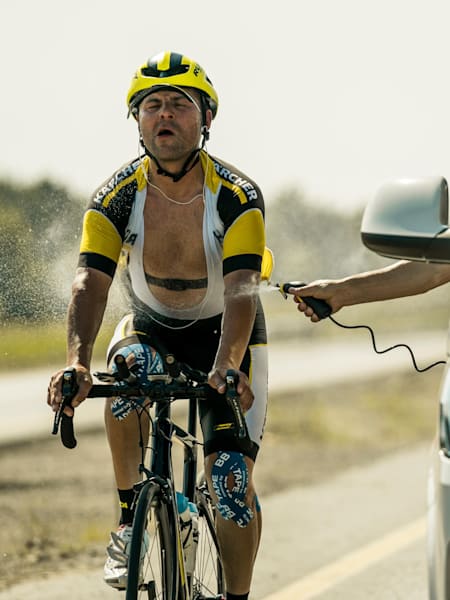
Five hours in the saddle, beating sun, temperatures of up to 40 degrees Celsius. It’s all in a day’s work for a pro cyclist at a Grand Tour, and their support staff who keep them hydrated and safe.
If you've ever caught any action from the Vuelta a España – the third and final of the annual Grand Tours – you've probably wondered how on earth the riders manage to cope with cycling in such blisteringly hot conditions.
Riding a couple of hundred kilometres in the baking sun, for anywhere up to five hours, and facing temperatures that have been known to exceed 40 degrees Celsius, is a huge demand on even the most elite professional cyclists. And it's not just for one day: it's every day, for the best part of three weeks.
Such draining conditions require the most diligent and dedicated team support staff to ensure the riders stay safe throughout – and can continue to perform to the best of their ability. Here, some of the Vuelta's team support staff give the lowdown on what exactly goes on beside the scenes...

Preparing for the onslaught
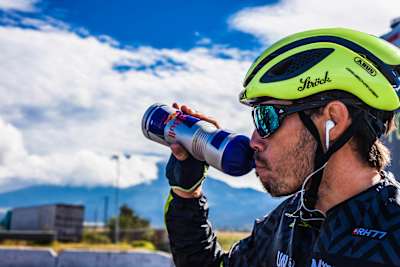
Last preparations before riding again
© Samuel Renner
Getting riders ready for what’s to come is a key foundation for ensuring they maintain a healthy and hydrated body for the rigorous demands of racing a Grand Tour, and the work starts well before a backside hits a scorching saddle.


“The night before the stage, we look at the weather and then reassess it in the morning, because sometimes the ambient heat can be a bit different, depending on factors such as cloud cover,” explains Dan Guillemette, physiotherapist for WorldTour outfit Mitchelton-SCOTT and the man in charge of the team’s “hot weather protocol”, which is implemented if the temperature rises above degrees Celsius.
As soon as the riders wake up on a day that’s pushing the temperature limits, their hydration needs are already a top priority.
“We prepare the riders a bottle of water with salt added to it. It’s beside the bed so that they can start drinking as soon as they wake up, because during the night they are already dehydrated a bit,” says Deceuninck – Quick-Step team nutritionist Martijn Redegeld.
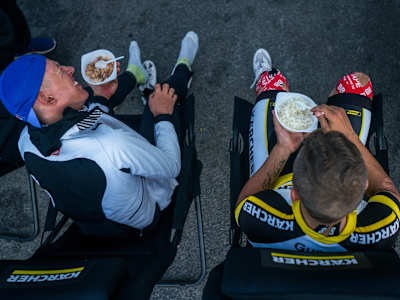
Riders top up their carb reserves a few hours before the race
© Masha Berliner / Red Bull Content Pool
“We check their urine in the morning to see their hydration status, and from there stimulate their hydration throughout the morning according to the results. Breakfast is focused on carbohydrate and fluid intake, and how much and what they’ll have will depend on what type of stage lies ahead”.
The importance of measuring those levels is reinforced by Guillemette.
Their energy or carb drink will be mixed with crushed ice – that gets them cool before the start.
“We monitor their hydration through their urine, and we have so much data on the riders that we know what’s a normal value for them, and we can really dial into the specifics. If it’s not in a good zone then we know exactly what does need to be done with their hydration, otherwise in two days they’ll have nothing left.”

The hours before the effort
With the waking hours negotiated and hydration well underway, the body’s core temperature also needs to be carefully regulated in anticipation of the hot day’s riding that lies ahead.
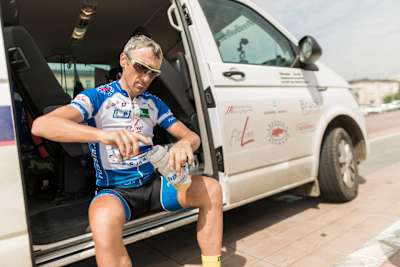
Eduard Fuchs prepares his drinks for the stage
© Denis Klero/Red Bull Content Pool
“When we’re on a hot weather protocol day, the bottles the riders will consume before the racing starts will be a ‘slushy’ version, so their energy or carb drink will be mixed with crushed ice,” says Guillemette. “That gets them cool before the start."
“We also use ice socks, which is just a tight or sock with ice cubes, and that’s placed inside the rider’s jersey at the top, just on the back of the neck, because we know that’s one of the best points for cooling down your whole system.
“On a really hot day you’ll see some teams using ice vests during their warm up, that’s usually for a time trial. We use towels that are soaking in ice, drape them over the rider's shoulders and back, and change the towel every one to two minutes”.
Onto the physical exertion
“In the first few hours on the bike they have normal food like bananas, rice cakes, oat bars, things like that, just because it’s tasty and they can’t be taking on sugary sweet stuff all the time for three weeks,” explains Redegeld. “Once the intensity increases during the stage, they switch to the commercial energy bars and, in the end, also the gels, just to keep getting the energy and carbohydrates into the body.”
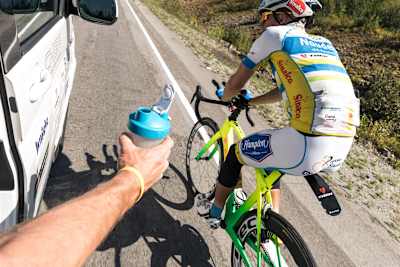
Support crew hands cyclist a fresh drink
© Denis Klero/Red Bull Content Pool
Both Redegeld and Guillemette emphasise that, on hot days, their respective teams target having a member of staff by the side of the road at every opportunity, to hand out bottles and food. That’s usually at least once every hour, and supplements the team car which is carrying ice boxes full of drinks and which the riders will drop back to for re-ups.
“If the temperature is really hot throughout the day, we’ll have those ice socks in the musette (feed bags that are handed out) too,” says Guillemette. “I think on an extremely hot day we can get through 80-90 of those.”
Redegeld explains that required fluid intake can depend on a range of individualised factors per rider, but that a minimum of two 500ml bidons per hour is the minimum, and that riders are constantly reminded and encouraged to keep drinking over the team’s radio communications. In the middle of racing, it’s easy for riders to forget to sip away, and that can lead to catastrophic effects further down the line. “It’s not uncommon for a rider to lose eight to 10 litres of sweat during a stage when conditions are very hot. Then it’s really a challenge to keep them drinking and give them enough bottles.”

Post-stage replenishment and recovery
As soon as the stage finishes, there are several processes that the team employ to help the riders rehydrate and recover for the following day’s racing.
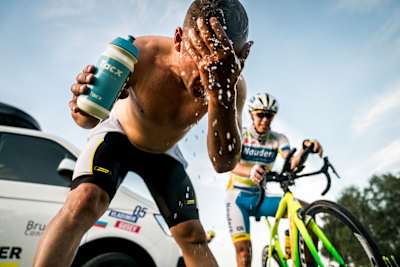
Cyclist throws some water on himself to cool down after a long stage
© Pavel Sukhorukov / Red Bull Content Pool
Guillemette gives the lowdown on what happens on the physio side of things…
“After the stage it’s more about heat stress management. We use ice baths, and we have a system we use called Physiolab which uses cryotherapy, which are leg sleeves the riders put on and which have pneumatic compression with air. They fill with ice water so that we can deliver anything from six to 12 degrees Celsius iced water, and which really helps to reduce the temperature in the muscles.
“Having those mobile systems where we can start that process straight away on the bus, and advance the whole recovery process, is very important. It’s a cumulative thing, and needs to be addressed with immediacy.”
The same urgency is applied on the nutrition side as well, and Redegeld outlines what happens with the riders’ food and drink requirements as soon as they’re done with a hot day out.
“At the finish line they take some water and a sugary drink, just for the immediacy of fluids and sugar. When they get on the bus they have a recovery shake, again that’s also sugar, protein, water, and this is the first step in the recovery process. We try to do that within half an hour.
“From there they take a meal on the bus and again have water with salt. We try to encourage that they’re always drinking during the transfer to the hotel, during massage and until dinner.”
Then, the whole cycle starts again as the preparations are made for the following day’s efforts.

